
30000 BC – The Very First Sculptures
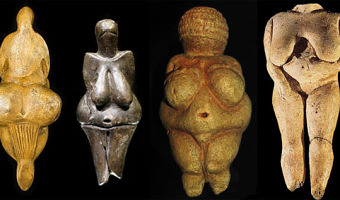
While data sculptures date back from the 1990s, the very first sculptures were Venus figurines: A Venus figurine is any Upper Paleolithic statuette portraying a woman with exaggerated physical features. The oldest ones are about 35,000 years old. Right image: modern versions. Also see V.S. Ramachandran on the peak shift principle in art. Sources: Wikipedia article on Venus figurines. Left image from ancient-origins.net, right images from Mari Shiranui's flickr page and heldenshop.de.
5500 BC – Mesopotamian Clay Tokens
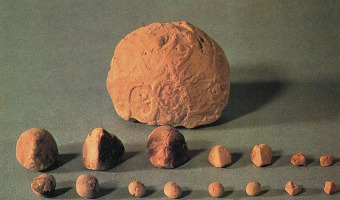
The earliest data visualizations were likely physical: built by arranging stones or pebbles, and later, clay tokens. According to an eminent archaeologist (Schmandt-Besserat, 1999): "Whereas words consist of immaterial sounds, the tokens were concrete, solid, tangible artifacts, which could be handled, arranged and rearranged at will. For instance, the tokens could be ordered in special columns according to types of merchandise, entries and expenditures; donors or recipients. The token system […]
2600 BC – Quipus
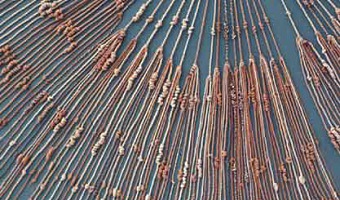
Quipus were complex assemblies of knotted ropes that were used in South America as a data storage device and played an important role in the Inca administration. Only a handful of specialists could use and decipher them. Their meaning mostly remains a mystery but it seems that color, relative position of knots, knot types and rope length were used to encode categorical and quantitative variables. The oldest known Quipu is 4600 years old. In the late 16th century quipus were still being used by […]
1600 BC – Water Clocks
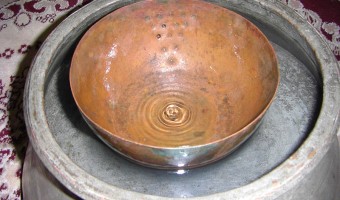
A water clock (or clepsydra) is an instrument where time is measured by regulating a flow of liquid. The oldest water clocks simply consisted of a pierced bowl placed in a larger pot filled with water (see left image, Persian artefact from 400 BC). These existed back in the 16th century BC. The passage of time was observed by counting how many times the bowl overflowed and its content had to be poured back in the larger pot. This was used for example in Persia to ensure fair irrigation […]
500 BC – Pebble Voting

The earliest participatory visualizations were probably voting systems. Voting in Greece was introduced in the 5th century BC. Adult male citizens were invited to express their opinion by dropping a pebble in an urn: a white pebble meant "yes" and a black pebble meant "no". Sometimes two urns were used. The left image is a detail of a Greek wine cup from the 5th century BC, and is one of the earliest known depictions of the act of voting. The middle image is a modern reconstruction from a TV […]
150 BC – Greek Orrery
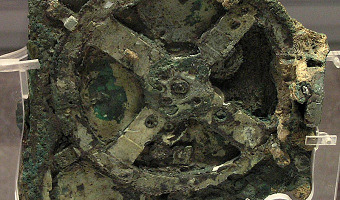
An orrery is a mechanical model of the solar system. The left image shows the Antikythera, the oldest known orrery. The middle image shows a virtual reconstruction. The right image shows a contemporary orrery. The Antikythera mechanism is an ancient analog computer designed to predict astronomical positions and eclipses. It was recovered in 1900–01 from the Antikythera wreck, a shipwreck off the Greek island of Antikythera. The instrument was designed and constructed by Greek scientists and has […]
132 – Chinese Seismoscope
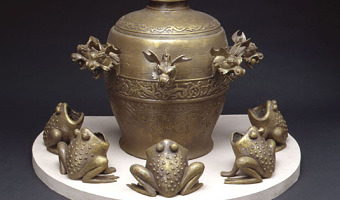
A seismoscope is a qualitative indicator of seismic activity -- as opposed to seismographs which show quantitative data, typically through line graphs. The oldest known seismoscope is Chinese and dates backs from 132. It was a large bronze device that dropped a ball into a bronze container (one of the eight frogs on the image above) every time an earthquake was detected, thus producing a loud sound. The direction of the earthquake could then be examined by looking at the container in which the […]
1200 – Pop-Up and Movable Books
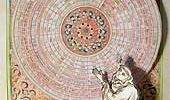
While gatefold mechanisms were already used in the 1100s, one of the first movable paper mechanisms was a volvelle created by Benedictine Monk Matthew Paris to calculate the dates of Christian holidays in his book Chronica Majorca (1236-1253, see left image above). Volvelles are paper discs or rings placed on top of each other that rotate around a string or rivet. Many other types of paper mechanisms have been invented since then, such as flaps, which were used in anatomy books starting from […]
1500 – Flow Visualization
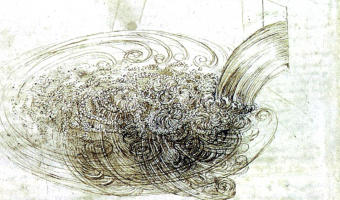
Although today computer graphics is often used for doing flow visualization, a range of physical methods exist that can visualize flows in-place. Leonardo da Vinci was presumably one of the first to use these methods: Leonardo da Vinci (1452-1519) also developed techniques for observing the wind (by generating smoke in a tube and adding it to the wind at suitable points). Most important of all, he made actual experiments under controlled conditions. For this purpose, he used, among other […]
1500 – Plans-Reliefs
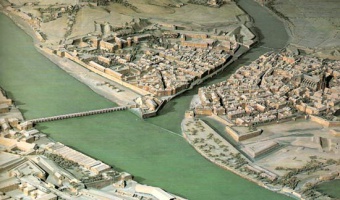
The first terrain/city models date back from the 16th century and were created for military purposes. Left image: a plan-relief of Bayonne, created by Sébastian Vauban (1633–1707), a famous fortification engineer of King Louis XIV. Right image: a plan-relief of Grenoble from 1848. These scale models were highly prized for the tactical advantage they brought, and they were also shown around for dissuasive purposes. “Il y a un relief de Namur dans les Tuileries, je vous demanderai d'avoir la […]
1660 – Galileo Thermometer
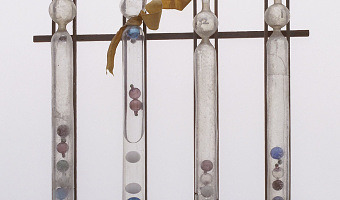
A Galileo thermometer consists of a set of floaters immersed in a clear liquid (typically ethanol) inside a sealed glass tube. Today a floater is typically a glass sphere containing a colored liquid and to which is attached a metallic temperature tag. The composition of a floater is irrelevant, its overall density just needs to be calibrated to a certain value and remain stable. Floaters being made of glass and metal, their volume - and therefore density - is largely unaffected by temperature. […]
1700 – Wearable Abacus from the Qing Dynasty
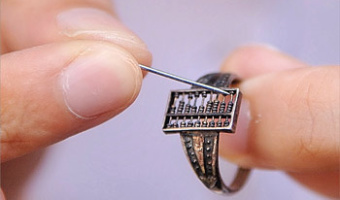
A functioning abacus ring from the Qing Dynasty (1644-1912), exhibited at the Cheng Dawei Abacus Museum in Huangshan City, China. Steve Mann mentions it as an early form of wearable "computer": Here is a "computer" (an abacus) and since it is a piece of jewelry (a ring), it is wearable. Such devices have existed for centuries, but do not successfully embody Humanistic Intelligence. In particular, because the abacus is task-specific, it does not give rise to what we generally mean by "wearable […]
1714 – Mercury Thermometer
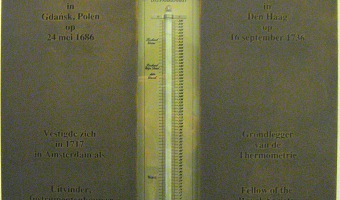
The mercury thermometer was invented by Dutch physicist Daniel Gabriel Fahrenheit in 1714. It consists of a narrow glass tube with a bulb at the bottom, containing mercury. The volume of mercury changes with temperature; mercury is driven out of the bulb and up the tube as the temperature rises. Sources: Wikipedia article on Mercury-in-glass thermometer Image Credit: Donar Reiskoffer, Wikimedia Commons
1750 – George Adams' Solid Geometry Models
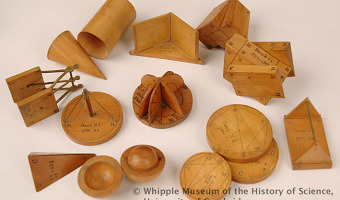
During the 18th century, instrument maker George Adams built and sold solid 3D geometric models as educational complements to the 2D images found in Euclid's Elements of Geometry. As argued by a 18th-century author: It is almost as necessary as in mechanics, to exhibit the objects, whose qualities are to be taught; and to call in the joint assistance of the hands and eyes. According to the Whipple Museum of the History of Science, authors were already experimenting with paper models soon after […]
1753 – Barbeu-Dubourg's Machine Chronologique
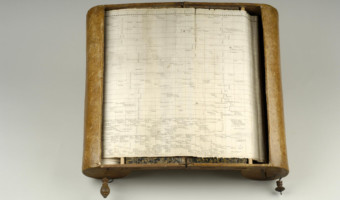
Before Joseph Priestley published his famous timelines, Frenchman Jacques Barbeu-Dubourg built a 16-meter long timeline showing 140 years of world history, which can be mechanically scrolled and folded for transport. Not a physical visualization but maybe the first “interactive” timeline representation in history. Seen in a talk by Catherine Plaisant. Sources: Stephen Boyd Davis (2009) The First Modern Timeline? Stephen Ferguson (1991) The 1753 Carte Chronographique by Jacques Barbeu Du Bourg. […]
1787 – Chladni Plates
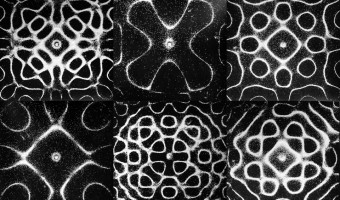
In 1787, German physicist and musician Ernst Chladni published a technique to visualize the modes of vibration of a rigid surface. Chladni's technique [...] consisted of drawing a bow over a piece of metal whose surface was lightly covered with sand. The plate was bowed until it reached resonance, when the vibration causes the sand to move and concentrate along the nodal lines where the surface is still, outlining the nodal lines. The patterns formed by these lines are what are now called […]
1820 – Papier-Mâché Anatomical Models
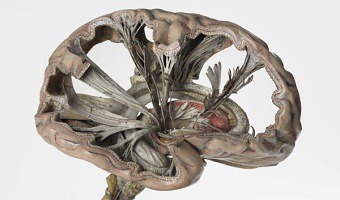
Left image: As part of its 2014 exhibition entitled Mind Maps: Stories from Psychology, the London Science Museum showcased this very accurate and intricate papier-mâché brain model from 1900 that shows path of nerve fibers. French physician Louis Thomas Jerôme Auzoux developed this technique around 1820 due to the shortage of human cadavers and wax models to study human anatomy. He was inspired by papier-mâché dolls that were common at the time. His models became popular in schools, […]
1839 – Théodore Olivier's String Models
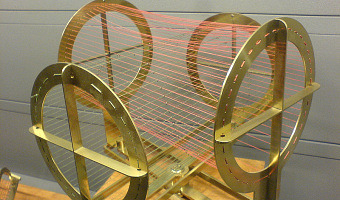
Between 1839 and 1853 the French mathematician Théodore Olivier created string models to teach and demonstrate descriptive geometry, some of which could be manipulated. He was a student of French mathematician Gaspard Monge, who invented descriptive geometry and was already illustrating his ideas with rudimentary string models. Photo above: intersection of two cylinders. Sources: Nicholas Mee (2013) Strings, Surfaces and Physics. Photo above taken in the Musée des Arts et Métiers in Paris, see […]
1850 – Merryweather's Leech Barometer
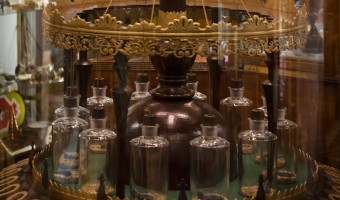
In 1850, British doctor and inventor George Merryweather built a barometer that uses live medicinal leeches to predict storms: The twelve leeches are kept in small bottles inside the device; when they become agitated by an approaching storm they attempt to climb out of the bottles and trigger a small hammer which strikes a bell. The likelihood of a storm is indicated by the number of times the bell is struck. The device, which Merryweather called the "tempest prognosticator", was shown at the […]
1862 – De Chancourtois' Telluric Screw
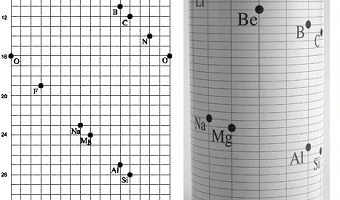
The French geologist Alexandre-Émile Béguyer de Chancourtois was the first scientist to see the periodicity of elements when they were arranged in order of their atomic weights. Credited with being the original discoverer of the periodicity of elements and the originator of the three-dimensional method of element arrangement and representation. He drew the elements as a continuous spiral around a metal cylinder divided into 16 parts. The atomic weight of oxygen was taken as 16 and was used as […]
1862 – Marshall Islands Stick Charts
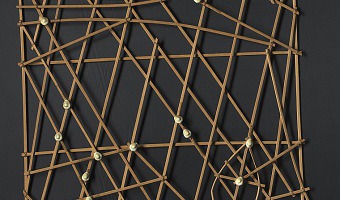
These physical visualizations show ocean swell patterns, and were built by native Micronesians from the Marshall Islands to facilitate canoe navigation. They were memorized before trips. The Western world remained unaware of the existence of these artifacts until 1862. The photo above is a stick chart from 1974. Straight sticks represent regular currents and waves, curved sticks represent ocean swells, and seashells represent atolls and islands. Sources: Wikipedia. Marshall Islands Stick […]
1865 – Hofmann's Croquet Ball Models
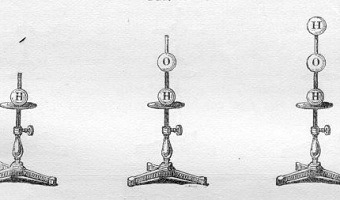
August Wilhelm Hofmann was the first to introduce physical representations of molecules into lectures during his Friday Evening Discourses presentation "On the Combining Power of Atoms" at London's Royal Institution of Great Britain in . He introduced a colored set of four croquet balls to represent atoms (hydrogen, oxygen, chlorine and nitrogen), implanted with a fixed number of sticks corresponding to each atom's valence. Thus we distinguish the chlorine atom as univalent, the atom of oxygen […]
1866 – Kundt's Tube
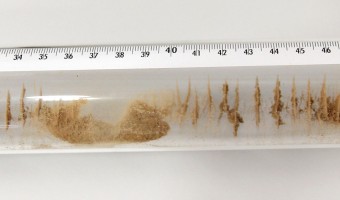
Kundt's tube is an apparatus invented in 1866 by German physicist August Kundt for measuring the speed of sound. It mostly consists of a transparent tube of adjustable length with powder in it. Sound is produced at one end of the tube, and the tube's length is adjusted until the sound becomes louder, indicating the tube is at resonance and the sound forms a standing wave. The powder then accumulates at the nodes of the standing wave, where is no vibration. The wavelength of the sound can be […]
1866 – Dewar's Brass Strip Models
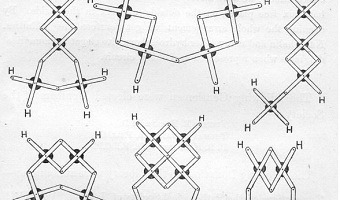
Mechanical arrangement adapted to illustrate structure in the non-saturated hydrocarbons by the chemist James Dewar. The model is made of bars, clamped together so as to allow free motion. In order to make the combination look like an atom, a thin round disc of blackened brass can be placed under the central nut. At the ends of the arms are holes to connect one carbon atom with another by means of a nut. The structure at the bottom right of his figure is now called "Dewar benzene". I bring […]
1871 – Thermodynamic Surfaces
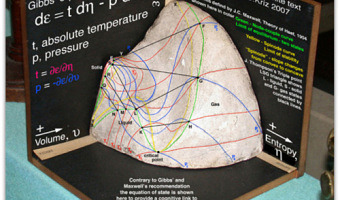
A physical visualization by Scottish physicist James Maxwell (left), constructed over the course of about seven months, from November 1874 to July 1875, based on the descriptions of thermodynamics surfaces described in two 1873 papers by American engineer Willard Gibbs. The molded shape depicts the geometry of the three-dimensional thermodynamic surface of the various states of existence of water: solid, liquid, orgas, shown on Cartesian coordinates of the entropy (x), volume (y), and energy […]
1875 – Van't Hoff's Molecular Paper Models
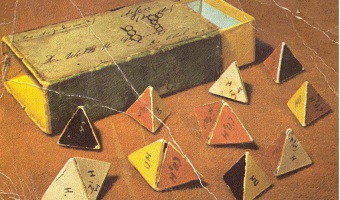
Van’t Hoff disseminated his stereochemical ideas to leading chemists of the day by sending them 3-D paper models of tetrahedral molecules, like these now housed in the Leiden Museum. There might be some difficulty in following my reasoning. I felt this myself, and I have made use of cardboard figures to facilitate the representation. Not wanting to require too much of the reader I will gladly send him the complete collection of all these objects Sources: Van der Spek, Trienke M. Selling a […]
1880 – Winogradsky Columns
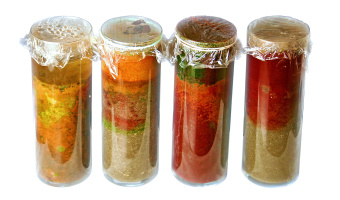
The Winogradsky column, invented by Sergei Winogradsky, consists in a transparent cylinder for analyzing microbial life by observing how the metabolism of micro-organisms evolve over time in stratified layers. By producing a small closed ecosystem, the column enables observing how bacteria can survive by providing a temporal and spatial visualization of layers such as in ecology, microbiology. Sources: The Microbiome of Your Gut Winogradsky Column—Microbial Evolution in a Bottle S. Kuznetsov, […]
1880 – Klein's Mathematical Plaster Models
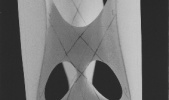
In the 19th century, mathematicians became interested in the question how mathematical functions look like. Felix Klein, a German mathematician, had several of such physical models in his lab in Göttingen, and popularized them in America when he brought a boatload to the World's Fair in Chicago in 1893. The photo above shows a model of a Clebsch surface from 1880, designed and presumably built by Adolf Weiler, Klein's grad student. It is kept today at the University of Göttingen. Sources: […]
1885 – Ammassalik Wooden Maps
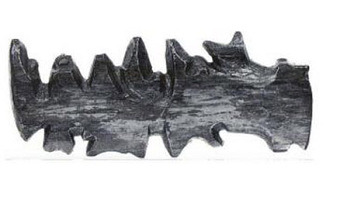
These three-dimensional maps were carved by inuits from the Ammassalik Fjord in Greenland, and used as eyes-free guides for sailing. The left one shows coastline, the right one shows a sequence of offshore islands. These inuit communities had had no direct contact with Europeans before a Danish explorer met them in 1885 and was shown the wooden maps. Sources: Bill Buxton (2007). Sketching User Experiences. page 36. Wikipedia. Ammassalik wooden maps.
1887 – Marey's Movement Sculptures
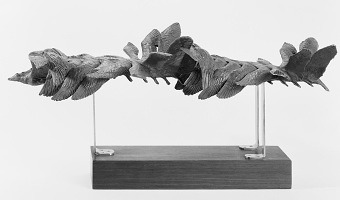
Bronze sculpture showing the phases of the flight of birds, created by French scientist Étienne-Jules Marey in 1887 based on photographs. Étienne-Jules Marey was a pioneer in the study of dynamic phenomena and invented a variety of scientific and medical instruments, photography techniques, and temporal visualization methods. A wealth of information is available about him online. Also see our entry on Peter Jansen's movement sculptures, inspired from his work. Sources: Russel Naughton (2007) […]
1889 – Gaudí's Hanging Chain Models
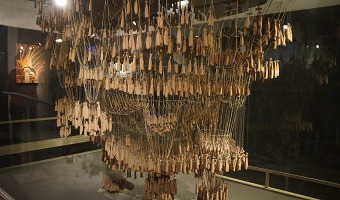
Spanish Catalan architect Antoni Gaudí disliked drawings and prefered to explore some of his designs — such as the unfinished Church of Colònia Güell and the Sagrada Família — using scale models made of chains or weighted strings. It was long known that an optimal arch follows an inverted catenary curve, i.e., an upside-down hanging chain. Gaudí's upside-down physical models took him years to build but gave him more flexibility to explore organic designs, since every adjustment would […]
1890 – Polynesian Genealogical Instrument
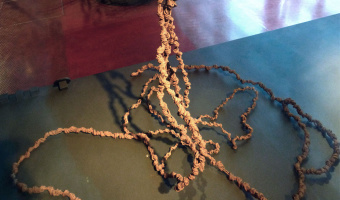
This artefact from the Marquesas Islands (French Polynesia) served as a memory aid for reciting genealogies during ceremonies. Each thread, made of woven coconut fiber, is a genealogical line and each knot is a generation. The genealogy goes back to the mythical origins of Earth, materialized by the oblong ball on top, made of wood (see left image). The date of the artefact is unknown. It was collected by Alphonse Long, French navy physician, while he was on duty in the Marquesas Islands […]
1896 – James Ive's Mechanical Teaching Map
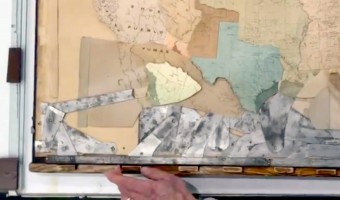
The boundaries of the United States transformed during the 19th century, often through violent means. Mapmaker James Ives created this mechanical map to help people, especially students, visualize these changes. Sources: Leventhal Map Center (2019) Tweet. Boston Rare Maps (2016) Fantastic mechanical map of United States territorial expansion. Video by the Leventhal Map Center.
1897 – Stop Motion Animation
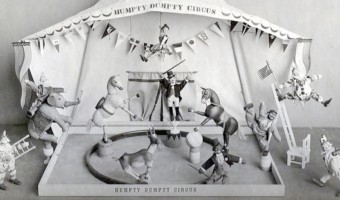
Stop motion animation is the frame-by-frame capture of (generally) inanimate objects which are manipulated by increments in order to produce the illusion of motion. It was first used in movies to produce magical effects. The first movie to use this technique was The Humpty Dumpty Circus (1897), where a toy circus of acrobats and animals comes to life (left image). With modern 3D computer graphics, stop motion animation has become largely obsolete, but remains occasionally used. A particularly […]
1898 – Crookes' Vis Generatrix
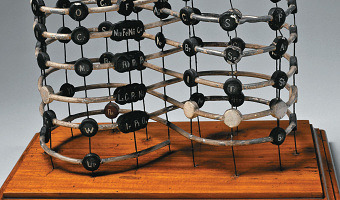
Model of Crookes’ "Vis Generatrix" made in 1898, built by his assistant, Gardiner. From: Proc. R. Soc. Lond. 63, 408. The vertical scale represents the atomic weight of the elements from H = 1 to Ur = 239. Missing elements are represented with a white circle. Similar elements appear underneath each other. With this model, Crookes was trying to visualize the hypothetical relationship between various elements in three dimensions. See all the other entries with the tag "periodic table" to see […]
1898 – Tallies Used as Social Displays on Pacific Islands
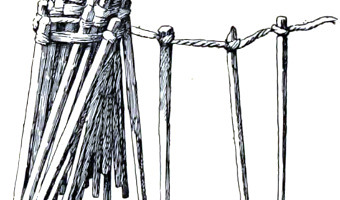
In the 19th century, the Torres Strait Islanders did not have a numeral system and used sticks to keep counts. Sticks were tied to a string, forming a bundle (called kupe) that could be rolled and unrolled when needed. Kupes were typically used by men to keep track of their accomplishments, such as turtles caught in deep water, fishes speared, or adventures with women (as the one above). These physical visualizations were used as social displays, and big kupes were greatly prized. According to […]
1900 – Pearson and Lee's Height Correlation Chart
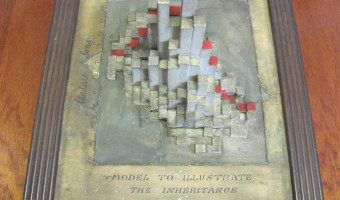
The physical model on the left is a bivariate histogram showing the correlation between the heights of fathers (horizontal axis) and sons ("vertical" axis). This data was famously collected by Karl Pearson and Alice Lee between 1893 and 1898. The physical visualization is thought to have been constructed around this time period or soon after, possibly under the supervision of Pearson. It is kept at the Department of Statistical Science, University College London, founded by Pearson in 1911. I […]
1900 – Crum Brown's Mathematical Surface
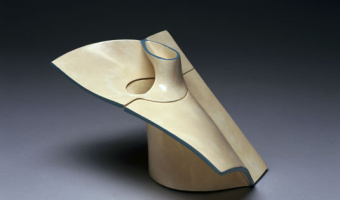
Model by Alexander Crum Brown (1838-1922) of a half-twist mathematical surface, featuring a non-Euclidean so-called Klein bottle, c. 1900. Sources: Photo from the Science Museum, London, textual description courtesy of Klaus Hentschel. For more, see Klaus Hentschel (2014): Visual Cultures in Science, Technology and Medicine, pp. 96ff. and pl. XIV.
1900 – Modern Solid Terrain Modeling
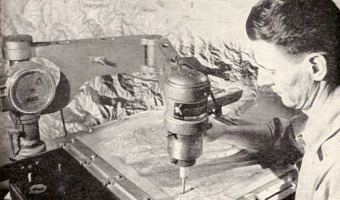
The Institute of Cartography ETH Zurich published a great review of past and present techniques for doing solid terrain modeling. Although terrain models are not physical visualizations in the strict sense, the techniques could be in principle used to convey data. Physical terrain models were already being built in 16th the century, and the review covers modern techniques from the early 20th century to today's digital fabrication. Source: Institute of Cartography ETH Zurich (2006) Terrain […]
1901 – Davenport's Physical Distributions
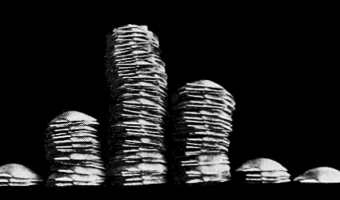
In 1901, biologist Charles Davenport "built" physical visualizations that show the distributions of features of objects and people. These visualizations were made out of the objects and the people themselves. The purpose was to explain the notion of statistical distribution to a lay audience. On the left image, seashells are piled up according to how many ribs they have. On the middle image, students are arranged in bins according to their height. On the right image, they are simply sorted. […]
1907 – Pin Maps
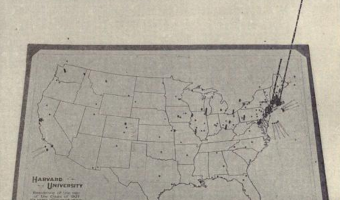
Left image: residence of Harvard students 6 years after their graduation (1907); made with beads, pins and wires. Middle image: Sources of the 3,000 first letters of appeal sent to Mrs. E. H. Harriman (1912); eight different kinds of pins were used to represent different kinds of appeals. Right image: collection of pins and beads made for maps. Sources: Willard Cope Brinton (1914) Graphic Methods for Presenting Facts pp. 227-253. John Krygier (2010) A Discourse on Map Pins and Pinnage. New York […]
1913 – Frankfurt Streetcar Load
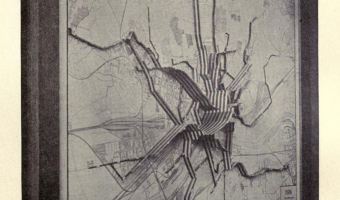
Strips of woods glued on top of each other convey the average number of passengers carried between two stops. Each strip corresponds to 4,000 passengers. Shown at the 1913 International building trade exhibition in Leipzig. Source: Willard Cope Brinton (1914) Graphic Methods for Presenting Facts pp 224-226.
1914 – Solid 3D Curves for Engineering
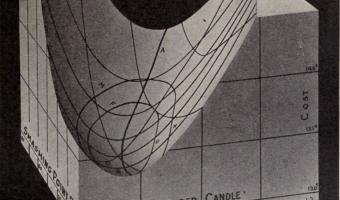
In his 1914 book, Brinton discusses various techniques for building solid models of three-dimensional charts and functions for the purposes of engineering, and uses the two designs above as examples. Although these don't look like they could be solid models, the text from Brinton's book suggests they are. The first one (left) is made of plaster and shows the characteristics of a light bulb. The second (right) is made of cardboard and shows the results of tests of a fan. The two artifacts are […]
1915 – Wire Models of Factory Worker Movements
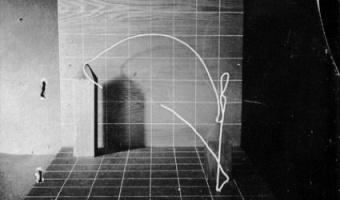
3D wire models of hand motion paths (or chronocyclegraphs) created by Frank Gilbreth, a pioneer in the study of motion in the workplace. In his 1917 book, Gilbreth explains how he created these solid models from time-lapse photographs, and how useful they are to study and teach human motion. Left image: Wire model of foreman on drill press. This shows “positioning” in the midst of “transporting.” Right image: First photograph of wire models showing one man's progress of learning paths of least […]
1920 – Yakama Time Ball

Women from the Yakama Native American tribe used strings of hemp as personal diaries. Each major event in their life was represented by a knot, a bead or a shell. This mnemonic device is called an Ititamat, or counting-the-days ball, or simply time ball. The first image shows an Ititamat created before 1920. On the second image, each string is a different Ititamat. The last image shows a 2003 replica. A young woman would use a time ball to record her courtship, marriage, and other experiences […]
1926 – Karsten's Tridimensional Chart
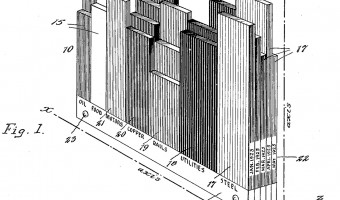
American economist and statistician Karl G. Karsten patented a method for creating physical visualizations of temporal data by stacking two-dimensional plates, each representing a time period. Each of the plates shown above is a variable-width column chart representing the state of the stock market at the end of a particular month. Each bar is a type of stock, where the height of the bar encodes the stock price and its width encodes volumes of sales. Each month, a new layer is added. Seen from […]
1930 – Mathematical Functions Embodied in Ballistic Cams
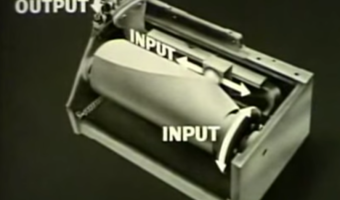
These cams are solid models of bivariate and univariate mathematical functions plotted in cylindric coordinates (left and middle images) and polar coordinates (right image). They were not meant to be visually examined, but were used in mechanical analog computers for aiming battleship guns during WWII. They were also called computing cams. Mechanical fire control aids started to be developed in the 1900s and and were still in use in the late 1980s. During WWII, they could solve multivariate […]
1933 – IBM's Cosmograph
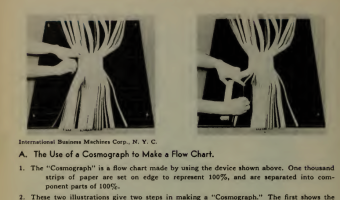
The left image above shows a physical flow chart (Sankey diagram) made of 1000 sheets of paper. It was not meant to be directly read, but to be photographed (see right image). The physical apparatus, called Cosmograph, allowed people without graphic skills to easily produce nice-looking Sankey diagrams. It was copyrighted by IBM in 1933 and sold for $50. Sources: Willard Cope Brinton (1939) Graphic Presentation, p. 78. Jim Strickland (2012) Cosmograph? What's a Cosmograph?
1934 – Hayward's Moon Model
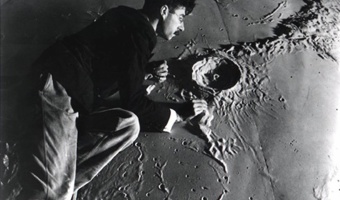
Illustrator and model-maker Roger Hayward (1899-1979) working on a model of the lunar surface for the Griffith Planetarium, 1934. Sources: Kevin Kidney (2009) Mr. Hayward's Moon Model. Photo from Keven Kidney's blog, textual description courtesy of Klaus Hentschel. For more, see Klaus Hentschel (2014): Visual Cultures in Science, Technology and Medicine, pp. 217-226.
1934 – Ford's Globe
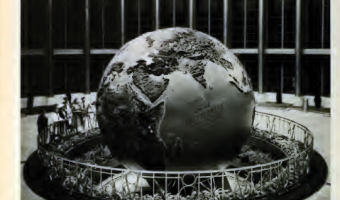
A large rotating relief globe showing Ford company's industrial sites around the word, exhibited at the Chicago World's Fair in 1934. Sources: Willard Cope Brinton (1939) Graphic Presentation, p. 160. The Henry Ford Blog (2013) Ford at the Fair. More photos from the Henry Ford Online Collection.
1935 – 3D Visualizations of Power Consumption
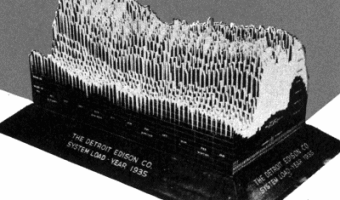
A large 3D physical visualization made by the Detroit Edison Company showing electricity consumption for the year 1935, with a slice per day and each day split into 30 min intervals. Two other examples from different Edison electricity companies are discussed in Brinton's book. These physical visualizations seem to have been used to better anticipate power demands. Also see our entry 1951 - Electricity Generated or Demanded. Sources: Willard Cope Brinton (1939) Graphic Presentation pp 354-355. […]
1939 – Map of Great Britain's Marine Trade
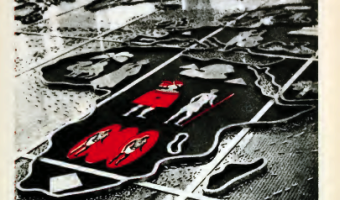
A physical World map made of copper and glass showing the size of Great Britain's merchant marine and the main trade routes as 9,000 miniature ship models. Exhibited at the New York World Fair in 1939. Sources: Willard Cope Brinton (1939) Graphic Presentation, p. 207. Life Magazine (1939) New York Opens the Gates to the World of Tomorrow. Vol. 6, No. 20, May 15 1939.
1940s – Stedman's 3D Periodic Table
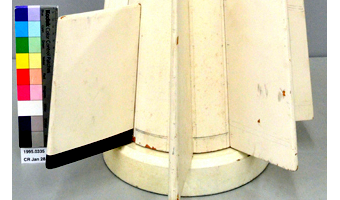
Dr. Don Stedman from the National Research Council Canada designed this 3-D periodic table in the 1940s. Stedman considered many factors and characteristics of the elements as he designed his models. While in this model all the usual groups of elements are found, changes from one group to another are also represented, and their origins are more easily understood. Stedman believed that his model gave more insight into “the orderly development and classification of the elements.” Source: Canada […]
1941 – Traffic Flow Profiles of the Interregional Highway System
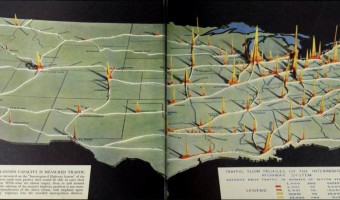
2D area diagrams encoding average daily traffic as height and color are set up along their respective highways on a background map of the US. Background map seems to be a cut-out wooden panel; area diagrams potentially cardboard, or also wood veneer. Source: In: Fortune, June 194, pp. 94-95. Original by-line reads "Map by PRA. Photograph by Richard Carver Wood". PRA is presumably the Public Roads Administration (cf. https://en.wikipedia.org/wiki/Federal_Highway_Administration#History). Accessed […]
1945 – Electron Density Map and Molecular Model of Penicillin
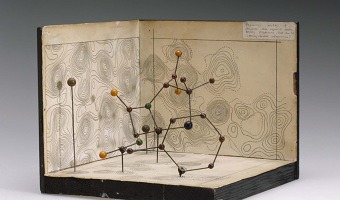
Electron density map and model of Penicillin created by Dorothy Crowfoot Hodgkin in 1945 based on her work on X-ray crystallography. The Penicillin molecule was the first molecule whose structure was derived entirely from X-ray data. Dorothy Hodgkin later received the Nobel price for applying the same technique to determine the structure of the B12 molecule. Dorothy Hodgkin (1910-94) was awarded the prestigious and exclusive Order of Merit in 1965 to add to her 1964 Nobel Prize for ”her […]
1947 – Dorothy Hodgkin's Electron Density Contours
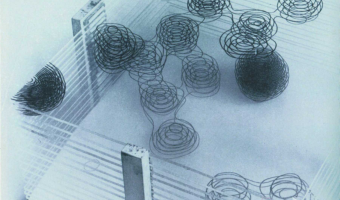
Nobel prize winning crystallographer Dorothy Crowfoot Hodgkin created another physical visualization in the mid 1940's, showing part of the structure of penicillin. An original of this artifact is in the Oxford Museum of the History of Science. This technique recently inspired artist Angela Palmer for her glass portraits. Sources: Lachlan Michael and David Cranswicka (2008) Busting out of crystallography's Sisyphean prison: from pencil and paper to structure solving at the press of a button: […]
1949 – Mississippi River Basin Model
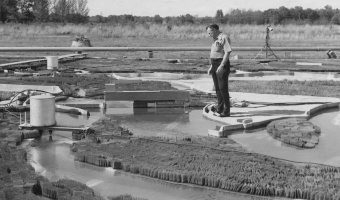
As a response to devastating floods of the Mississippi river in the early 1900s, the US Army Corps of Engineers built a large-scale hydraulic model of the entire river system. The model, 2.5 times the size of Disneyland, allowed them to design better flood control infrastructures and to eventually save millions of dollars. In 1973, the physical model ceased to be used and was replaced by computer models. Nevertheless, mathematical equations still cannot capture all the complexity of river […]
1949 – Moniac: A Hydromechanical Machine to Teach Economics
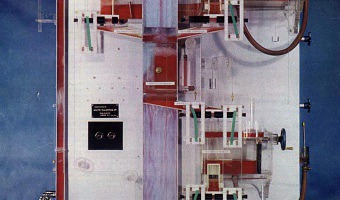
The MONIAC or Phillips machine is a hydromechanical analog computer built to teach basic economical principles using colored water flowing in transparent pipes. The machine was built in 1951 after electrical-engineer-turned-economist William Phillips and his economist colleague Walter Newlyn realized that flows were used as a metaphor to teach economics, but have never been made physical. Phillips is also known for his eponymous curves. Several MONIACs were built, and a working one is […]
1951 – Electricity Generated or Demanded
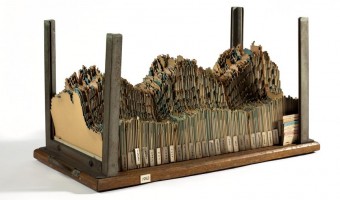
A 3D chart made out of a jagged cardboard for each year representing generated electricity and demand over time. Three-dimensional chart used by Central Electricity Generating Board planners, c.1954. Consists of about 300 cards with square-cut stepped edges in an enclosure of chrome steel uprights, mounted on a wooden base, with a handle at each end. Data represented from October 1951 to April 1954. An early example of 3D data visualisation [...] Also see our entry 1935 - 3D Visualizations of […]
1951 – Microtiter Plates
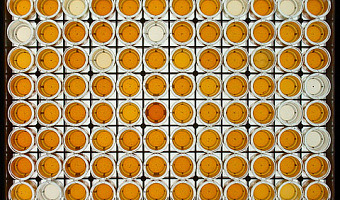
A microtiter plate is an array of chemical test tubes called "wells", invented in 1951 by a Hungarian medical doctor. They are used in a variety of experimental designs, most typically biochemistry assays. The picture above is an example of a colorimetric assay result. Most of the time, they are not directly interpreted visually, as in this example, but are instead put into a plate reader that measure light transmission in each well and converts it to a numerical result. See an example catalog […]
1953 – Watson and Crick's 3D Model of DNA
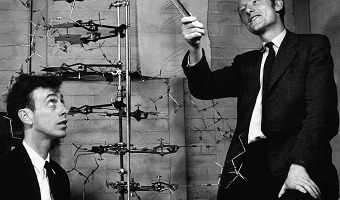
In 1953, James Watson and Francis Crick suggested what is now accepted as the first correct double-helix model of DNA structure in the journal Nature. Their double-helix, molecular model of DNA was then based on a single X-ray diffraction image taken by Rosalind Franklin and Raymond Gosling in May 1952, as well as the information that the DNA bases are paired. Experimental evidence supporting the Watson and Crick model was published in a series of five articles in the same issue of Nature. Of […]
1957 – US Army Corps of Engineers San Francisco Bay Model
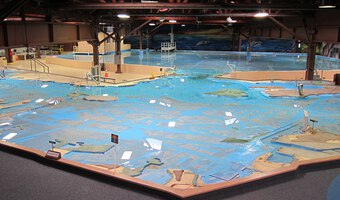
A working hydrodynamic model of San Francisco Bay and the surrounding waterways, with tides. It is still open to the public as a demonstration, although it is no longer used for research. Also see our related entry 1949 – Mississippi River Basin Model. Source: Wikipedia U.S. Army Corps of Engineers Bay Model.
1957 – Proteine Visualizations

Left image: The very first physical model of a protein (myoglobin) built by crystallographer John Kendrew in 1957 using plasticine. The image is from a 1958 Nature article, for a more recent photo see here. In 1960 Kendrew completed a higher-resolution skeletal model known as the "forest of rods". The model was 2-meter wide, made of brass, and supported with 2,500 vertical rods, making it barely legible. Colored clips were attached to the rods to visualize electron density. See photos here and […]
1960 – 3D Spectrogram
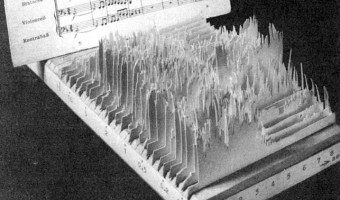
The object on the left may be one of the first sound sculptures. It appears in a 1960 book by German acoustician and musicologist Fritz Winckel (click on the middle image to see the full page). It is a physical 3D spectrogram showing a frequency analysis of an 8-second recording of Beethoven's Eighth Symphony. The left axis is frequency, the bottom/right axis is time, and the vertical axis is the strength of a particular frequency at a particular time. The figure caption uses the term […]
1961 – Voskhod Spacecraft 'Globus' IMP navigation instrument
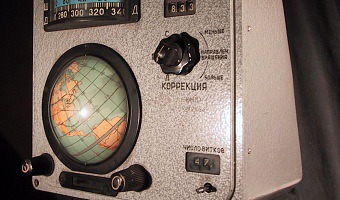
This device was the location indicator for Russian spacecrafts from the world's first manned spaceflight by Yuri Gagarin, 12 April 1961, until 2002. It contains a mechanical computer and a physical globe which rotated to always display the point on earth exactly underneath the spacecraft, or, alternatively, the point where the spacecraft would land if the re-entry rockets where fired at that exact moment. The numbered bullets on the globe in the third picture indicate radio communication […]
1965 – Stop Motion Animation of Physical 3D Map
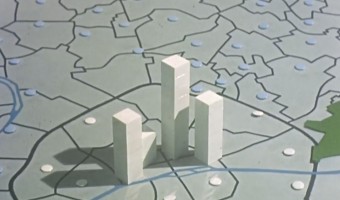
This educational movie from the 1960s uses physical bars and stop motion animation to show the evolution of population in the Paris area between 1801 and 1961. It was made between 1962 and 1967 by the Institut des Sciences Humaines Appliquées (ISHA) and the Centre de Mathématique Sociale et de Statistique (CMSS), in collaboration with the Laboratoire de Cartographie directed by Jacques Bertin. You can see the physical visualization from all sides by […]
1968 – Grace Hopper's Nanoseconds
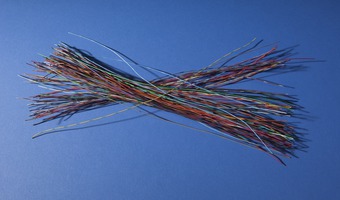
Grace Hopper, a computer scientist and US Navy Rear Admiral, used wire to visualise very short durations of time in computing. Each wire is cut to the maximum distance that light or electricity can travel in a nanosecond, one billionth of a second. She wanted programmers to understand 'just what they're throwing away when they throw away a millisecond', and describes using them to help military commanders understand why signals take so long to relay via satellite. This lecture was given at MIT […]
1968 – Charles Csuri's Numeric Milling Sculpture
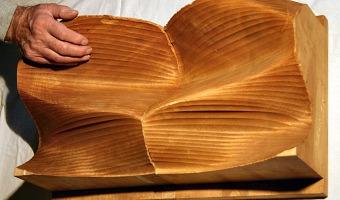
Csuri's wooden sculpture Numeric Milling is one of the few early computer sculptures created with a computer-driven milling machine... This work made use of the Bessel function to generate the surface. The computer program then generated a punched tape to represent the coordinate data. Included were instructions to a 3-axis, continuous path, numerically controlled milling machine. Sources: Csuri Project: Plotter Drawing, 1966 - 1970: Numeric Milling Photo of Numeric Milling Sculpture courtesy […]
1968 – Jacques Bertin's Reorderable Matrices
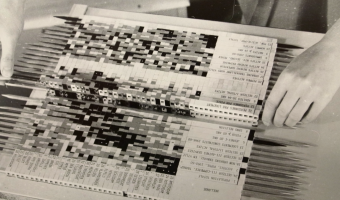
The reorderable matrix is a physical device developed in the mid 1960s by French cartographer Jacques Bertin for exploring and presenting tabular data. Bertin designed several reorderable physical matrices he called Dominos, each with a different size and visual encoding. The first three images above show a small, medium, and large version. A rod mechanism allowed unlocking either rows or columns for reordering. The dominos were part of a general method of “graphic information processing”, […]
1970 – Byron's Bender
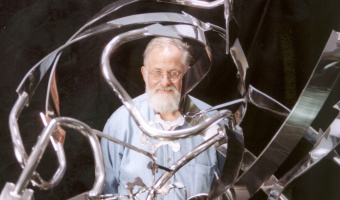
In the early 1970's, crystallographer Byron Rubin invented a tool that bends wires to make proteins models. The tool was popular until the 1990s. Byron Rubin became an artist who builds large-scale molecular sculptures. Eric Martz and Eric Francoeur explain how such physical models yielded important scientific insights: An example illustrating the importance of models from Byron's Bender occurred at a scientific meeting in the mid 1970's. At this time, less than two dozen protein structures had […]
1970 – MoMA Poll: Participatory Bar Chart
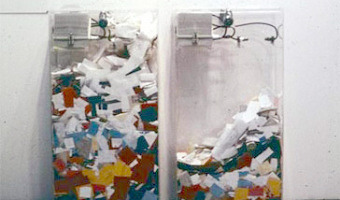
German-American artist Hans Haacke created a participatory physical bar chart as part of a 1970 exhibition at the Museum of Modern Art (MoMA). The audience expressed his opinion on the question "Would the fact that Governor Rockefeller has not denounced President Nixon's Indochina Policy be a reason for your not voting for him in November?". The left plexiglass box collected "Yes" answers, while the right box collected "No" answers. Rockefeller was running for re-election and was a major donor […]
1970 – 3D Sankey Diagram
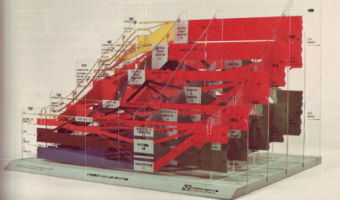
This physical 3D Sankey diagram shows complex energy flows and was created in the 70s by the Center for Strategic & International Studies (CSIS). Little information is available about it. It seems to be composed of five layers of transparent sheet, with four additional layers running perpendicularly. Physical size unknown. Source: Energy Education References Wiki. Energy Flow Diagrams 1949-2009.
1973 – Mazamet Ville Morte
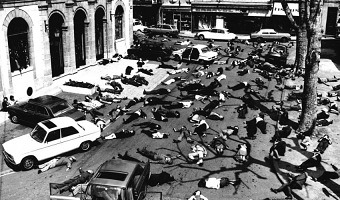
In 1973, the French town of Mazamet had a population that closely matched the nationwide number of motor vehicule deaths across the previous year. A TV reporter decided to show all inhabitants lying on the floor to symbolize these deaths. Source: Marieaunet (2010) 1973 Mazamet ville morte.
1977 – Graphical Waterfall
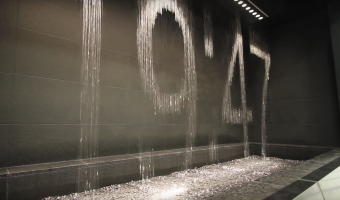
A graphical waterfall is a display where images are formed by water droplets falling from computer-controlled nozzles. It was invented in 1977 by Stephen Pevnick, an American artist. Graphical waterfalls can be used with regular lighting (as on the left video) or with a stroboscope (as on the right video), depending on the desired effect. It is unclear whether such devices have been already used to display data. Sources: Pevnick Design (2018), Invention of […]
1979 – Great Polish Map of Scotland
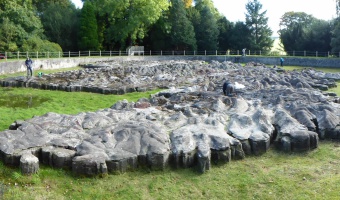
The "Great Polish Map of Scotland" is a 50 x 40 m concrete terrain model of Scotland. It was built by a Polish sergeant who stationed in Scotland during WWII and ended up living there. It is claimed to be the world's largest terrain model, although the Chinese built a 900 x 700 m model in 1999. Source: Atlas Obscura. Great Polish Map of Scotland.
1984 – Dewdney's Analog Gadgets
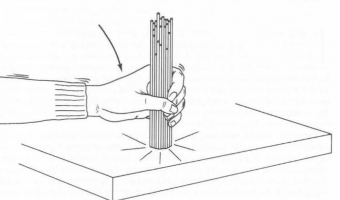
Alexander Dewdney is a Canadian mathematician and computer scientist who authored the recreational mathematics column in the Scientific American magazine from 1984 to 1991, after Martin Gardner and Douglas Hofstadter. In 1984, he describes a number of imaginary analog computers he calls "Analog Gadgets", which can in principle solve computing problems instantly. The first one, shown on the left image, uses spaghetti to sort numbers. The second one uses strings to find the shortest path in a […]
1985 – Using the Physical to Explain the Virtual
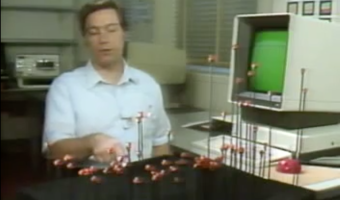
In this 1985 video, Rick Becker from AT&T Bell Labs explains the concept of "dynamic graphics". Already in the early 70s, statisticians like John Tukey were starting to experiment with multidimensional data visualization on flat computers screens, including 3D data visualizations that could be interactively rotated to convey depth. This video shows how enthusiastic these people were to transition from the physical to the virtual. Nevertheless, it is interesting to see that Rick Becker felt […]
1987 – All the Submarines of the United States of America
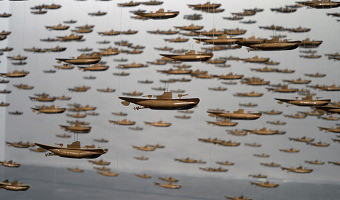
This installation from American artist Chris Burden shows the 625 submarines of the US fleet from the late 1890s to the late 1980s. The cardboard models have been suspended at different heights to look like a school of fish. Also see our other entries on single-datum physical visualizations. Sources: Found on Loren Madsen's lecture slides Art as Information – Information as Art. Wikipedia article on Chris Burden. Photo from Giorgia Valli, Grey Magazine.
1991 – Münster Congestion Visualization
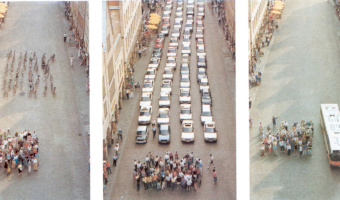
In order to encourage bus use, in 1991 the city of Münster, Germany created a poster that compares the space taken by 72 bicycles (left), 72 cars (middle), and a bus (right). This idea is not new. For example, the city of London has made a very similar poster in 1965. Thanks to Will Stahl-Timmins for pointing this out. Sources: Benjamin Starr (2014) How Much Space Do Cars Take? Cyclists Demonstrate How Bicycles Flight Congestion Image from visualnews.com
1992 – Durrell Bishop's Marble Answering Machine
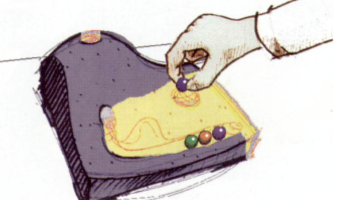
In 1992, Durrell Bishop, then a student at the Royal College of Art, came up with an original answering machine design that is considered as one of the first tangible user interfaces (TUIs). The machine spits out a marble each time an incoming voice message is recorded. The order of the marbles indicates the order in which the messages arrived. Messages can be played back by putting a marble in a small dent. If the message is for somebody else it can be placed on a small dish to the side that […]
1992 – Tactile Infographics
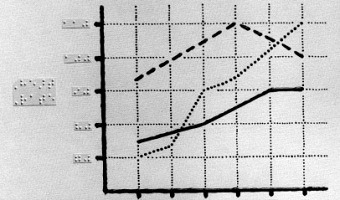
In 1994 the American Printing House for the Blind publishes a short guidebook explaining how to convey infographics for the blind using tactile graphics (first and second images). Most of it is inspired by a 1992 book by Polly Edman. Although it's not clear when were the first tactile infographics created, (non-thematic) tactile maps already existed in the 1910s (right image). Sources: APH (American Printing House for the Blind), Inc. (1994) Tactile Graphics Starter Kit. Polly Edman (1992) […]
1993 – Slumber: Brainwave Weaving
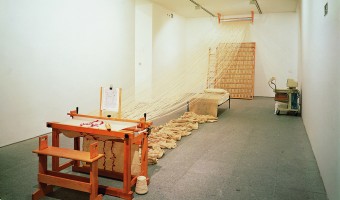
Slumber was a multi-year gallery installation/performance by artist Janine Antoni. From the website description: Performance with loom, yarn, bed, nightgown, EEG Machine and artist’s REM reading. Antoni transforms the fleeting act of dreaming into a sculptural process. Between 1994 and 2000, the artist slept in the bed while an electroencephalograph machine recorded her eye movement. During the day, Antoni would sit at the loom and weave shreds of her nightgown in the pattern of her REM. The […]
1995 – San Diego TeleManufacturing Facility
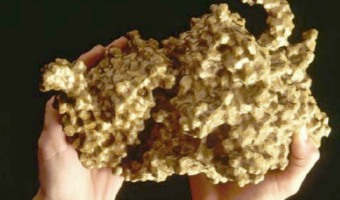
In 1995, Mike Bailey from the San Diego Supercomputer Center created the SDSC TeleManufacturing Facility to help scientists visualize their data in physical form. In 1997, the facility produced one of the first digitally-fabricated molecular models using laminated object manufacturing. The biochemists involved in the project got insights that they were not able to get from the on-screen 3D models, and concluded that: modern physical models are important tools that significantly extend the […]
1995 – Loren Madsen's Early Data Sculptures

Californian artist Loren Madsen has been making data sculptures since 1995 and still continues today. CPI / Cost of Living (left image) is the first of his series: A lamination is one year. Vertical axis is the Consumer Price Index (CPI) for food; the horizontal axis is the CPI for gasoline + electricity. The rising center line is the CPI for housing. The 'snout' is the 1960's when housing and food were cheap. The bulge above the snout is 1973---OPEC, gasoline lines, etc. Thereafter the cost of […]
1996 – Ned Kahn's Wind-Visualizing Facades
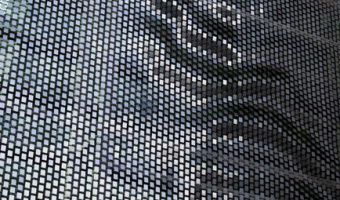
Since 1996, Nothern California artist Ned Kahn creates large-scale installations that visualize wind patterns. The left image shows Wind veil (2000), a facade of a parking garage covered with 80,000 small aluminum panels that are hinged to move freely in the wind. The right video shows Wind arbor (2011), a facade of a hotel lobby in Singapore covered with a cable net structure composed of a half a million hinged elements. Sources: List of Ned Kahn's wind sculptures on his website. David Mather […]
1997 – Level: Hans Hemmert's Same-Height Shoes
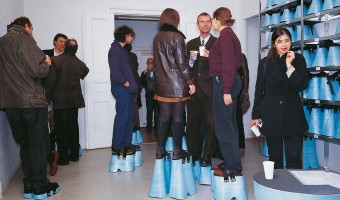
“Level” (1997), Styrodur/rubber/Velcro/measuring device, 50 pairs of platform shoes with heights of 5-43 cm, installation view at Galerie Gebauer Berlin, © Hans Hemmert and VG Bild Kunst. Guests to this installation picked out shoes that brought them all to the height of two meters. The blue height of the shoes served as a physicalization of the height disparities around the room. Sources: Hans Hemmert (1997) Personal Absurdities, Galerie Gebauer Berlin 1997. Interview With Hans Hemmert, 2018 […]
1999 – World's Largest Solid Terrain Model
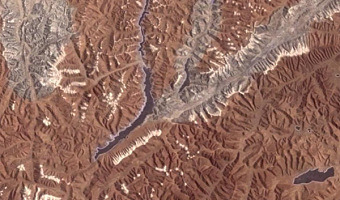
In 2006, a mysterious 900x700m solid terrain model with military facilities was discovered by a German Google Earth user next to the Chinese town of Huangyangtan. It was quickly identified as a 1:500 replica of a disputed area in Tibet between China and India 2400km away, with perfectly matching orientation. Chinese authorities claimed the model was built 7-8 years earlier as a tank training facility. It is unclear whether the right image represents the same model. Sources: Newswatch (2011) The […]
2000 – A Shape Display Appears in a Movie
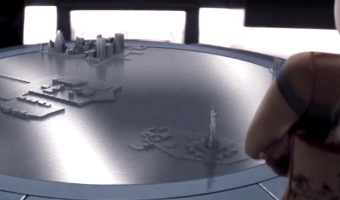
An imaginary ultra high-resolution 2.5D shape display appears in the 2000 movie X-Men. The rendering and animations are visually quite appealing. Notice how impossible overhangs appear at 0:27 (the bridge) and 0:33 (the torch of the Statue of Liberty). This movie scene has prompted a company to design and build an actuated solid terrain model for military customers, see our entry 2004 – XenoVision Mark III. Also see our entry 2009 – Leithinger’s Interactive Shape Displays for a much […]
2000 – Kanban Boards
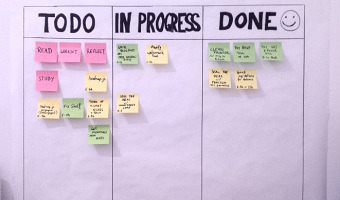
A Kanban board is a task management tool where sticky notes representing work items are moved across a board to reflect their state of advancement. The simplest form has three states: to do, in progress, and done (left image). A Kanban board provides a visual overview over all work items that makes it possible to rapidly spot time management issues, such as too many items in progress. Although software versions exist, many people prefer Kanban boards to be physical. Several recent blog posts […]
2000 – Graph Boards
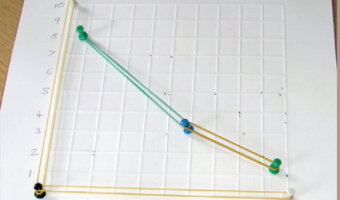
Mathematics and geometry are often taught to blind students using a cork board with raised grid lines, push pins and rubber bands. The right image shows a teacher explaining the use of the Graphic Aid for Mathematics, a physical kit sold by the American Printing House for the Blind. Date of invention unknown. Sources: Suzan Osterhaus (2001) Teaching Math to Visually Impaired Students. Youtube video series explaining the traditional cork board: APH Graph Board with Susan Osterhaus. McGookin et […]
2002 – Bathsheba Grossman's Crystal Engravings
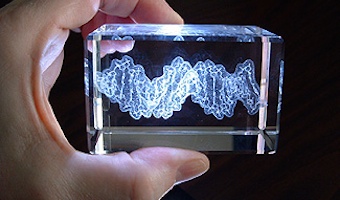
Artist Bathsheba Grossman has been 3D printing mathematical surfaces as early as 1997. In 2002 she started to use subsurface laser engraving to produce 3D physical visualizations of data from astronomy, biology, and physics. Left image: a piece of DNA molecule. Right image: a 3D map of our nearby stars. The artist explains to us: This medium excels at imaging less structural data such as disconnected volumes, non-compact point clouds, and the convoluted strands of proteins. It works by […]
2003 – Pattern Recognition in a Bucket
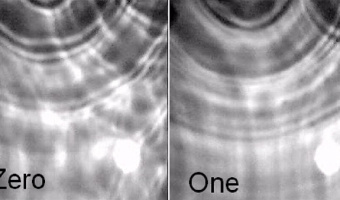
Chrisantha Fernando and Sampsa Sojakka from the University of Sussex published a paper where they demonstrate that a bucket of water can carry out complex, parallel computations, and can even do simple speech recognition. Their setup called "liquid brain" consists in a transparent water tank suspended over an overhead projector and four LEGO motors. Input values are sent to the motors which vibrate the water. A camera then reads the watter ripples and sends the data to a simple perceptron. The […]
2003 – Time Pieces: Physical Space-Time Cubes
Artist Marilynn Taylor created seven three-dimensional maps (one for each day of the week) in which time is the z-axis and a copper wire shows how she moved across the city during the day. Source: Maryline Taylor (2003) Time pieces - Mapping the time and space of place (2003 version).
2003 – Solid Terrain Model with Airplane Trajectory
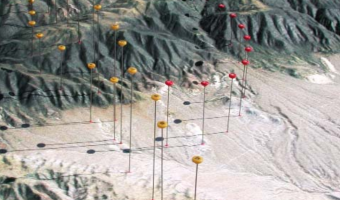
A real case study involving the use of a physical 3D trajectory visualization on top of a 3D terrain model to analyze the causes of a plane crash. This case study is interesting in terms of cost-benefit analysis, since these models appear to be extremely time-consuming to build. The case study includes an informal comparison with animations: "The mock jurors later related that the physical model was easier to understand and it allowed them to discuss the issues with each other more easily than […]
2003 – Mount Fear: Elevation Map of Crime Rates
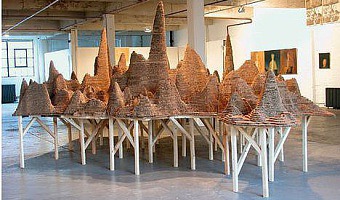
A 3D map of East London where elevation represents the rate of violent crimes between 2002 & 2003. Corrugated cardboard, 145h x 540w x 425d cm. Source: Abigail Reynolds. Mount Fear East London.
2004 – Worry (Prayer) Beads
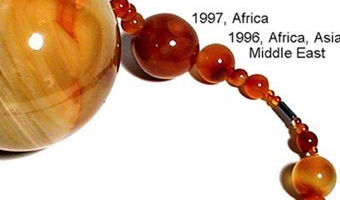
One bead = one year. Size of colored beads is proportional to number of terrorist-caused deaths. Black beads = no terrorist deaths. The largest bead is 2001. Also see Loren Madsen's earlier piece Tops (2001) featuring the same dataset, our entry 1995 – Loren Madsen’s Early Data Sculptures, and our interview with the artist. Sources: Loren Madsen
2004 – Of All the People in All the World: Stats with Rice
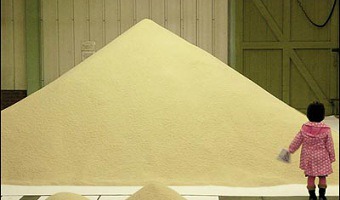
Since around 2004 the British group of artists Stan’s Cafe is creating data landscapes all over the world by mapping each grain of rice to a person in order to convey various statistics such as city populations or deaths in the holocaust. The size and theme of the show change depending on the location. The largest one involved 104 tons of rice. Rice is weighted manually in small quantities and manually poured over piles. This labor-intensive process is part of the show. Sources: Stan's […]
2004 – Array of Belts Visualize Public Presence
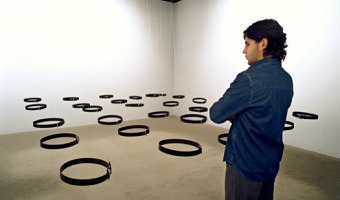
Standards and Double Standards is an interactive installation that consists of 10 to 100 fastened belts that are suspended at waist height from stepper motors on the ceiling of the exhibition room. Controlled by a computerized tracking system, the belts rotate automatically to follow the public, turning their buckles slowly to face passers-by. When several people are in the room their presence affects the entire group of belts, creating chaotic patterns of interference. Non-linear behaviours […]
2004 – Synaptic Caguamas: Visualize Cellular Automata

Synaptic Caguamas is a kinetic sculpture consisting of a motorized Mexican "cantina" bar table with 30 "Caguama"-sized beer bottles (1-litre each). The bottles spin on the table with patterns generated by cellular automata algorithms that simulate the neuronal connections in the brain. Every few minutes the bottles are reset automatically and seeded with new initial conditions for the algorithm, so that the movement patterns are never repeated. This kinetic sculpture is a primitive and absurd […]
2004 – Cylinder: Early Sound Sculpture

Cylinder by Andy Huntington and Drew Allan may be one of the first digitally-fabricated sound sculptures. Also see our entry 2007 - Explosion of sound sculptures. Source: http://extraversion.co.uk/2003/cylinder/
2004 – Scripps' Molecule Models
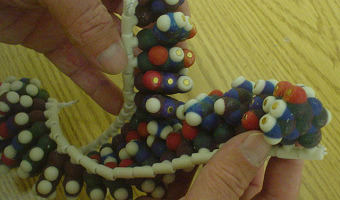
Since 2004 the Molecular Graphics Laboratory at the Scripps Research Institute has been making heavy use of 3D-printed full-color physical molecule models, some of which are articulated (left image), flexible (middle image), and even self-assembling (right image, see video). They also publish augmented reality systems that use those physical models. Also see our entry 1995 – SDSC TeleManufacturing Facility. Sources: Web Page: http://mgl.scripps.edu/projects/tangible_models Tommy Toy (2011) How […]
2004 – XenoVision Mark III: A Dynamic Solid Terrain Model
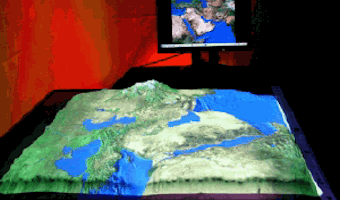
The XenoVision Mark III Dynamic Sand Table by the company Xenotran is a self-reconfigurable solid terrain model with military applications. There is little information on this device but it seems well ahead of its time. Michael Schmitz and coauthors explain how this high-resolution shape display with 7000 actuators was originally inspired by a scene from the X-Men movie (see our entry 2000 – A Shape Display Appears in a Movie). Sources: Directions Magazine (2004) Interview with Xenotran […]
2004 – Full-Color 3D-Printed Scientific Visualizations
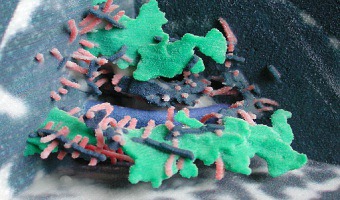
In 2004, the Visualization Research Lab from Brown University printed full-color 3D models of scientific visualizations. They published a poster on the topic where they discuss the technical challenges they faced. The printer used was a Zcorp Z406. Also see our entry 1995 – SDSC TeleManufacturing Facility. Source: http://vis.cs.brown.edu/areas/projects/rapid.html
2005 – Molecular Jewellery
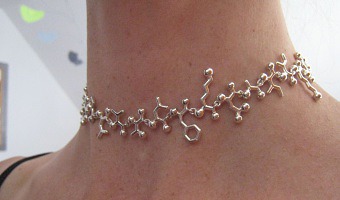
Raven Hanna got her PhD in biochemistry in 2000, and five years later, she became an artist and started to create jewelry based on molecular structures in order to communicate science through art. Image above: endorphine necklace. Sources: Raven Hanna www.madewithmolecules.com (see 2005 version) Leigh Krietsch Boerner (2010) Profile: Molecular Jewelry Design
2005 – Time-Evolving Scatterplot

Unemployment rate plotted against inflation for 8 countries over 10 years. Every layer represents a year and each country is a wire of a different color. This physical visualization was built by Tim Dwyer for his PhD dissertation. His goal was to experimentally compare a 3D and a 2D data representation, and he used a physical object to emulate a perfect 3D display. Source: Tim Dwyer (2005) Two and a Half Dimensional Visualisation of Relational Networks. PhD Dissertation.
2005 – Tactile Rubik’s Cubes
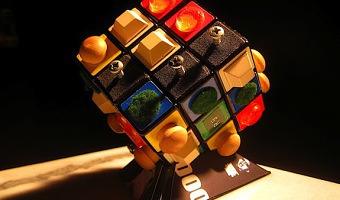
An online article compares several different designs for tactile Rubik's Cubes created between 2005 and 2010. Left image: different objects on the outside of the cube give each side a different feel. Right image: laser-cut shapes. Source: Smithsonian magazine.
2006 – Clebsch Cubic Surface
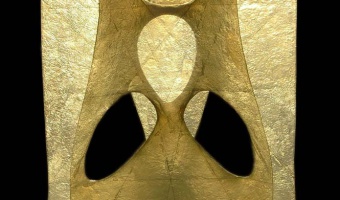
A 90 cm tall Clebsch bicubic surface hand made in resin and fiber. It includes all lines lying inside the surface. Also see our entry 1880 – Klein’s Mathematical Plaster Models for an earlier version made of plaster. Sources: Cayetano Ramirez. obratano.com (alternative website) Cayetano Ramirez (2006) Creation process for the transparent Clebsch surface.
2006 – Peter Jansen's Movement Sculptures
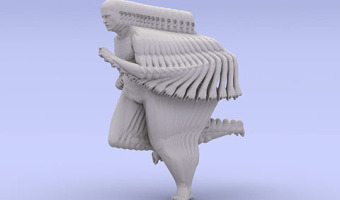
Dutch artist Peter Jansen creates sculptures of moving characters by merging successive snapshots into a single monolithic object. These are not physical visualizations as they do not display data, but the technique could certainly inspire the creation of physical visualizations for complex temporal data. The idea of merging time slices is reminiscent of the pioneering work of Étienne-Jules Marey in the 1880s on chronophotography. See our entry on Marey's movement sculptures. Source: Peter […]
2006 – RoomQuake: Earthquake Visualization for the Classroom
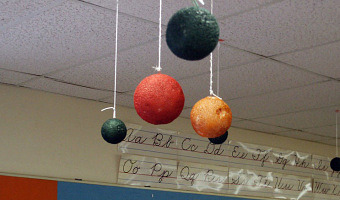
Styrofoam balls hung from classroom ceiling representing the epicenters (location), magnitudes (diameter and color), and depths (length of the string) of a series of simulated earthquakes in a fifth grade classroom. Source: Tom Moher (2006) Embedded Phenomena: Supporting Science Learning with Classroom-sized Distributed Simulations.
2006 – Pulse Room: Light Bulbs Show Heart Beats
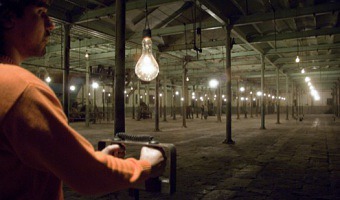
Pulse Room is an interactive installation featuring one to three hundred clear incandescent light bulbs, 300 W each and hung from a cable at a height of three metres. The bulbs are uniformly distributed over the exhibition room, filling it completely. An interface placed on a side of the room has a sensor that detects the heart rate of participants. When someone holds the interface, a computer detects his or her pulse and immediately sets off the closest bulb to flash at the exact rhythm of his […]
2006 – Nathalie Miebach's Woven Sculptures
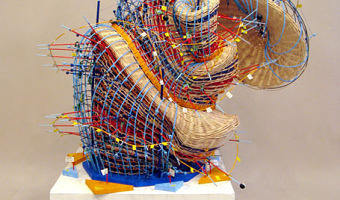
Artist Nathalie Miebach created a range of beautiful woven sculptures out of weather data. Source: Nathalie Miebach. http://www.nathaliemiebach.com/weather.html (see TED Talk).
2006 – Inverted Participatory Bar Charts
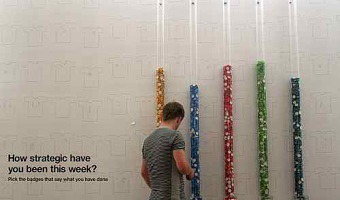
Participatory physical visualization where people pick badges from tanks to vote. A lower bar means more votes. Source: Lucy Kimbell (2006). Physical Bar Charts.
2007 – Garden of Eden
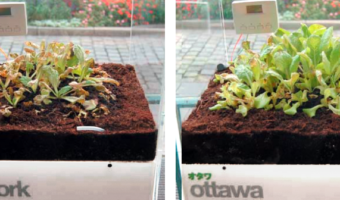
Garden of Eden consists of eight lettuces, each of which is enclosed in its own air-tight plexiglas box and represents a major city. The concencration of ozone in each box is controlled in real-time to reflect the current pollution level in the city. Sources: Thorsten Kiesl, Harald Moser, and Timm-Oliver Wilks (2007) Garden of Eden (web page) Thorsten Kiesl, Harald Moser, and Timm-Oliver Wilks (2007) Garden of Eden (paper)
2007 – Wavefunction: Visualize Public Presence in Waves
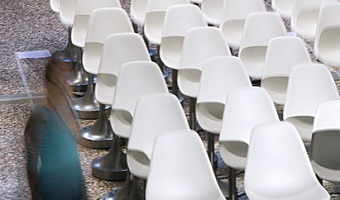
Wavefunction is a kinetic sculpture comprised of fifty to one hundred Charles and Ray Eames moulded chairs (designed in 1948) and placed in a regular array of rows, facing the entrance to the exhibition space. When someone approaches the work, a computerised surveillance system detects their presence and the closest chairs automatically begin to lift off the ground, creating the crest of a wave that then spreads over the whole room. A system of electromechanical pistons raises each chair forty […]
2007 – Explosion of Sound Sculptures
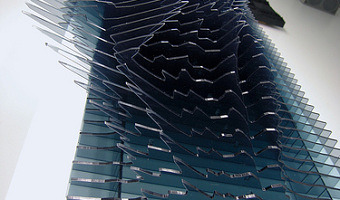
In 2007-2008, sound became an endless source of inspiration for data sculptors. Examples include (images from left to right): Binaural by Daniel Widrig & Shajay Bhooshan (2007) Sound/Chair by Plummer Fernandez (2008) Sound Memory by Marius Watz (2008) Reflection by Andreas Nicolas Fischer & Benjamin Maus (2008) I Will Never Change by Us by Benga (2012) Microsonic Landscapes by Juan Manuel de J. Escalante (2012) The Shape of the Sound of the Shape of the Sound by Stephen Barrass (2012) […]
2007 – Global Cities: Elevation Maps of City Population
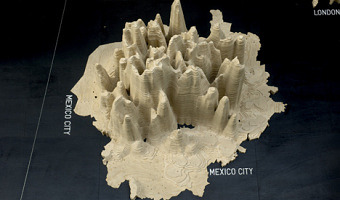
Large-scale physical density models where plywood forms represent the populations of 12 of the world’s major urban centres. Made by a team of designers and architects led by Professor Richard Burdett. Source: Eliza Williams (2007) Global Cities at Tate Modern. Right photo by Stefan Geens.
2007 – Wable: Web Behavior Shown with a Dynamic Bar Chart
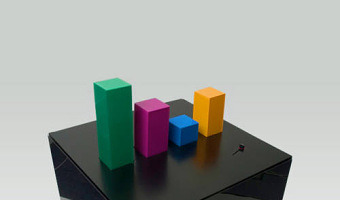
A dynamic bar chart visualizing one's online activity. From the company's website: The personal feeds from webapplications like Plazes, Flickr, and Last.fm tell much about the activity of an individual on the internet. In this project we aim to explore how you can visualize the changes of your web identity over time and create a physical link between your virtual and real identity. The interface consists of both a physical table and a web application. This direct feedback from your web identity […]
2008 – 100% City
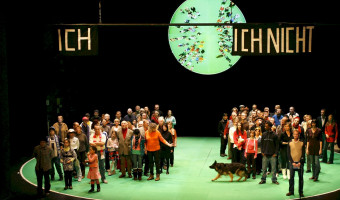
Since 2008, the German theater group Rimini Protokoll organizes performances where they select 100 people in such a way that they form a representative sample of a given city, and then invites them on the stage. Each person briefly introduces themselves, after which everyone participates in a series of physical visualizations where each person takes the role of a data point. The first performance was titled 100% Berlin. Similar performances were then organized in 18 other cities between 2010 […]
2008 – Psychogeographical Mapping: Travel Logging with LEGO bricks
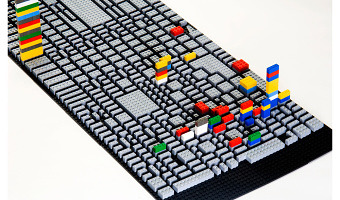
American artist Cory Imig reconstructed the layout of the city of Savannah using LEGO bricks, and over the course of one month she added a colored brick every time she went to a particular place. Each color is a different day of the week. Source: Cory Imig (2008) Psychogeographical Mapping (see the section Documenting of her Web page for more data sculptures).
2008 – Bug Tracking with LEGO Bricks
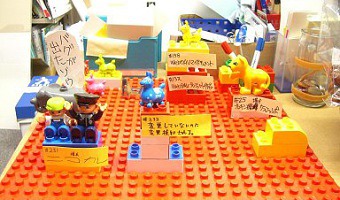
Takeshi Kakeda explains how to use LEGO bricks for bug tracking. Source: Takeshi Kakeda (2008) Tangible Bug Tracking using LEGO bricks. Agile 2008 conference.
2008 – Activity Logging with LEGO Bricks
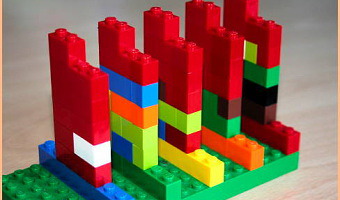
A visualization and logging method for personal work activity. Every tower is a day of the week. A layer is one working hour, horizontally subdivided in four quarters of an hour. Different colors are different projects. The constant availability of this interface makes it easier to log personal activity data on-the-fly, before entering it in a PIM software (an automatic method involving computer vision is being considered). Source: Michael Hunger (2008) On LEGO Powered Time-Tracking. Blog post. […]
2008 – Rearrangeable Wooden Model of Brain Scan
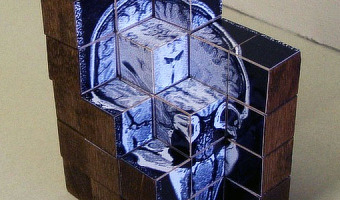
A selection of MRI data glued on 60 wooden blocks which allow to physically dig into cross sections, by Neil Fraser. More details on infosthetics. Source: infosthetics.com.
2008 – BMW Kinetic Sculpture
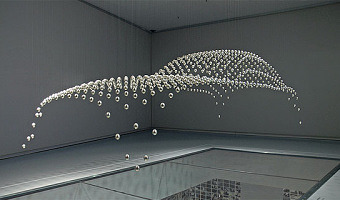
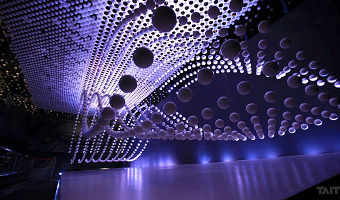
The Kinetic Sculpture is a metaphorical translation of the process of form-finding in art and design. 714 metal spheres, hanging from thin steel wires attached to individually-controlled stepper motors and covering the area of six square meters, animate a seven minute long mechatronic narrative. In the beginning, moving chaotically, then evolving to several competing forms that eventually resolve to the finished object, the kinetic sculpture creates an artistic visualisation of the process of […]
2008 – Andreas Fischers' Data Sculptures
Andreas Nicolas Fischer is a Berlin-based artist. Above are four of his 3-D data sculptures: Fundament (world GDP and derivatives volume) Indizes (finance data over time) A week in the life (cellphone communications) Reflection (FFT of a music piece). Source: http://anfischer.com via infosthetics.
2008 – Joshua Callaghan's Physical Charts
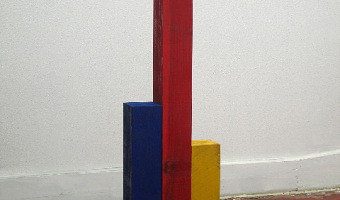
Joshua Callaghan has created various extruded 2-D charts. Source: http://www.joshuacallaghan.com/Graphs.htm
2008 – Justin Stewart's Data Sculptures
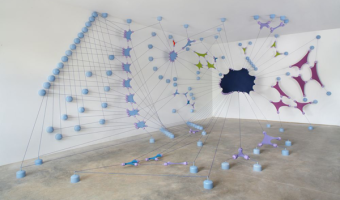
A 3-D graph and a time series visualization. Source: http://thesocietypages.org/graphicsociology/tag/r-justin-stewart/
2008 – Scientific Visualization in Crystal
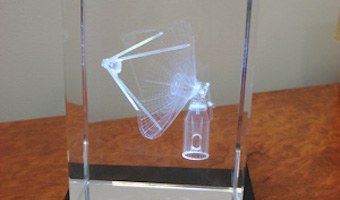
Paul Bourke proposes to use sub-surface laser engraving for communicating about scientific findings at conferences. He also has seminar slides and a poster discussing the use of 3D-printed models. Source: Paul Bourke (2008) Presenting Scientific Visualisation Results as 3D Crystal Engravings.
2008 – Kids Reconstruct Harry Potter's Social Network
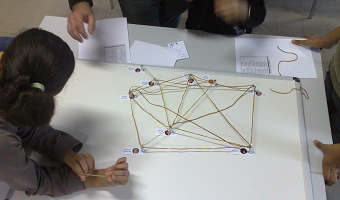
At the 2008 science fair (fête de la science), the Aviz group had kids build physical node-link diagrams of Harry Potter's social network using magnets and rubber bands. Source: Aviz. http://www.aviz.fr/old/fetedelascience08/
2009 – How Much Sugar do you Consume?
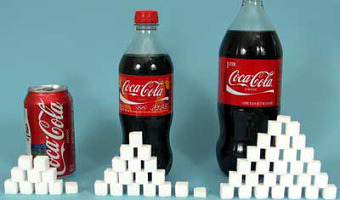
Nutrition labels are often difficult to apprehend: when you drink a can of coke, you consume 39g of sugar, but how much is that? In order to increase consumer's awareness of how much sugar they ingest when eating and drinking, several campains have used a physical visualization using actual sugar cubes and sugar grains to represent the sugar content in food. Many examples can be found online (search for "sugar stacks" and "rethink your drink"). It is unclear when these representations started. […]
2009 – Federal Budget Explained with 10,000 Pennies
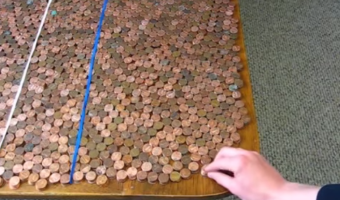
Political Math (formerly called 10000Pennies on the Youtube channel) is a blogger who criticizes the US policy using stats and low-tech physical visualizations. His first 2009 video titled "Obama Budget Cuts Visualization" (left image) got 1.7 million views. Coins, but also bills, water or whisky stand for units of money or jobs. A video often ends with a dramatic action where the blogger cuts a penny in two, overturns a gallon container, spills hundreds of coins from a table, freezes water, or […]
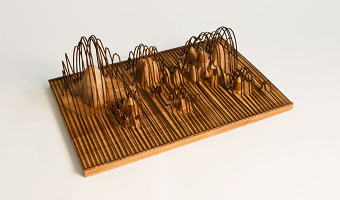
2009 – Windcuts: Wind Travels Captured on Wood
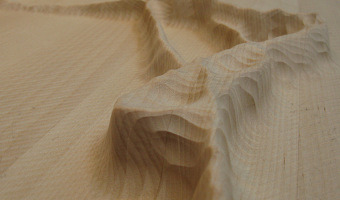
Windcuts is a physical information visualisation retelling the Helsinki wind's travels over five days, using wind sensor measurements from Helsinki, and wood and a CNC machine to cut it from there too. [...] The line's direction shows the wind's direction, the line's width shows the wind's speed - a more intense wind makes a bigger line - and the line's height shows the wind's temperature. Source: Miska Knapek (2012) Windcuts.
2009 – Marcovici's Single-Datum Visualizations
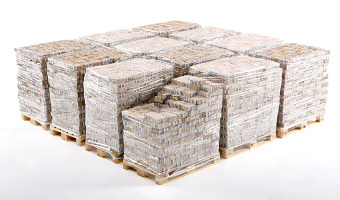
Vienna artist Michael Marcovici created two physical visualizations that convey a single numerical value. The first one shows one billion dollar - the most expensive piece of art ever made, according to him (although these were actually miniature bills). The second one called Rolex Time Sand shows an entire lifetime worth of hourglass sand. For another single-datum physical visualization see our entry Ceramic Poppies to Commemorate Fallen Soldiers in WW1, and our entry on Chris Burden's […]
2009 – Leithinger's Interactive Shape Displays
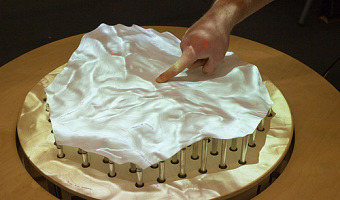
Daniel Leithinger, PhD student at MIT MediaLab and his colleagues, are studying interaction with shape displays. The team designed two impressive shape displays made of arrays of ultra-fast motorized pins. Relief (2009-2010, first row above) is made of 120 motorized pins on top of which can be added a rubber sheet and a projected image. Each pin can be addressed individually and senses user input like pulling and pushing. In 2011, the team extends Relief (later renamed Recompose, second row […]
2009 – Mitchell Whitelaw's Weather Sculptures
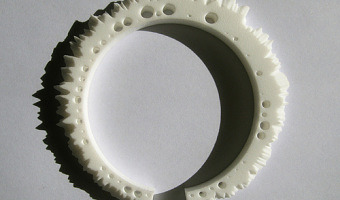
Weather data is another interesting choice for creating data jewelry. Above to the left is a bracelet created by Mitchell Whitelaw based on one year of weather data from Canberra. The right image shows a measuring cup made by the same artist, where each ring represents monthly average temperatures in Sydney over 150 years. Sources: Mitchell Whitelaw. Weather Bracelet (2009) Mitchell Whitelaw. Measuring Cup (2010)
2009 – Centograph: Dynamic Bar Charts Show Keyword Popularity
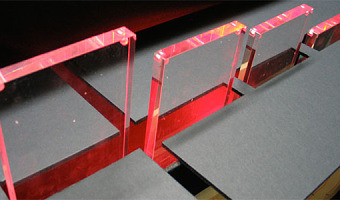
Ten actuated bar charts that show the popularity of keywords of interest in news articles over time, made by the company Tinker from London. A separate search interface is provided on a regular desktop computer and sends queries to the Google News Archive. It is permanently installed in the St Paul's School for Boys Computing Department in London. Sources: infosthetics Tinker London
2009 – Distribution Plushies
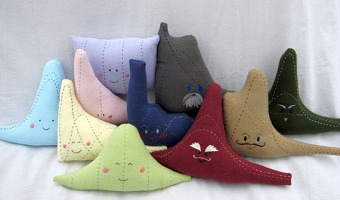
A commercial offer for a set of 10 plush distributions. Although not formally physical visualizations, they could in principle encode actual data. Source: web shop
2009 – DataMorphose: Animated Sails
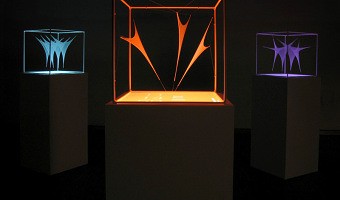
DataMorphose is an interactive installation which projects various data streams into real space and visualizes it three-dimensionally. Information is represented by spanned and moving sails directly in the room. Source: Christiane Keller (2009). Data Morphose.
2009 – S-XL CAKE: Irregular Cake Mold
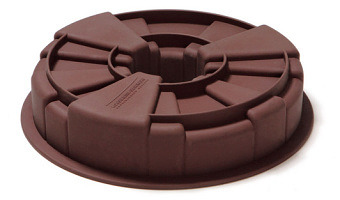
A cake mold that creates pieces of cake in different sizes. Although not a physical visualization, it could in principle encode data. Source: Ding 3000 via Infosthetics.com.
2009 – In-Formed: More Data-Driven Tableware
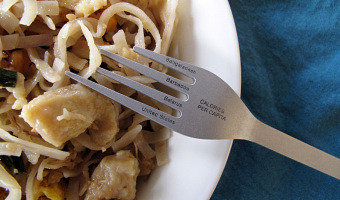
Another data-driven tableware, this time conveying world statistics. The fork on the image shows calories consumption for the US and three other countries. Source: Nadeem Haidary.
2009 – Form Follows Data: Tableware
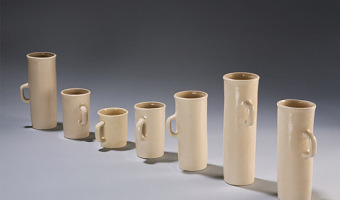
This set of tableware by designer Iohanna Pani conveys personal statistical data. Source: designboom
2009 – Poly: Physical Bar Chart Showing Online Poll Data
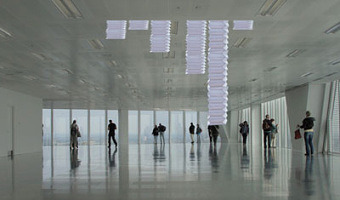
Poly, a self-actuated bar chart which shows replies to online polls. Sources: Digit, London. Original polling website is down [Oct 2014]; check out an archived version instead.
2009 – Pulse: Animated Heart Shows Sentiments
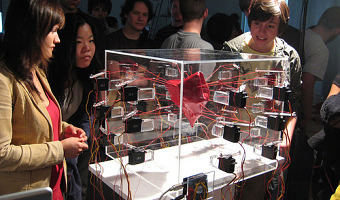
pulse is a live-visualization of recent emotional expressions, written on private weblog communities like blogger.com. Weblog entries are compared to a list of emotions, which refers to Robert Plutchik’s seminal book Psychoevolutionary Theory of Emotion published in 1980. Plutchik describes eight basic human emotions in his book: joy, trust, fear, surprise, sadness, disgust, anger, and anticipation. He developed a diagram in which these eight emotions, together with their weakened and amplified […]
2009 – Virtual Gravity: Giving Physical Weight to Data
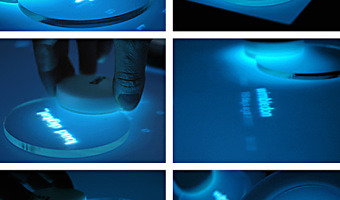
Virtual gravity is an interface between digital and analog world. With the aid of analog carriers, virtual terms can be taken up and transported from a loading screen to an analog scale. The importance and popularity of these terms (data base: Google Insights for Search), outputted as a virtual weight, can be weighed physically and compared. Therefore impalpable, digital data get an actual physical existence and become a sensually tangible experience. Source: Silke Hilsing (2010) via fubiz
2010 – and Counting... Tattoo of War Casualties
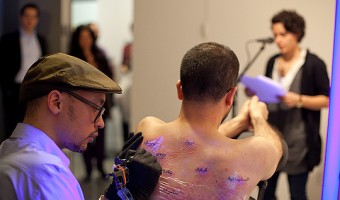
Wafaa Bilal’s brother, Haji, was killed by a missile at a checkpoint in their hometown of Kufa, Iraq in 2004. Bilal feels the pain of both American and Iraqi families who have lost loved ones in the war, but the deaths of Iraqis like his brother are largely invisible to the American public. and Counting… addresses this double standard as Bilal turns his own body — in a 24-hour live performance — into a canvas, his back tattooed with a borderless map of Iraq covered with one dot for each Iraqi […]
2010 – Computer Glitches as 3D Objects

Glitch objects is a series of artworks by Tracy Cornish which transform two-dimensional visual results of computer glitches into three-dimensional objects by mapping properties of a visual glitch into 3D space. The left image shows glitch object 22, the right image shows glitch object 218. Computer glitches are the completely random, unpredictable and unexpected failures of digital systems. They are the result of approximated values and computational compensations for inaccessible information. […]
2010 – Cookbook Arranges Ingredients into Physical Visualizations
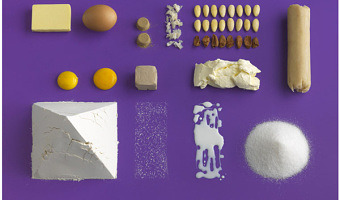
In Sweden, IKEA gives away baking books where ingredients are arranged into physical visualizations. The photos are by Karl Kleiner. This idea is reminiscent of Ursus Wehrli's art projects. Sources: Niels-Peter Foppen (2010) Hembakat är Bäst. Via Iohanna Nicenboim's pinterest. Images from notcot.com.
2010 – Retweet Ripples
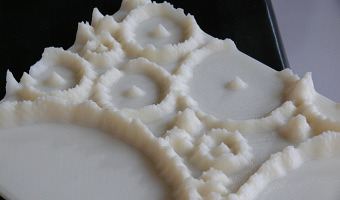
Interpreting tweets as droplets on an imaginary fluid surface, Karsten Schmidt and his colleagues created a 3D printed abstract visualization of tweets and their retweets forming ripple patterns. The visualization is created by first executing a Twitter search (here: "Justin Bieber") to create the initial droplets shown in the center of each ring. For each search result they then recursively executed secondary Twitter searches for retweets to create more droplets and used these to form […]
2010 – Quipu of the Periodic Table
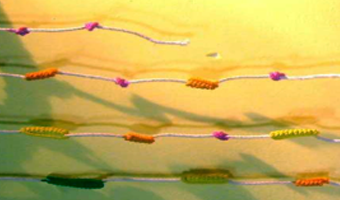
As a result of bringing together each pair of periods in a single function or binod, the author has found a new regular on the subject, which has been defined as a new quantum number, since the number of orders or regulations binod growth elements in the table, under the appearance of pairs of new types of quantum structures or periods whose organization responds to a simple mathematical function: a parable of the type Y = 4 X ^ 2 - In this case report: a) That the strings correspond to pairs […]
2010 – Dust Serenade: Sound Waves Materialized
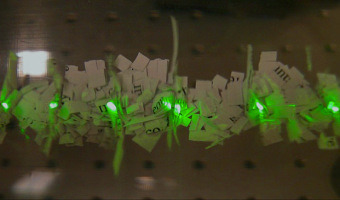
'Dust Serenade' is a reenactment of an acoustic experiment done by German physicist August Kundt. Inspired by the Chladni's famous sand figures visualizing sound waves in solid materials, Kundt devised an experiment for visualizing longitudinal sound waves through fine lycopodium dust; a setup that would allow him to measure the speed of sound in different gases. Kundt was a strong believer in experimental methods over purely theoretical inquiry in a time when the disciplines of theoretical and […]
2010 – Data Sculptures in Class
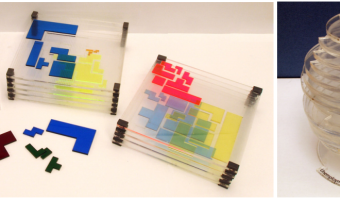
The two data sculptures above have been created by undergraduate students as part of a design class given by Andrew Vande Moere at the University of Sydney. A 2010 article he coauthored with Stephanie Patel (link below) provides many other examples of these. Andrew Vande Moere has published several articles on data sculptures since 2008. Sources: Andrew Vande Moere and Stephanie Patel (2010) The Physical Visualization of Information: Designing Data Sculptures in an Educational Context. Also see […]
2010 – Hans Rosling Adopts Physical Visualizations
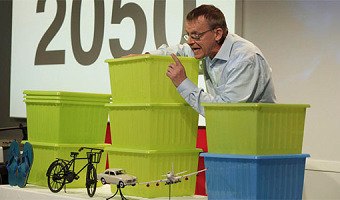
Hans Rosling is famous worldwide for his fascinating speeches about population growth and income inequalities, notably his 2006 TED Talk where he debunks myths about the third world using animated charts. In 2010 he started to tell stories about data using physical visualizations. He started by stacking Ikea boxes, then switched to a variety familiar objects including pebbles, toy construction kits, fruit juice, snow balls and even toilet paper. Hans' son Ola Rosling is behind the technology […]
2010 – Thematic Maps of Germany
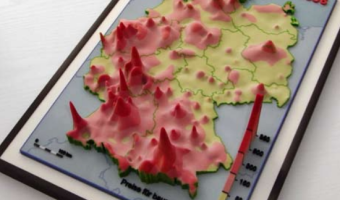
Physical cartographic visualizations built by geographer Wolf-Dieter Rase with a Z650 printer. Left: average prices for building lots in Germany in 2006. Middle: unemployment in Germany in 2006; The surface represent trends, the columns represent local deviations from the trends (magenta means higher, cyan means lower). Right: travel distance to airports. Source: Wolf-Dieter Rase (2012) Creating Physical 3D Maps Using Rapid Prototyping Techniques.
2010 – Shanghai Spheres
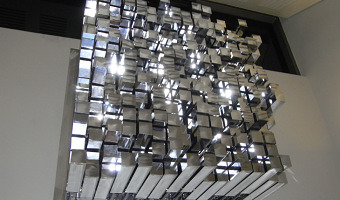
For the 2010 World Expo at Shangai, Japanese firms ADK and Murayama and Las-Vegas firm Fisher Technical Services, Inc. created an array of 1,008 15cm diameter actuated spheres, each suspended by its own micro winch. The show does not include data visualizations. Kinetic sculptures made of arrays of suspended spheres abound. An early one is Joe Gilbertson's (2007). More recent ones include Kinetic Rain (2012) and Triptych (2014). Also check BMW's Kinetic Sculpture (2008) on this list. Source: […]
2010 – Headspace: Array of Actuated Bars
Artist Geoffrey Drake-Brockman created Headspace, a matrix of 256 motorized bars (total size 150 x 150 x 80cm) to display the faces of over 700 schoolchildren. Not a data visualization, but could be used as such. Source: Geoffrey Drake-Brockman (2010). http://www.drake-brockman.com.au/
2010 – eCLOUD & airFIELD: Ambient Airport Visualizations
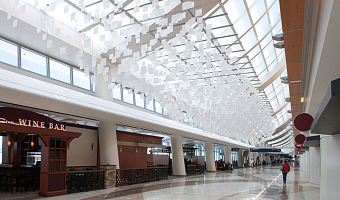
Left image: eCLOUD is an airport installation at the San Jose International Airport created by Dan Goods, Nik Hafermaas, and Aaron Koblin. It is made of many large LCD pixels laid out in 3D space whose opacity change as a function of weather. Right image: A similar installation called airFIELD was created by the same team two years later. It shows air traffic and is installed at the Hartsfield-Jackson Atlanta International Airport. For other examples of non-regular or 3D layouts of physical […]
2010 – Limbique: Brain Slices
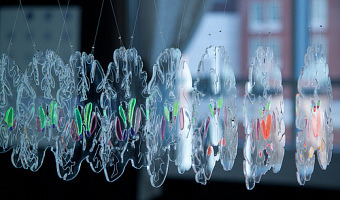
A neuroscientific physical visualization made by an artist and a neuroscientist. Exhibited at the at the VisWeek 2011 art show. Source: David Paulsen and Pinar Yoldas. Photo by Samuel Huron.
2010 – Relational Ornaments: Networks Shown with Textile
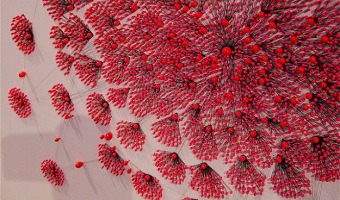
Textile art based on the network maps of Valdis Krebs. Gundega Strautmane, a Latvian textile artist and designer, visualizes social and physical networks in a show called Relational Ornaments. The networks are created using various sized pins to depict nodes and threads connecting them to show relationships. Bringing visualization into the tactile world lends it a weight not able to be achieved on a computer screen. It allows the viewer to pause, spend time with the information, feel it, sense […]
2010 – Dynamic Bar Chart to Visualize One's Finances
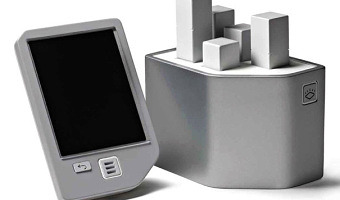
A design project by Swedish designer Hampus Edström to help people keeping an overview of their financial situation. Sources: Hampus Edström, project presentation. Yanko Design blog.
2010 – Keyboard Frequency Sculpture
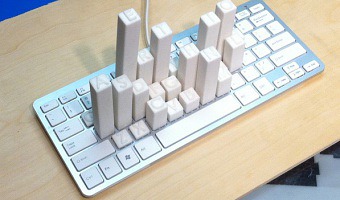
A 3D bar chart on top of a keyboard which shows the frequency of each letter in the alphabet. Source: Michael Knuepfel. Keyboard Frequency Sculpture.
2011 – Digital Arab Spring
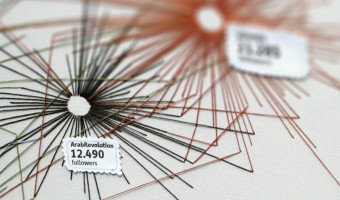
Twitter-networks were used by the citizens of the North African states to communicate and organize during the Arab Spring. The virtuality of a computer network becomes tactile and palpable here, like the virtual organization led to actual protests in the streets. The purpose of this data visualisation is to illustrate a magazine-cover and spread and was created as part of an academic graphic design programme. Sources: René Rieger, Digital Arab Spring. Gestalten Blackboard entry (2012).
2011 – Ursus Wehrli's Art of Clean Up
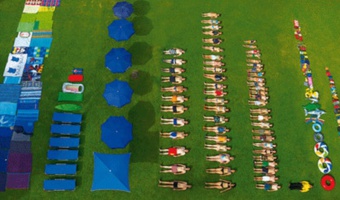
Ursus Wehrli, a Swiss comedian and artist, is known for his parodic art project called "Tidying up Art", where he rearranges well-known paintings in an orderly fashion (see his 2003 book and his 2006 TED Talk). In 2011, he started a project called "The Art of Clean Up" where he rearranges everyday objects and people. Also see our other entries on physical visualizations created by rearrangement. Sources: Maria Popova (2013) The Art of Cleanup: Ursus Wehrli Playfully Deconstructs and Reorders […]
2011 – Sleep Patterns

Laurie Frick's Pokey Red is a physical visualization of sleep data over a month. Frick makes an interesting use of the physical support: in her visualization, periods of sleep of a lesser interest (light sleep) are folded up, giving more importance to the periods of quality sleep (coloured rectangles), while remaining integral part of the visualization. "Pokey Red" 12 in x 12 in, cut paper, watercolor and ink. Based on a month of sleep data, with the light sleep (aka trash sleep) periods folded […]
2011 – Blip: A Year of Travel
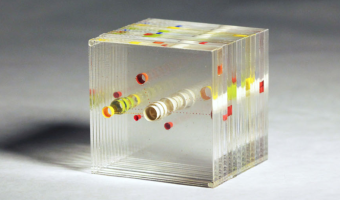
In his experiments with visualizing data from Tripit to look back at his own (and other people's) travel, Cemre Güngör came up with a new system to create data sculptures from one's travels over time. This work is of a particular interest, in that it shows an excellent example of how a physical visualization design process unfolds, with many questions unique to physicalization add up to the challenge of designing an effective visual representation, i.e., contrasting materials and treatments […]
2011 – Manually Animated Graph of Scientific Data
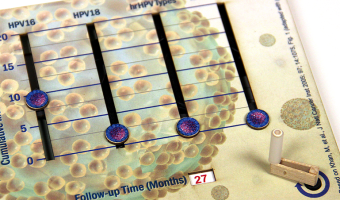
Philadelphia-based multi-discipline artist Bradley Litwin built this physical chart that can be animated by turning a crank. It is the only manually-animated physical visualization we know of so far. It was commissionned by a pharmaceutical company, intended as an educational device for distributing to doctors. Bradley was kind enough to send us an image of the insides of the original prototype, "not quite as pretty as the final product", he says. His explanation: As the crank is turned, a […]
2011 – Jose Duarte's Handmade Visualization Toolkit
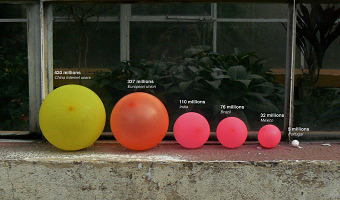
Colombian designer Jose Duarte wants to bring the DIY concept to data visualization. Using ordinary materials like balloons, tape and rubber balls, he has experimented with various visualization techniques from area charts to bubble graphs and ven diagrams in diverse scenarios as business, art, street interventions and even astronomy. To help people build physical visualizations he designed a physical toolkit he calls the Handmade visualization toolkit. Sources: Maria Popova (2011) Analog […]
2011 – Stephen Barrass' Physical Data Sonifications
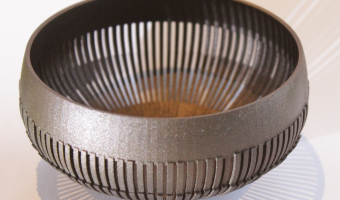
Physical representations of data can target other senses than vision or touch. Stephen Barrass, one of the inventors of sonification in the late 90s and now at the University of Canberra, started to explore physical sonifications in 2011. He calls this principle Acoustic Sonification: Acoustic Sonifications are physical objects designed to make sounds that convey useful information about a dataset of some kind. Unlike other sonifications, they do not require a power supply, and the sounds are […]
2011 – Tape Recorders: Time-Measuring Tapes
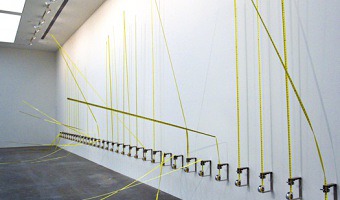
Rows of motorised measuring tapes record the amount of time that visitors stay in the installation. As a computerised tracking system detects the presence of a person, the closest measuring tape starts to project upwards. When the tape reaches around 3 meters high it crashes and recoils back. Each hour, the system prints the total number of minutes spent by the sum of all visitors. Commissioned by the Museum of Contemporary Art, Sydney Source: Rafael Lozano-Hemmer […]
2011 – Warning: Real Time Global Air Quality Display
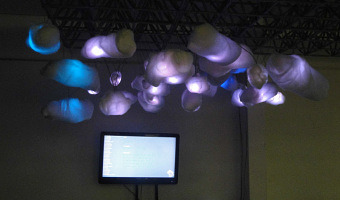
Warning - Real Time Global Air Quality Display is an installation of ambient display that receives data from the internet about the air quality in 30 cities in 5 continents. The installation of these data is dynamically displayed on a screen and a physical structure through a lighting system (LED) located in a public space. The motivations for this project are digital aesthetics of climate change created by Pold, (2010), that means artworks in digital art involving the issue of the environment […]
2011 – Adrien Segal's Data Furniture
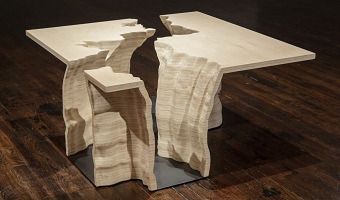
Adrien Segal is an artist with a background in furniture design. She takes a data-driven approach where she uses data of natural events and environmental developments and transforms them into beautiful furniture. The choice of forms and materials conveys the origin of the data in an intriguing way. Left image: TRENDS IN WATER USE is a data sculpture that graphs national statistics of water usage in the United States over 50 years, from 1950 - 2000. The width of the canyon walls represent how […]
2011 – Laser-Cut Time Series
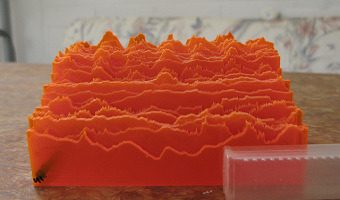
Temperature measurements in Helsinki from May 2009 to May 2010. Each row is one week long. Source: Miska Knapek, see flickr photoset.
2011 – David Bowen's Sea Wave Replicators
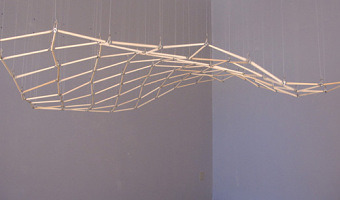
Top: Tele-present water by David Bowen is an actuated surface controlled by wires and servo-motors that replicates sea wave patterns measured in real time in a remote location. Bottom: Underwater is a larger-scale version created by the same author. Sources: David Bowen (2011) Tele-present water series. David Bowen (2012) Underwater series.
2011 – DataCoaster: Data-Driven Toys
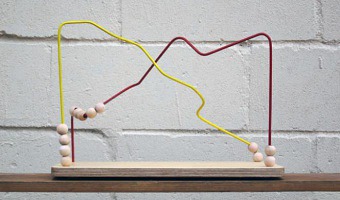
DataCoaster is a re-imagining of the classic waiting room toy. But instead of arbitrarily loopy lines, DataCoaster's lines are generated by data, essentially transforming a simple, kinetic toy into a graph of information. If you're interested in getting one of these for your data, have a look at the source for this entry and contact Bobby - he is planning to offer this service. Source: Bobby Genalo. DataCoaster.
2011 – Can We Keep Up: Sponges Show Domestic Water Usage
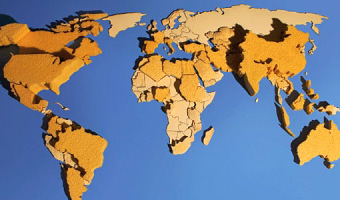
Can We Keep Up is a a physical data visualisation that investigates the domestic need for water in cities all over the world. Source: infosthetics.com. Image from Hal Watts.
2011 – DIY United States Electoral Vote Map
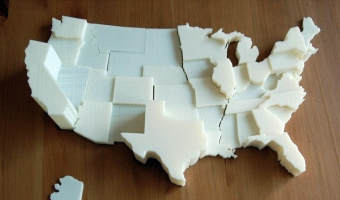
This is a 3D scale replica of the United States, the state height corresponds to the number of electoral votes each state controls in a presidential election. Source: thing 11178 on thingiverse.com
2011 – Paper Models of 3D Plots
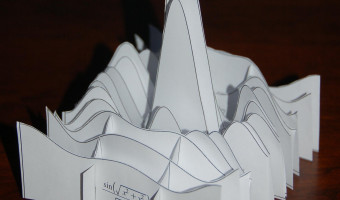
Paul DeMarco from Maplesoft explains how to slice up 3D plots to build solid paper models. Source: Mapleprimes
2011 – Tōhoku Japanese Earthquake Sculpture
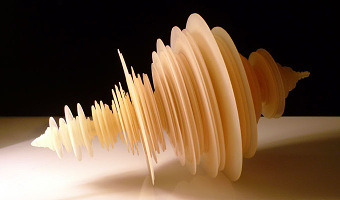
A data sculpture by Luke Jerram that depicts nine minutes of seismographic readings during the 9.0 earthquake. Source: Gizmodo. Photo by Luke Jerram.
2011 – From Over Here: News Trends
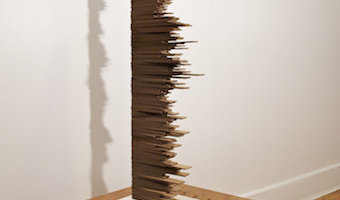
"From Over Here" is a physical representation of articles from the New York Times from 1992-2010. Each card represents a month of articles about, or related to Ireland. The people and topics mentioned in the articles are etched on each card. Sources: Paul May, From Over Here, March 2011. infosthetics. Flickr album by Paul May - paulmay.org.
2011 – LEGO Prism Maps
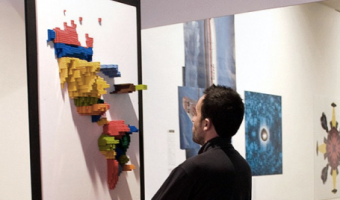
Prism maps showing migration patterns between the Americas. Each Lego brick represents 10.000 people. Source: Samuel Granados. Lego Cartograms (via FlowingData and infosthetics).
2012 – A Soft and Transparent Handleable Protein Model
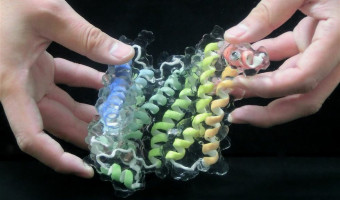
This report demonstrates the viability of a new handleable protein molecular model with a soft and transparent silicone body similar to the molecule’s surface. A full-color printed main chain structure embedded in the silicone body enables users to simultaneously feel the molecular surface, view through the main chain structure, and manually simulate molecular docking. The interactive, hands-on experience deepens the user’s intuitive understanding of the complicated 3D protein structure and […]
2012 – Stop & Frisk: Physical Data Filtering
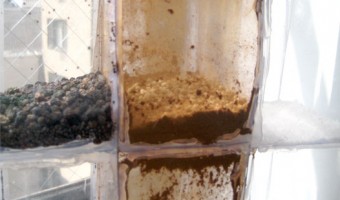
Chilean designer Catalina Cortázar created a physical visualization showing the proportion of black, hispanic and white people searched by the New York police in 2010. Each of the three compartments stands for a race and contains an amount of powder proportional to the race's population in New York. When the object is turned upside down, the powder falls into an adjacent compartment except for coarser particles that do not make it through the holes and represent people stopped by the police. […]
2012 – What made me
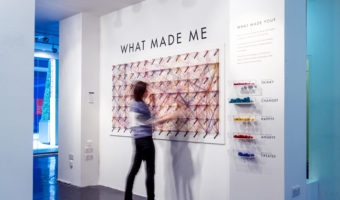
An interactive public installation where visitors could engage by picking coloured strings corresponding to feelings, inspirations, thoughts or influences that make the person they are today, and link these strings to words on the wall to make a path visualizing associated concepts tied to each of these feelings, inspirations, thoughts and influences. WHAT MADE ME was designed by Dorota Grabkowska and Kuba Kolec for the Birmingham Made Me Design Expo (15-22 June 2012) at the Mailbox, […]
2012 – Point Cloud: A Dynamic Weather Sculpture
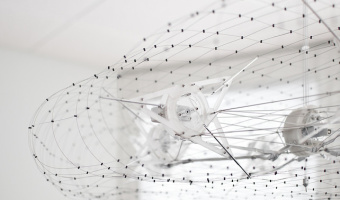
James Leng’s ‘Point Cloud‘ consists in a 3D wire structure materializing real-time weather information by moving and undulating. The wire structure is articulated by pistons activating wheels to deform the surface according to data. The structure could be articulated for other types of data than weather forecast. This structure represents a first attempt to build a physical 3D weather forecast system. The speed, smoothness, and direction of rotation are modulated to interpret a live feed of […]
2012 – Bit Planner - LEGO calendar
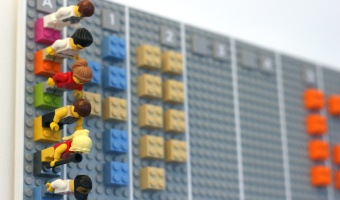
Vitamins studio created The Bit Planner, an elegant wall mounted time and resource planner made entirely of Lego bricks. In this tangible calendar, each gray row represents a month, and each gray rectangle represents a week, and everyone in the group has their own line in the calendar (see left image). Projects are associated to different colors, and each LEGO block corresponds to half a day spent working on a project. While entirely tangible, the Bit Planner can be synched with an online, […]
2012 – Poland Budget Presented with LEGO Bricks
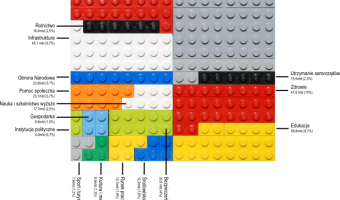
An area chart created with LEGO bricks. Each colour presents a single domain in the 2011 Polish budget. Source: Przemyslaw Biecek (2012) SmarterPoland.
2012 – Pulse: Tangible Line Graph
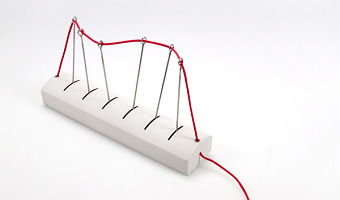
Pulse is a tangible line graph. It is composed of a string whose position is changed with six servo motors. By tilting the device, one can change between three information feeds. Pulse was created by designers Jon McTaggert and Christian Ferrara. Source: Christian Ferrara and Jon McTaggert, cargocollective.com/Pulse
2012 – Google Eye: Radial Visualization of Page Visits
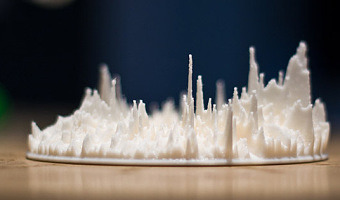
During the Generator.x 3.0 workshop, interaction designer Andrej Boleslavský created a radial visualization of page visits where each day spans a specific angle of the ring, and the entire ring spans one year. Source: Andrej Boleslavský (2012) Google Eye.
2012 – Grand Old Party: Political Satire
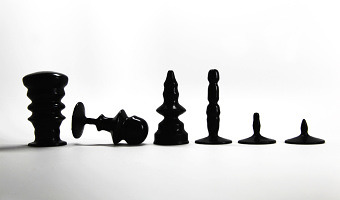
American designer Matthew Epler shows how to build physical visualizations out of silicone using 3D printing and mold casting. He also shows how to use them to make political statements. Source: Matthew Epler (2012) Grand Old Party (video here).
2012 – Data Cuisine
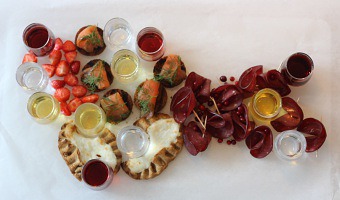
The left image is a map that shows the differences in alcohol consumption across Finland, as well as typical local food. The right image shows the number of immigrants in Finland by nationality (rice for the Chinese, salmon for the Swedish). Many other examples of edible physical visualizations can be found on the Data Cuisine web site. Data Cuisine is a series of workshops organized by Moritz Stefaner and prozessagenten. Seven workshops took place so far, the first one was in Helsinki in 2012. […]
2012 – Slime Mold Imitates the United States Interstate System
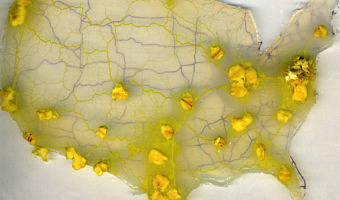
Can a slime mold solve the traveling salesman problem without a digital computer? From the article's abstract: The plasmodium phase of Physarum polycephalum is a champion amongst living creatures used in laboratory prototypes of future and emergent computing architectures. A wide range of problems from computational geometry and logic can be solved by this cellular slime mold. A typical way to perform a computation with the slime mold is to represent a problem’s data as a spatial configuration […]
2012 – Pulse Drip: Visualize Heartbeats with a Water Hose
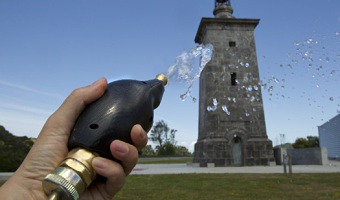
Pulse Drip Interactive installation originally developed for Urdaibai Art 2012 in which the public can water the lawn at the Torre de Madariaga using a water hose with a heart rate sensor built-in. To participate, visitors take the hose wherever they want to water: by putting their index finger on a tiny sensor on the spray head, his or her pulse is detected and an automated electromechanical valve controls the water flow to match the beat of the participant's heart. The spray head is a […]
2012 – Chaotic Flow: Abstract Flow Visualization of Copenhagen Bike Traffic
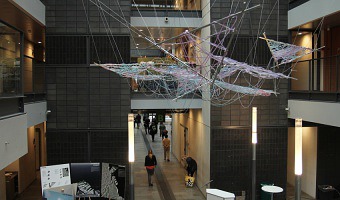
Biking is the transport form of choice in Copenhagen, Denmark. The city is equipped with generous bike lanes and the municipality put up counters at some check points to get a better estimate of the thousands of cyclists coming through every hour. Tobias Lukassen, Halfdan Hauch Jensen and Johan Bichel Lindegaard from Illutron Collaborative Interactive Art Studio used this data to create the above depicted abstract visualization of the city's bike traffic for the 4S / EASST joint conferences in […]
2012 – Large-Scale Drone Swarm
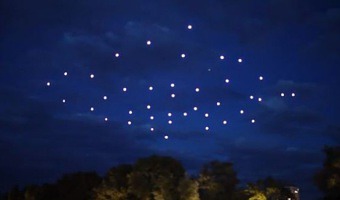
Floating spheres again, but this time there is no wire. An outdoor demonstration of 49 quadrocopters in a synchronized motion, by Ars Electronica Futurelab and Ascending Technologies GmbH. Sources: The Blaze (2012) Also watch another demonstration involving 20 small quadrocopters indoors by the GRASP Lab at the University of Pennsylvania (2012).
2012 – Dynamic Network Sculpture
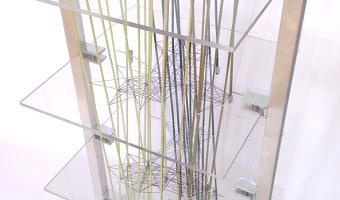
A physical space-time cube representation of cultural heritage data. Source: Florian Windhager, Eva Mayr. Cultural Heritage Cube: A conceptual framework for visual exhibition exploration. IV '12.
2012 – Rearrangeable 3D Bar Chart
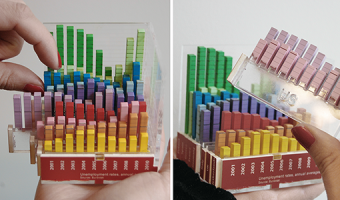
A modular physical visualization like this rearrangeable 3D bar chart allows people to sort, filter, compare and examine data by direct physical manipulation. Sources: Yvonne Jansen and Pierre Dragicevic (2013) An Interaction Model for Visualizations Beyond the Desktop. Also see Yvonne Jansen's PhD dissertation on Physical and Tangible Information Visualization (2014)
2012 – Putting Physical Visualizations to the Test
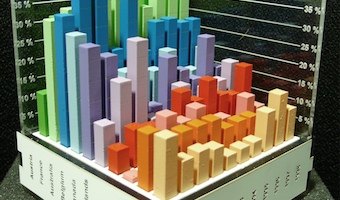
These physical bar charts, showing the evolution of country indicators over time, were used to conduct the first empirical study showing that physical visualizations can outperform their on-screen counterparts for data retrieval tasks. Sources: Yvonne Jansen, Pierre Dragicevic and Jean-Daniel Fekete (2013) Evaluating the Efficiency of Physical Visualizations. Also see Yvonne Jansen's PhD dissertation on Physical and Tangible Information Visualization (2014).
2012 – Matthijs Klip's Data Sculptures
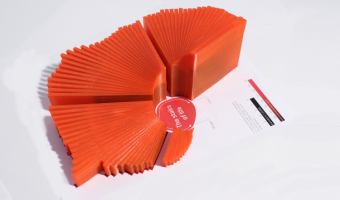
Left image: data sculpture by Dutch designer Matthijs Klip showing life expectancy of the Netherlands population. Each bar maps to an age; the bar's height represents life expectancy while its length represents the amount of people having that age. Right image: other designs by Matthijs Klip. Source: Matthijs Klip (2012) Physical Information Design.
2012 – PARM: Static Terrain Models with Projection
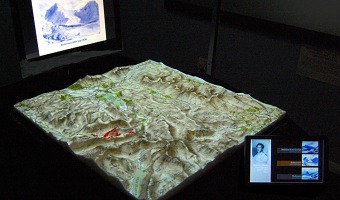
The PARM system is part of an ongoing research project at the University of Nottingham. A static physical relief model is augmented with top projection to display landscape details and to overlay with additional data visualizations. Sources: James Goulding's project page. Pristnall et al (2012). Projection Augmented Relief Models (PARM): Tangible Displays for Geographic Information.
2012 – Meshu.io: Data Jewellery you can Order Online
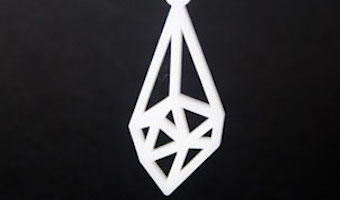
A company lets you enter in cities you've been to and generates a physical mesh to order as a necklace, earrings, or cufflinks. Source: http://meshu.io/
2012 – Thesis LEGO Board
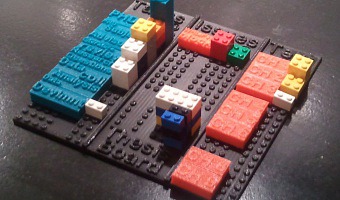
A design exploration of LEGO-based physical visualizations for project management by educational scientist Daniel K. Schneider. Sources: Daniel K. Schneider (2012) Lego-compatible thesis project board. Edutech Wiki. Daniel K. Schneider (2015) Poster presentation from the EIAH'15 conference (the paper, the actual poster)
2012 – All Possible Photons: Steel Feynman Diagrams
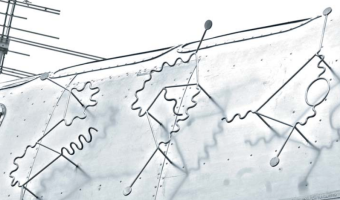
These are stainless steel sculptures of Feynman diagrams created by Edward Tufte. They are currently (opening Sep 12, 2012) exhibited at Edward Tufte's gallery in Chelsea. Source: Edward Tufte. All possible photons - The conceptual and cognitive art of feynman diagrams.
2012 – Emoto: Projection Augmented Heatmaps of Twitter Data
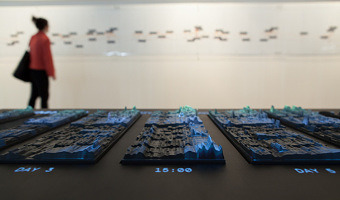
The core of the installation is a physical data sculpture consisting of 17 objects, each representing all Tweets we have collected during one day of the Olympics. Mapped onto this physical sculpture we have then projected individual heat maps for the most interesting themes we have identified while observing emoto during the Games. Users were able to navigate through these themes using an interactive controller and thus explore our archive. Source: Moritz Stefaner, Drew Hemment […]
2012 – Hypermatrix: Animated Matrix-Walls
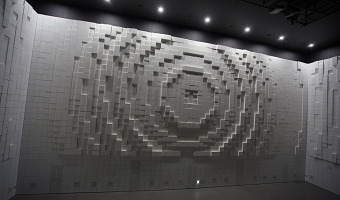
2012 Yeosu EXPO HYUNDAI MOTOR GROUP created by media artist group : Jonpasang. Hyper-Matrix is a kinetic landscape installation created for the Hyundai Motor Group Exhibition Pavilion in Korea, the 2012 Yeosu EXPO site. The installation consists of a specially made huge steel construction to support thousands of stepper motors that control 320x320mm cubes that project out of the internal facade of the building. The foam cubes are mounted to actuators that move them forward and back by the […]
2012 – General Motors' 3D LEGO Visualizations
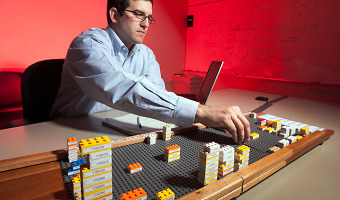
LEGOs help business executives log and explore data. Sources: Mark Wilson (2012) How GM Is Saving Cash Using Legos As A Data Viz Tool. The Daily Drive (2012) GM Plays with Legos (Video).
2013 – Solar Radiation Dowsing Rod
The Solar Radiation Dowsing Rod is a device created for a space observatory that allows visitors to point it towards the sky and feel, through light, vibration and sound, the level of radiation coming from that direction. The rod enables people to perceive data only during interaction (as data is not encoded in the shape of the artifact, but rather experienced through it). ”[…] crossmodal data-driven artefacts that represent live data streams using haptic-auditory feedback. The motivation for […]
2013 – Tidal Memory
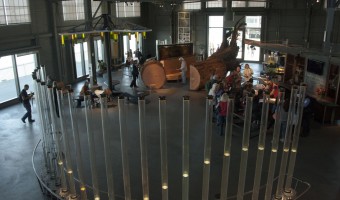
Tidal Memory displays the evolving daily tide at full scale. Receiving live data from the oldest tide station in the western hemisphere, twenty-four water-filled glass columns function as a tidal clock and 24-hour sculptural archive; recording a full day of hourly tide levels starting at midnight. 26’L x 2.5’W x 10’H - Glass, stainless steel, water, custom electronics. Tidal Memory is permanently exhibited at the Exploratorium, San Francisco, CA. Source: Charles Sowers (creator), […]
2013 – State Of The Union
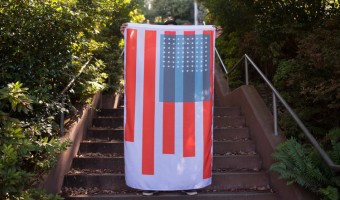
In this project, data related to the condition of American citizens is mapped to the number of stars, size of the bars, and size of the blue square on the American flag. The flag is presented as a dynamic entity that evolves over time: State of the Union takes a set of metrics and visually transforms elements on the flag to represent their current state1. Over years or decades, citizens would be able to perceive shifts in the country as we get wealthier, healthier and live better lives—or not. […]
2013 – Pop-Up Infographics
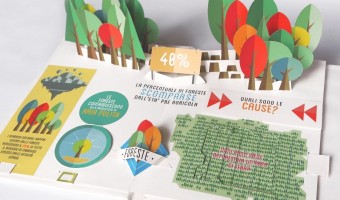
In 2013, Italian graphic designer Elena Turtas crafted four books that convey data about sustainability using pop-up and movable paper mechanisms. Source: Elena Turtas (2014) The Four Books of Visualising Sustainability.
2013 – Temperature Scarves and Afghans
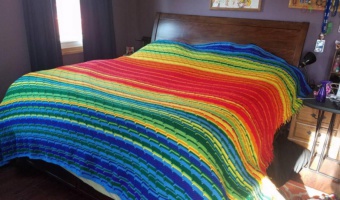
On January 2013, Kristen Cooper Nutbrown from British Columbia had the idea to create a temperature scarf by knitting one row every day using a color that encodes the temperature of the day. At the end of the year, the scarf visualized local temperature readings for the whole year. Soon after Kristen pitched her idea, Arlene Cline, also from British Columbia, started to create a temperature afghan (a blanket of knitted or crocheted wool). Temperature scarves and afghans became quite popular in […]
2013 – 3D Spherical Visualization with Aural Sonification
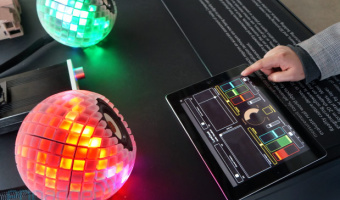
Evan Atherton created a LED-based 3D ball rendering visual effects from sound while diffusing the music through small cones of the device. This has been produced with a high-resolution 3D printer. LumiGeek developed an application to control the device, such as for playing music. Independently of that usage, the device could be envisioned to produce 3D spherical visualisation, a promising area according to the references below, both mathematically and interactively. Sources: Michael Gorman, 3D […]
2013 – Releases
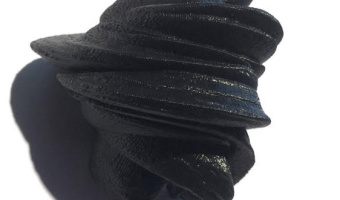
The New-York-based design agency HUSH crafted a piece of custom software that generates digital, three dimensional visual forms based on the unique timbres and tonalities of individual voices. They asked 100 people to share their feelings about the end of 2013, and the beginning of 2014, in the form of a spoken “release.” Using the forms generated by their software they then created and analog printed a limited run of 100 posters (right image) that they sent to the people that inspired them […]
2013 – Doug McCune's Physical Maps
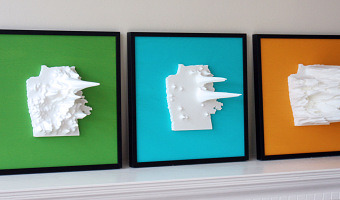
Doug McCune is a programmer turned artist, and he is obsessed with maps. In 2013, he got bored with screens and started to build physical thematic maps. He specializes in turning "horrible data" such as murders and natural disasters into beautiful objects. Above on the left is an artwork titled "stalagmite crime" that shows elevation maps of crime rates in San Francisco: narcotics-related crimes (green), prostitution (blue) and vehicle theft (orange). Sources: Doug McCune (2013) Physical Maps – […]
2013 – Walkable Age Pyramid
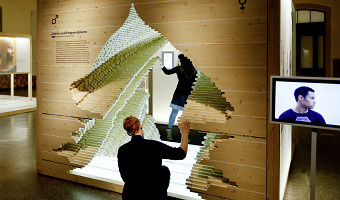
A walkable age pyramid of the German population. It was part of an exhibition on demographics by Atelier Brückner. The sculpture gives an impression how the distribution of age groups shifted between 1950 and 2010. For example, it shows how two world wars took out certain age groups and the lasting effect of the "Pillenknick" (the drop of birth rates due to the wide availability of "the pill"). Sources: Left photo: front view (time goes from the front to the back) picture taken by Michael […]
2013 – Population Density Emerging from Walls
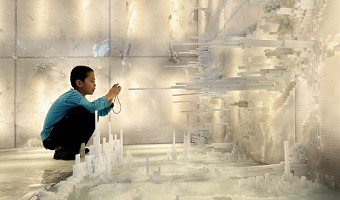
Two Yale architects created a room-sized physical visualization of world population density folded into itself: Hsiang and Mendis then turned that spatial visualization into a physical installation at the 2011 Chengdu Biennale in China. They modeled the population distribution of the entire world in a kind of inverted map that visitors could walk into, inside a 10-by-10-by-10 foot room, with North America on the ceiling, Asia on one wall, Africa on another (see also the little boy in the above […]
2013 – Programmable Matter Stars in a Movie
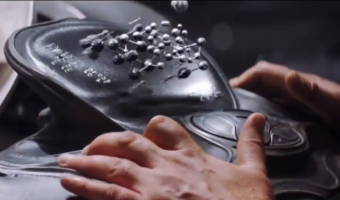
Programmable matter with levitation capabilities is a key visual element in the 2013 movie Man of Steel. The (slowed down) segment above reveals what appears to be a 3D node-link diagram. This display technology is employed by an advanced civilization on Krypton and is referred to as Liquid Geometry or Liquid Geo by the movie team. Visual effects supervisor Dan Lemmon explains that it consists in: a bunch of silver beads that are suspended through a magnetic field, and the machine is able to […]
2013 – Punchcard Economy: Data Knitting
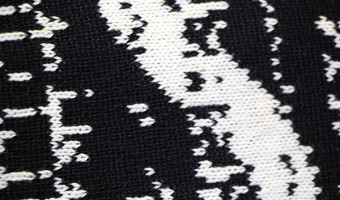
Punchcard Economy is a machine-knitted tapestry inspired by a 1856 banner advertising the Eight-hour day movement. The layer of visual noise shows today's departure from the eight-hour day philosophy. Working hours were collected from 116 participants, and each hour of work outside normal working hours was encoded as a color-inverted knit. A smaller version was made for the 2014 Data as Culture exhibition. Sources: Sam Meech (2013) Punchcard Economy. Explanation of the data encoding in this […]
2013 – Examined Life: Giving Shape to Activities
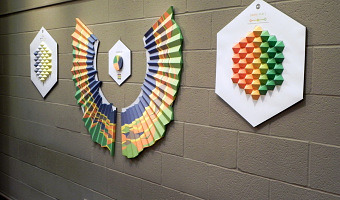
Designer Alex Getty logged his daily activities for 40 days and turned them into data sculptures that look like colored paper origami. Source: Alex Getty (2013) The Examined Life
2013 – Loci: 3D Printed Sculptures of Your Flights
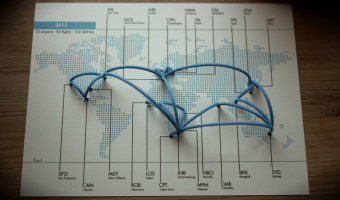
Loci by Andrew Spitz lets you easily create physical 3d arc diagrams based on your past flights, and may be soon be available through an iphone app. Source: Andrew Spitz (2013) Loci - 3D Printed Sculptures of Your Flights.
2013 – Turning Facebook Connections into Data Sculptures
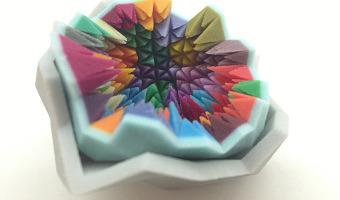
An application created by SOFTlab and The Creators Project lets you turn your facebook social network into a beautiful crystal-like data sculpture. Sources: Kree8tiv via iohannan's pinterest. See the page on shapeways.
2013 – A Snow Chart of Mobility in Science
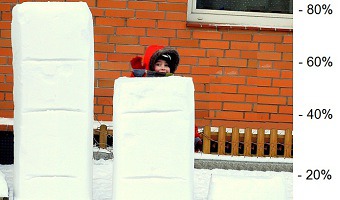
A barchar made out of snow. Each bar is a percent of scientist after PhD that changed their university after thesis defence. Source: Przemyslaw Biecek (2013) SmarterPoland.
2013 – 3D Social Networks
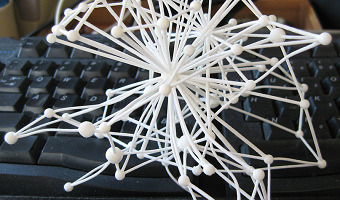
Jeff Hemsley from Syracuse University explains how to create solid models of social networks using the statistical package R and a 3D printer. 3D node-link diagrams have been explored for a while due to their potential benefits. One is that any node-link diagram can be laid out in 3D without any link crossing. Some studies have also shown that in some cases 3D node-link diagrams are easier to read than 2D ones. However, 3D visualizations are generally hard to navigate and to perceive on regular […]
2013 – Motion Structures: Videos as Space-Time Objects
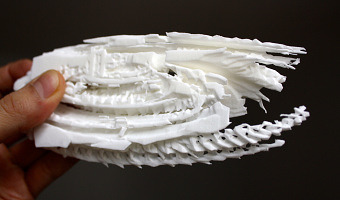
Everardo Reyes-Garcia from Université Paris 13 turns video sequences into space-time shapes that can be 3D printed. The sculpture above represents 5 seconds of the opening theme of Game of Thrones. Also see our entry on Peter Jansen's sculptures. Source: Everardo Reyes-Garcia (2013) Motion Structures.
2013 – Flip Books Rather Than Movies
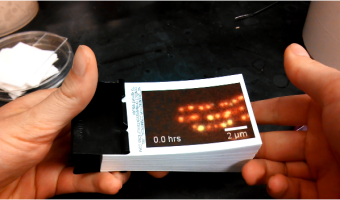
Cell biologist Jessica Polka discusses the benefits of making flip books to bring to scientific conferences: With the advent of smartphones and tablets, bringing movies to poster sessions is becoming more common than ever before. Even so, a low-tech flip book is still a lot more fun for visitors to use, and it's easier to pass around a large group. When the session's over, a flip book can live at your bench indefinitely, ready for visitors with no boot time. Source: Jessica Polka (2013) Hands […]
2013 – Data Sculpture of Chicken Inbreeding
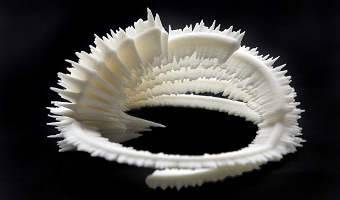
Ryo Sakai and Jan Aerts from the Bioinformatics/Data Visualization Lab at KULeuven created a data-driven sculpture representing inbreeding in a particular chicken. Each loop in the sculpture represents a chromosome. On the outside is a histogram of the heterozygosity of the DNA; the inside a histogram of the homozygosity in that region. These sculptures are part of the Cosmopolitan Chicken Project, and have been presented at the Art Biennale in Venice. Source: Text and images from Jan Aerts.
2013 – Pneumatic Charts
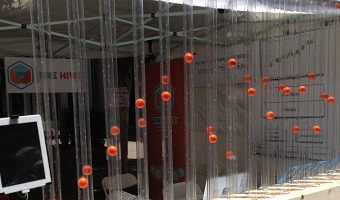
The Hive Big Data Think Tank at Palo Alto created a device for visualizing city data (power, waste, demographic, transportation) using blowers, microcontrollers and ping pongs balls. Sources: Lance Riedel, Christophe Briguet, Srinivas Doddi, Daniel Schwartz, Pashu Christensen, The Hive @City Camp Palo Alto for the National Day of Civic Hacking! Svetlana Sicular (2013) Now Open.
2013 – Very Pointy Elevation Map
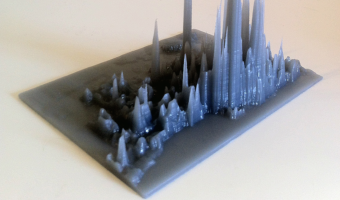
Toronto-based startup DataAppeal, which develops Web apps for 3D geo-spatial data visualization, created this very pointy stalagmite-looking elevation map of GTA Transit volume in Toronto. Sources: Andy Kirk (2013) 3D Printing Capabilility via DataAppeal Maps. Candice So (2013) Data visualizations go from flat to 3D.
2013 – Robot Arranges 8,000 Nails Into a Data Sculpture of the Wind
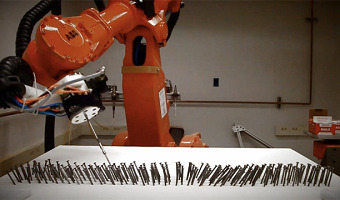
Student and interaction designer Charles Aweida used a foam board, a robot and lots of nails to build a physical visualization of a wind simulation. Sources: Charles Aweida (2013) An exploration in art + robotics representing wind through digital fabrication and the tangible. Via The Creator Project (2013) Data Sculpture Of The Wind Created Using A Robot And Lots Of Nails.
2013 – Behavioral Landscapes

A mixed team of artists and scientists at Pennsylvania State University devised a method to visualize human behavior, personality and emotions as 3D probability density functions. They then produced solid models using CNC milling. Sources: Studio|Lab (2013) Behavioral Landscapes. Nilam Ram, Michael Coccia, David Conroy, Amy Lorek, Brian Orland, Aaron Pincus, Martin Sliwinski, and Denis Gerstorf (2013) Behavioral Landscapes and Change in Behavioral Landscapes: A Multiple Time-Scale Density […]
2013 – Line Charts of Cortisol Levels
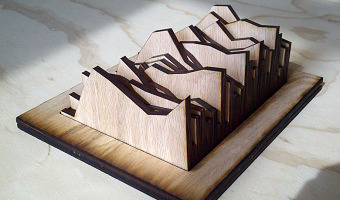
This data sculpture created by Nilam Ram from the Studio|Lab team at Penn State University shows the evolution of cortisol levels for 34 people after they experienced a stressful situation. Source: Nilam Ram (2013) Cortisol Data Sculpture.
2013 – Quickly Authoring Physical Visualizations
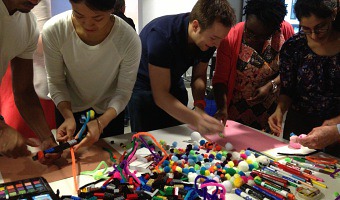
Rahul Bhargava animates workshops where he has participants quickly build physical visualizations using raw material. One of the workshop's goals is to develop people's visual literacy. Source: Rahul Bhargava (2013) Activities for Building Visual Literacy. datatherapy.wordpress.com.
2013 – SweatAtoms: Physical Activity Sculptures
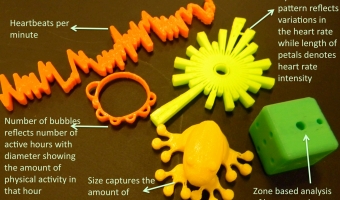
Rohit Ashok Khot is a PhD student at the Exertion Games Lab at RMIT University in Melbourne who studies how physical visualizations of self-logged physical activity data can enhance the experience of exercising and perhaps provide an incentive for exercising more. Sources: Khot et al (2013) SweatAtoms project page Khot et al (2014) Understanding Physical Activity through 3D Printed Material Artifacts
2013 – Network of the German Civil Code
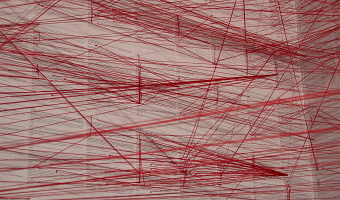
A room-filling visualization by Oliver Bieh-Zimmert (Visual Telling) that illustrates the patterns of references within the German civil code. Each red thread stands for a reference to another paragraph. Source: you can find more info and images on the visual telling website.
2013 – Season in Review: iPad + Physical Charts Show Baseball Stats
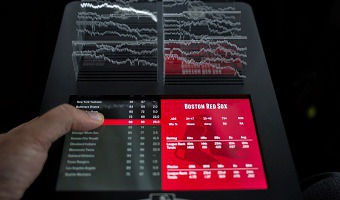
Baseball stats for an entire season created by Teehan+Lax labs as a combination of an interactive ipad app with an overlay of physical charts cut from acrylic. Depending on the current choice in the app, the edges of different charts get highlighted by the ipad. Source: Teehan+Lax labs & vimeo.
2013 – Layered 2D Plots
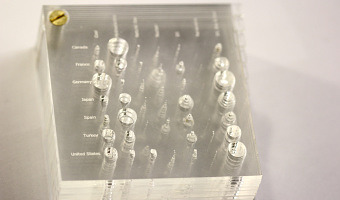
A series of stacked 2D plots showing changes in energy sources for different countries by PhD student Simon Stusak from University of Munich. All plots are cut from acrylic and hold together in one corner to facilitate alignment of the layers. The y-axis is mapped to countries, the x-axis to different energy sources, and the z-axis to time. Sources: Simon Stusak (2013) Physical Visualizations: An Exploration. Simon Stusak, Aurélien Tabard and Andreas Butz (2013) Can Physical Visualizations […]
2013 – NYC High School Dropouts
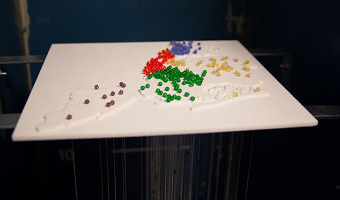
Ben Kauffman and Sam Brenner created this visualization as part of the ITP program at the NYU Tisch School of the Arts. It is a combination of a 3D-printed relief map of New York City with beads where each bead represents one school location. Each bead on top of the relief map is connected to a string below whose length indicates the number of students who dropped out of that school. Source: More pictures, a video and all the details on the project can be found on their project page.
2013 – Solid Statistics
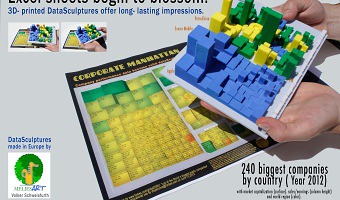
Left image: A 3D printed version of the "Forbes 2000" list showing the 240 largest companies, by Volker Schweisfurth. Market value is mapped to surface area, sales volume is mapped to volume, and the continent from which the company originates is mapped to color (America (blue), Europe (green), Asia (yellow)). The picture illustrates how a physical model of this 3D visualization gives a better impression of perspective than the printed perceptual cues in the original paper visualization. Right […]
2014 – 3D Interest Rate Surface
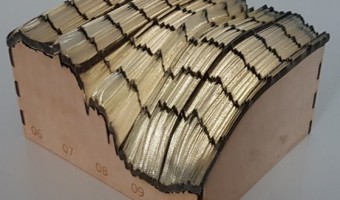
3D print of a yield curve surface with change in material to create grid lines; on matching laser cut box with light inside. Left axis is time (2006-2010), right axis is "term structure", i.e. interest rates for 1 month out to 120 months; height at any given point is the interest rate on that day for that time period. Data is from Bank of Canada, visualization and print is is by Richard Brath at Uncharted Software. Source: Richard Brath, 3D Canadian Yield Curve Surface 2006-2010 for 1 to 120 […]
2014 – Data Sculpture in the White House
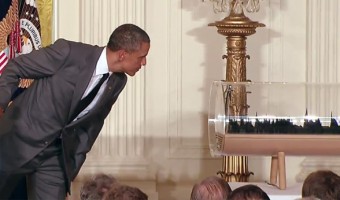
Gilles Azzaro, a French digital artist and fab lab co-founder, created a sound sculpture of Obama's 2013 State of the Union Address where Obama mentions 3D printing as the next revolution in manufacturing. Azzaro's sculpture was exhibited in the White House in 2014 during the inauguration of the first White House Maker Faire. The sculpture is interactive: a movement sensor activates the system and a laser beam scans the 3D recording to reveal the President’s speech. See this video for an […]
2014 – WeatherWindow
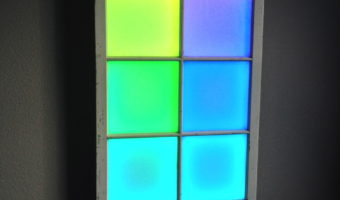
WeatherWindow – wall art that shows weather forecasts in a simple, ambient, and unobtrusive way. This old, wooden window is a decorative piece when it's off. Turn it on, and it becomes alive and connected to the Internet. Suddenly, this 8-paned window communicates to the world, fetches weather predictions, and lights up each pane with soothing colors communicating the weather outlook. Source: Tim Dye (2014) WeatherWindow – An IOT Art Piece.
2014 – Mount Saint Helens - Pre and Post Eruption
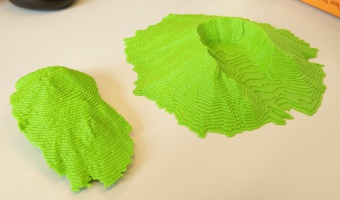
Mount Saint Helens is an active volcano located in the north-west of the United States. In an eruption in 1980, the upper section of the volcano was destroyed, reducing the peak's elevation from 2950 m to 2549 m. This two-part 3D printed model of Mount Saint Helens visualizes the dramatic change that occurred over a very short period of time. The digital data for 3D printing and the white and red model were prepared by Drew Thompson, the green model was printed by Jeppe Vestergaard. Sources: […]
2014 – Lego Senate
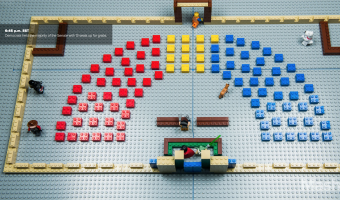
Built by Lance Ulanoff, this Lego representation tells the story of the 2014 US midterms. Red and blue Lego blocks represent the number of Democrat and Republican senate seats. The representation was updated over the evening of the election, as seats went to either Democratic or Republican candidates. Captions tell the story, indicating the time of seat wins and the names of senators. Source: Mashable, The Lego Senate: How the 2014 midterms played out, brick by brick
2014 – Rearrangeable Display of Ice Data
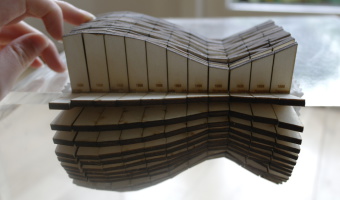
This 3d data visualization, created by Johannes Jacubasch and Judith Weda, shows sea ice levels from 1979 to 2012. The years are plotted on one axis and the months on the other axis, while the height of the wooden pieces shows the level of sea ice. This data visualization can be opened up at any year or month to view the data from up close. If you break the Y-axis it shows all the data from a particular year. If the X-axis is broken it shows ice levels of a particular month over all the years. […]
2014 – Sound Bites
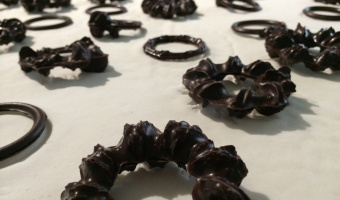
Sound Bites is the result of an experimental design practice. Four days of 24/7 ambient sound recordings resulted in 128 4-second intimate sound loops. Fast Fourier Transform frequency analysis and geometrical operations transformed time, frequency, and amplitude into X, Y and Z dimensions, forming 3D sonic shapes. These ‘disco donuts’ were 3D printed into 128 sound objects. Vacuum molded they formed the base to cast 128 unique chocolate objects. New rhythmic patterns were created, comprising […]
2014 – #Good vs. #Evil
A race is going on between two Twitter hashtags, materialized by two cars. The blue car represents #Good, the red car represents #Evil. Source: Patrick Keller (2014). I&IC Workshop #3 at ECAL: output > “Botcaves” / Networked Data Objects.
2014 – Made By Numbers
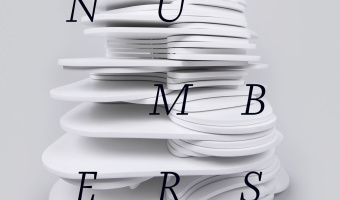
“Made By Numbers” represents a design methodology that translates data into form. The 5′ high sculpture is physical and interactive (sound, light). The form expresses the year-in-the-life of our agency, showing changes over time. The piece can also be “played” via a simple hand movement up or down, releasing 52 sonic chords and light effects – all tied to the data. Together, the sculpture (to be featured in an upcoming gallery show), a run of 250 limited posters featuring the sculpture, and the […]
2014 – x.pose: a Wearable Dynamic Data Sculpture
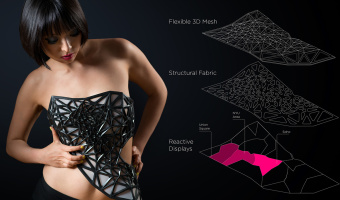
x.pose is a dynamic wearable data sculpture that makes the collection of the wearer's location data visible in real-time in the physical world. From the project webpage: x.pose is a wearable data-driven sculpture that exposes a person's skin as a real-time reflection of the data that the wearer is producing. In the physical realm we can deliberately control which portions our bodies are exposed to the world by covering it with clothing. In the digital realm, we have much less control of what […]
2014 – Silver Ring Shaped by DNA Profile
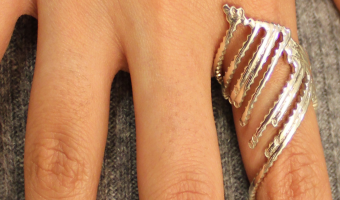
PhD student Alireza Rezaeian designed a silver ring whose texture and shape is uniquely determined by the wearer's DNA profile. His article explains how data is mapped to physical form in a way that balances between legibility and aesthetics. Right image: bracelet-sized prototype. Also see our other entries on data jewellery. Source: Rezaeian, Alireza & Donovan, Jared (2014) Design of a tangible data visualization.
2014 – Data Storytelling with LEGOs
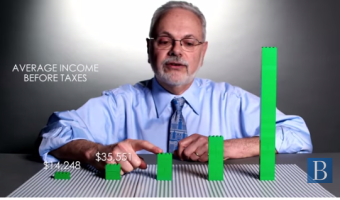
LEGO blocks are convenient tools to progressively construct a physical visualization while unfolding a story. In the same vein as Hans Rosling's educational stories on data, Brookings fellows use LEGO bricks to explain societal concerns such as how much the U.S. tax system helps shrink the gap between extreme social classes1 and the chances for economic success of Americans born at the bottom of the economic ladder 2. Sources: […]
2014 – District 5: Tube Charts Reveal Decline in Violence
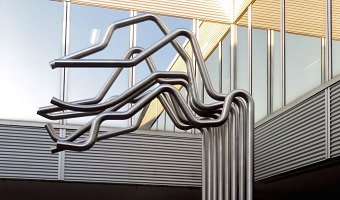
California-based artist Loren Madsen, a long-time data sculptor (see our 1995 entry and our interview with him), created an outdoor sculpture where steel tubes show falling crime rates across eight crime categories over 30 years. The sculpture stands in front of a police station and jail in Chicago City. Sources: Healther Schultz (2015) California Sculptor Completes Commissioned Piece. Image courtesy of Loren Madsen. Also see Steven Pinker's TED Talk on the topic.
2014 – DIY Bertin Matrix
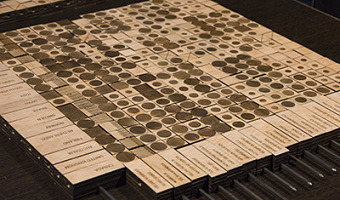
This wooden matrix is a large-scale replica of Jacques Bertin's reorderable physical matrices. It shows a subset of the World Value Survey, a series of questionnaires that assess people's moral values across countries and years. This physical visualization is interactive as row and columns can be manipulated, promoting engagement and collaboration. This 18x20 matrix was built by Mathieu Le Goc in the Fablab Digscope with Charles Perin and Romain Di Vozzo, on the occasion of the 25th birthday of […]
2014 – Physical Visual Sedimentation
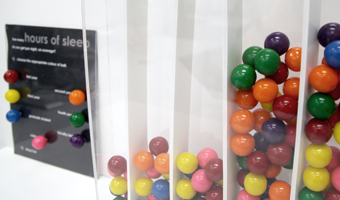
This visualization created by Jennifer Payne and inspired by Samuel Huron's visual sedimentation was created from gumballs, an acrylic (plexiglass) box and adjustable foamcore bin dividers. Huron's work is inspired by the physical process of sedimentation. The above figures illustrate a participatory representation of hours of sleep for a university population, with different colours of gumballs representing different groups present on a university campus (i.e. blue gumballs for graduate […]
2014 – Drip-By-Tweet: Each Vote is a Drop
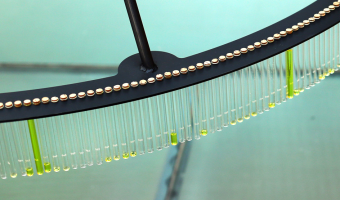
Team of developers Domestic Data Streamers created a real-time physical visualization of votes for a graphic design contest. A person can vote for a specific piece by sending a tweet, after which the machine releases a drop of yellow liquid and sends it to the corresponding test tube. Source: Domestic Data Streamers.
2014 – Data Strings: Physical Parallel Coordinates
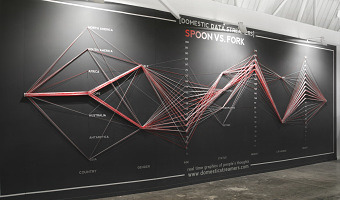
During the SWAB International Contemporary Art Fair, the group of developers Domestic Data Streamers had the audience create a physical parallel coordinates visualization based on their demographic profile (social status, weight, etc.) and by answering a meaningless question on whether they choose a spoon or a fork. Source: Domestic Data Streamers (2014) Data Strings. They have a range of other interesting physical visualization projects on their Web page.
2014 – Data Clothing: Dresses Show Air Pollution
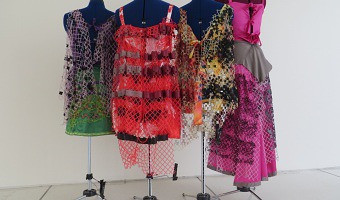
Laura Perovich explored the concept of data-driven clothes as part of her Master thesis at the MIT Media Lab. The fashion dresses above show the concentrations of 100 chemical contaminants measured in the air of a particular household (left image). Chemicals are mapped to small squares and relative concentration is mapped to square size. Squares are repeated to create lace patterns (right image shows the concentration of several factory-related pollutants). In her thesis Laura Perovich […]
2014 – TiltWatch: Physical Tilt Indicator For Shipping Goods
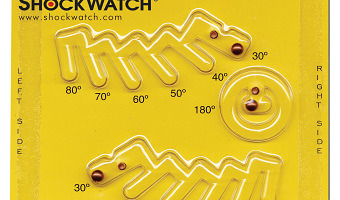
This ShockWatch tilt indicator can be attached to packages which must remain upright during transportation. If the packet is tilted to either side, the little balls move into the next chamber. The recipient can then later check the degree of tilting the packet experienced during transportation. The upper row indicates tilting to the left, the lower to the right. The ball in the round indicator moves in to the outer torus when the packet is turned over 180°. Source: ShockWatch, TiltWatch Plus […]
2014 – Cosmos: Carbon Exchange Captured in a Wooden Ball
Artist duo Ruth Jarman and Joe Gerhardt created this two-meter spherical wooden sculpture located in a forest in England, and representing the take up and loss of carbon dioxide from the forest trees across one year. Watching the video, I was somehow expecting this sphere to roll at some point, but it did not happen. Source: Semiconductor (2014) Cosmos.
2014 – Dynamic Physical Charts Display Community Data
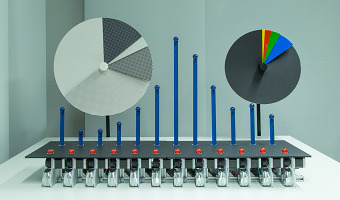
David Sweeney from Microsoft Research designed these beautiful, mechanically driven, physical charts to communicate data to people living or working on Tenison Road in Cambridge, UK. The charts are part of a research project to explore what is the general public’s understanding of data and how it can be used to improve the life at street level - be that, better access to services, improving social relationships, better engaging with local governance, etc. Beyond making data more eye catching […]
2014 – Abyss Table - Scale Model of Deep Sea as Furniture
This table created by the furniture design company Duffy London is a geological cross-section of the sea shown with layered wood and glass sheets. Designer Christopher Duffy got the idea while visiting a glass factory and noticing that glass sheets darken as more layers as added, as does the sea. You can have this piece of furniture at home for £9,800. Sources: Duffy London (2014) Abyss Table. Nina Azzarello (2014) Duffy London layers the abyss table to look like ocean depths.
2014 – Data Crystals: Conglomerated World Stats
During his residency at Autodesk, artist Scott Kildall created crystal-looking data sculptures by turning world data such as city populations into small cubes laid out on an Earth globe, then running a force-directed algorithm that conglomerates them into a monolithic structure that can be 3D-printed. The image above shows the 2500 nuclear detonations in recorded history, two of which (the black dots) are the bombs dropped at Hiroshima and Nagasaki, the only ones used as weapons. Source: Scott […]
2014 – 888,246 Ceramic Poppies to Commemorate Fallen Soldiers in WW1
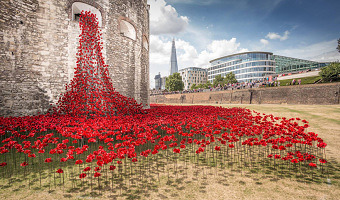
Don't miss the major art installation Blood Swept Lands and Seas of Red at the Tower of London, marking one hundred years since the first full day of Britain's involvement in the First World War. Created by ceramic artist Paul Cummins, with setting by stage designer Tom Piper, 888,246 ceramic poppies will progressively fill the Tower's famous moat over the summer. Each poppy represents a British military fatality during the war. The poppies will encircle the iconic landmark, creating not only a […]
2014 – Pan-Anthem: Visualize Statistics Using National Anthems
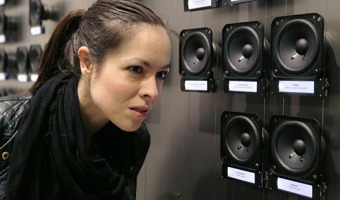
"Pan-Anthem" is an interactive sound installation where the national anthem of every country in the World plays back on a movable speaker that is magnetically attached to a large wall. The speakers are precisely arranged to visualize national statistics: population, GDP, area, number of women in parliament, GINI, year of independence, HDI and so on. For example, when the work is configured to show military spending per capita, on the far left of the wall the public can hear the anthems of […]
2014 – Building Visualizations with Tokens
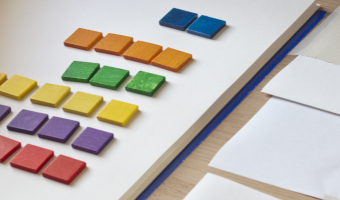
Samuel Huron and his collaborators show how anyone can build their own visualizations by assembling physical tokens. Sources: Samuel Huron, Sheelagh Carpendale, Alice Thudt, Anthony Tang, Michael Mauerer (2014) Constructive Visualization (Web Page) Samuel Huron, Yvonne Jansen and Sheelagh Carpendale (2014) Constructing Visual Representations: Investigating the Use of Tangible Tokens (Web page)
2014 – Blaue Blumen: Handcrafted Offline Data Visualization of Population Density
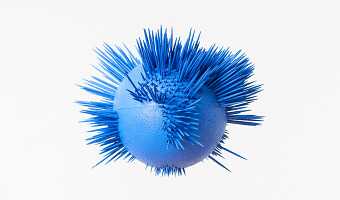
Physical visualization of the population density of the world. Handcrafted with toothpicks and a styrofoam ball. Based on data taken from this map. Source: Ewa Tuteja, (http://tuteja.info/blaueblumen/)
2014 – Light Painting Acceleration
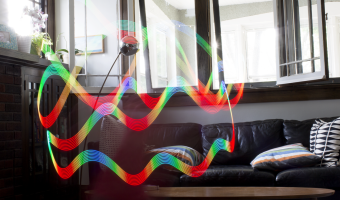
By mapping the output of a motion sensor to the hue of an LED strip (red for +2 G's along the Z-axis, and blue for -2) we can visualize the acceleration changes at the peaks and valleys, as the sensor is waved around. Source: Jake Ingman (@jingman), Data Painting
2014 – Water Works: Maps of the San Francisco Water Infrastructure
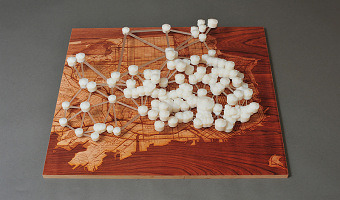
“Water Works” is a 3D data visualization and mapping of the water infrastructure of San Francisco. These consist of three large-scale 3D-printed sculptures, each generated by custom C++ code. The concept behind the project is to make visible a small portion of an invisible network of pipes underneath our feet. The three physical data visualizations are: "San Francisco Cisterns", “Imaginary Drinking Hydrants” and "Sewer Works". "Sewer Works" uses 60,000 data points from San Francisco sewers and […]
2014 – Sphere Packing: Visualize Composers' Total Musical Production
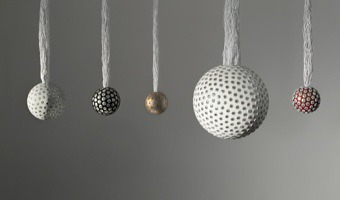
"Sphere Packing" is a series of 3D-printed spheres designed to concentrate the entire musical production of a composer in a single dense multi-channel device. The size of each sphere is directly proportional to how prolific the composer was, for example the sphere for Johann Sebastian Bach has 48 cm diameter and holds 1100 loudspeakers playing simultaneously Bach's 1100 different compositions, while the sphere for Hildegaard Von Bingen only has 11 cm diameter and 69 loudspeakers. The project […]
2014 – People Wood: Data Sculpture of Questionnaire Data
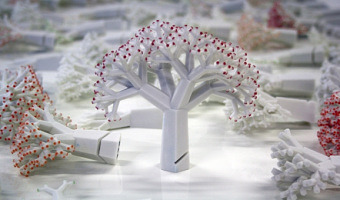
Manor House Development Trust, a charitable social enterprise centred in Hackney, commissioned Something & Son to create a sculpture to take pride of place in the new Redmond Community Centre at Woodbury Down in North-East Hackney. Something & Son approached Inition for help creating a crowd-sourced data sculpture featuring a forest of over 400 3D-printed trees, each corresponding to an individual’s answers to an online questionnaire. Source: Something & Son with Inition. People […]
2015 – Quantum of Peace: Numerical Display Made with Bullets
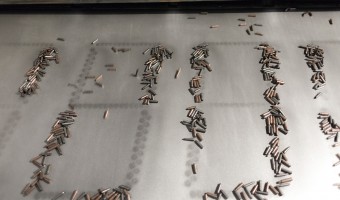
"Quantum of Peace" by Miara Pokoju is an interactive installation and kinetic infosculpture commissioned by the Warsaw Rising Museum for the celebrations of the 71st anniversary of Warsaw Rising and the 70th anniversary of the end of WWII in Europe. The installation utilised thousands of bullet shells, 70 pneumatic actuators, hundreds of neodimium magnets and 5 industrial-grade transmission belts to present series of numbers conveying WWII and Warsaw Rising facts. Source: […]
2015 – Rearrangeable Physical Map
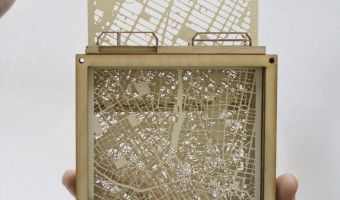
Andrew Chard, an award-winning graduate student in architecture at Oxford Brookes, created this multi-layered wooden map where layers can be individually pulled out and rearranged. According to the object's legend, this map shows different cities on top of each other so that people can compare their structure. There is not much information available online but Andrew explained to us by e-mail: It was so long ago that I wouldn’t be able to remember the scale or locations I am afraid. Apart from […]
2015 – Wage Islands
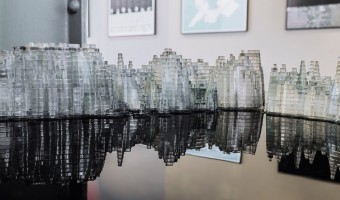
The "Wage Islands" installation by Ekene Ijeoma makes clever use of water as a data query device. Wage Islands is an interactive installation which submerges a topographic map of NYC underwater to visualize where low-wage workers can afford to rent. Sources: Ekene Ijeoma: Wage Islands Huffington Post: Dazzling Interactive 3-D Artwork Visualizes The Tragic Affordable Housing Crisis In New York City Creators: Turning New York's Salary Gap into an Interactive Sculpture Design Boom: Wage islands […]
2015 – Life in Clay: Sharing Memories through Data Pottery
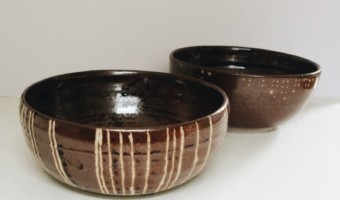
Alice Thudt, a PhD student in Computational Media Design, crafts pieces of pottery that embody data about moments she shared with her loved ones. Left image (2015): cereal bowls showing Skype-call history between Alice and her parents. On the front bowl, each line represents a day where they skyped. On the other bowl, each dot represents 10 min of call time. She offered a bowl as a present to her parents and kept the other one as a reminder to stay in touch every time she has breakfast. Middle […]
2015 – U.S. Unemployment Rate 1948-2015
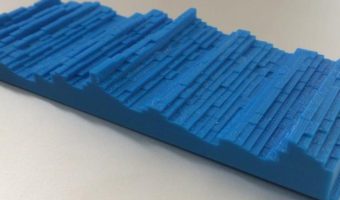
Visual journalist Jon Keegan created this quick chart using U.S. unemployment rate starting from January 1948 (the first year that the U.S. started to record the number) through the end October 2015. The long axis represents years from 1948-2015, and each column is made of of 12 chips, each representing one month's unemployment rate figure. The height of each chip represents the rate for that month. One can see a dramatic cliff start to rise up in the fall of 2008, as the global economic […]
2015 – Summer in the City
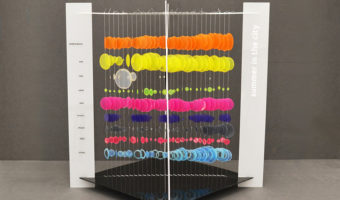
The visualization explores the direct influence of weather and traffic volume on air pollution, comparing data of a 4-week period during summer 2015 in Lugano (Switzerland). Different colored laser cut plates fixed on wires represent daily data. As the wires are diagonally mounted on the structure, looking from different sides, they evidence either daily data or the evolution of the parameters. Source: Carola Bartsch (2015), Summer in the city
2015 – Dataseeds: Flying Data
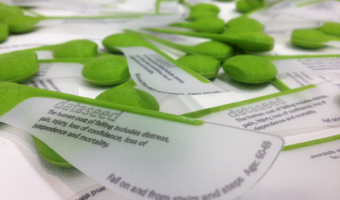
The dataseeds are a translation of data on ‘falls on and from stairs and steps, aged 50-89’. The data drives the surface area of the wing of the dataseed, which dictates the spin and falling speed of the data-object©. Source: Nick Dulake and Ian Gwilt (2015) Dataseeds - flying data
2015 – Participatory Representation of Happiness
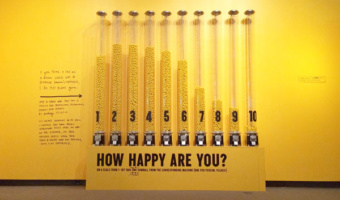
This 2015 physicalization was part of designer Stefan Sagmeister's exhibit on happiness. It contains a participatory representation of exhibition viewer's happiness, remiscent of Hans Haacke's MOMA poll (1970) and Lucy Kimball's participatory chart (2006). The units which make up the representation are gumballs, like Jennifer Payne's participatory representation (2014). Sources: Stefan Sagmeister (2015) The Happy Show Myles Constable (2015) The Happy Show asked "How Happy Are You? The results […]
2015 – Jller: A Robot Rearranges Pebbles by Geologic Age
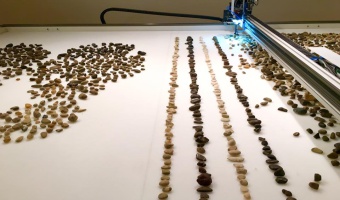
Jller is a machine created by German artist Benjamin Maus and Czech artist Prokop Bartoníček that sorts pebbles from the German river Jller by their geologic age. To do this, Jller first analyzes an image of the stone it selects, extracting information like dominant color, color composition, lines, layers, patterns, grain, and surface texture. The machine then places the stones in alignment of age and type by sucking them into an industrial vacuum gripper and dropping them in the correct […]
2015 – Create your own Sound Sculpture
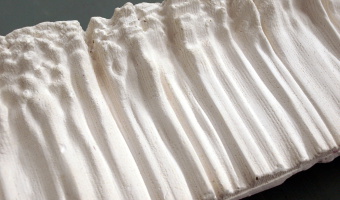
This Rhinoscript/Grasshopper procedure creates a 3D printing of an audio file by translating the waves into 3D curves instead of displaying them in 2D, thus elabling the user to "feel" the sound. Also see our other entries on sound. Source: 3D Sound representation
2015 – Inequalities Quipu
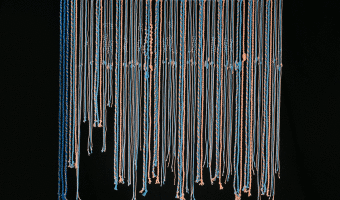
This project is about the revival of the ancient Incan Quipu. This project is about a comparison of well-being in Latin America and top leading countries in Scandinavia as assessed by the OECD Better Life Index. It shows the inequalities between those two cultures as well as between men and women visualised with the help of the Incan recording devise - the quipu. Source: Ewa Tuteja, http://tuteja.info/inequalities-quipu/
2015 – Lake Brite: Ecological Data on a LED Cube
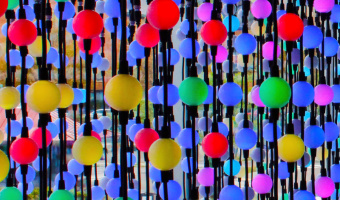
Lake Brite is a data visualization project which allows the public to learn about Lake Champlain through a display of 7,500 LED’s. From temperature statistics to animal life, Lake Brite will encourage interaction and data literacy, connecting everyone around the common cause of Lake Champlain health. Sources: ECHO, Leahy Center for Lake Champlain; www.echovt.org/lakebrite
2015 – Passim: Visual Reconceptualisation of Spatial Theories
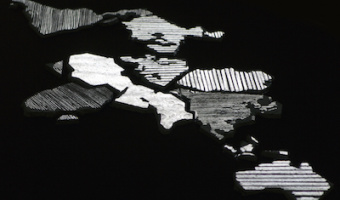
The master thesis of Paul Heinicker, Passim, visually reflects the humanistic discourse about space. The research of spatial theory led to four major notions how to think space from a sociopolitical perspective. The installation explores the relationship of these four spatial notions by projecting visualisations of geopolitical data from the Heidelberg Institute for International Conflict Research onto the physical sculpture. Eventually, different world-views are created, that show how notions […]
2015 – U.S. Cost of Political Campaigns
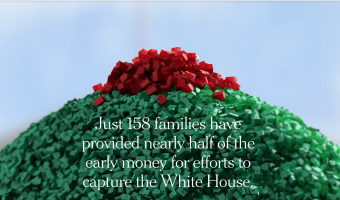
The New York Times has used stacks of Monopoly plastic hotels to explain what the cost of the U.S. political campains means in terms of households. Though closer to concrete scales than it is to data visualization (that usually presents data in a more structured manner), this representation made of physical pieces from the famous board game makes the message particularly compelling. According to the New York Times, Just 158 families have provided nearly half of the early money for efforts to […]
2015 – Canadian Federal Election Explained with LEGOs
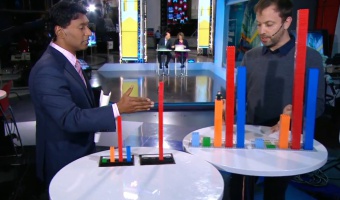
On Canadian national news, Toronto-based artist and organiser Dave Meslin used LEGO bricks to illustrate the results of the 2015 federal election. He shows election results based on a first-past-the-post system, and compares them to a representation illustrating what results would look like if based on proportional representation. Source: CBC News (2015) If Canada had proportional representation: Dave Meslin shows with Lego.
2015 – Kohei Nakajima's Computing Tentacle
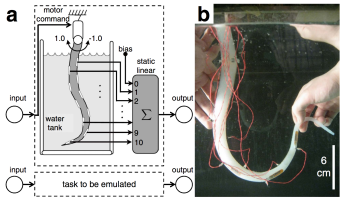
Kohei Nakajima and his colleagues argue that soft bodies are hard to control from a robotics perspective, but precisely because of their complex dynamics they can be used as information processing devices for solving hard computational problems. In a recent article they explain how they send inputs to a motor that wiggles a silicon tentacle, and read the system's output by sensing the arm's posture. I'm not entirely sure what's being calculated exactly, but the idea seems quite compelling. Also […]
2015 – Dan Gilbert's TV Ads
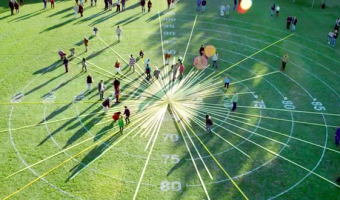
The famous psychology professor Dan Gilbert made a series of TV commercials for the insurance company Prudential, together with Ray Del Savio from Droga5 and Colin McConnell from Prudential. These TV commercials make a clever use of participatory physical visualizations to demonstrate and explain human biases in financial planning. Ribbon Experiment (left image): Dan Gilbert asks bystanders to estimate how much money they will need to retire. He then gives each of them a ribbon and asks them to […]
2015 – Beeswax Maps Crafted by Bees
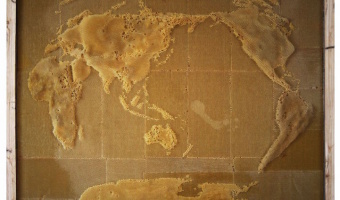
Artist Ren Ri uses beeswax as his medium for making geographical maps and a bee colony as the builder. This original project results in beautiful data visualizations collaboratively crafted by a human and a bee colony! Here's how it works: Because a colony will follow the queen bee and build a hive based on the pheromones that she releases, Ri is able to move the queen such that the others in the colony act accordingly. More details on the project can be found on the Flowing Data blog [1]: The […]
2015 – 3D Paper Model of Shrinking Aral Sea
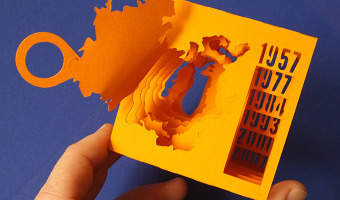
The Aral Sea in Uzbekistan, formerly one of the largest lakes in the world, has been drying up since the 1960s and is currently 10% its original size. Peter Vojtek made a 3-D paper model that shows the shrinkage — from 1957 on top, down to 2007. Each layer represents the surface outline during the corresponding year on the right. Vojtek also provides his paper template in case you want to fashion your own box. Sources: FlowingData Peter Vojtek (2015) 3D Paper Model of Shrinking Aral Sea.
2015 – Multivariate Beer
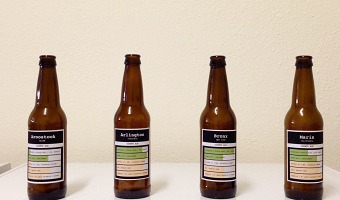
Nathan Yau from flowingdata brewed four different types of beer based on county demographics. For example, he mapped population density to the total amount of hops, and race percentages to the type of hops used. He describes the process in detail on his web site, with R source code. The idea is reminiscent of Rohit Khot's TastyBeats shown at the CHI '14 conference, an installation that creates personalized energy drinks based on heart beat data. Also see our entry on data cuisine. Sources: […]
2015 – London Eye Chart: A 135m Tall Donut Chart
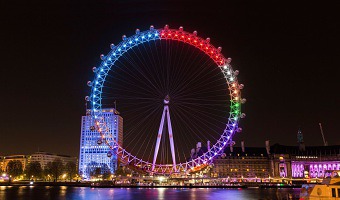
One week before the UK general election of 2015, the design studio Bompas & Parr and Facebook turned the Ferris wheel of London into a giant donut chart of the political parties most discussed on Facebook. Blue stands for the Conservative Party and red stands for the Labour Party. Learn more. Sources: Bompas & Parr (2015) London Eye Chart. Photo by Bompas & Parr.
2015 – Physical Weather Display
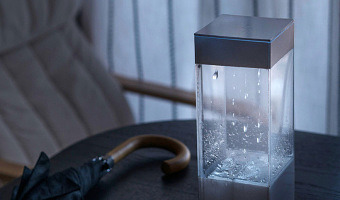
Japanese Software engineer Ken Kawamoto invented the Tempescope, a device that displays weather forecasts or current weather physically. The Tempescope physically simulates weather forecasts via a wireless connection from a computer or a smartphone in real-time in order to get a better idea of what the actual weather is outside. Raining is simulated by water dripping down the box, temperature is represented by color-chaning LEDs and cloudiness is conveyed by a mist diffuser. Source: Dovas […]
2015 – Paper Cut Terrain Models
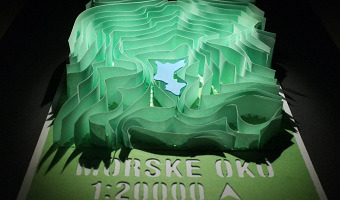
Paper models of terrain/landscape. Mapquest Elevation API is used to gather the elevation isolines and the paper layers are cut on a blade cutter machine. Source: Peter's DIY Blog
2015 – Interregional Merchandise Trade
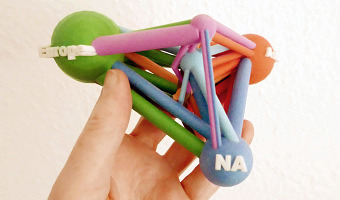
Trade data often show a network of money flows. Spreadsheets of such data are difficult to remember and hardly find their way to the long-term memory. The chosen intra- and intraregional WTO data of 2012 have been modeled and printed as a 3D data sculpture. It offers some fresh insights on flows, intraregional trade sizes, has some haptic quality and can be put on the table to accompany presentations and debates. Source: Volker Schweisfurth / MeliesArt (2015) Trade Data Materialized.
2015 – Sicherheit: Switzerland's Money in Bar Charts
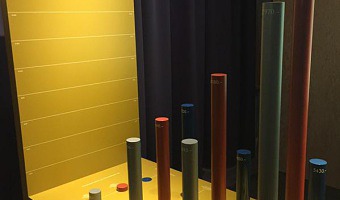
This physical bar chart titled Sicherheit (Security) is part of the exhibition Geld – Jenseits von Gut und Böse (Money - Beyond Good and Evil) at the Stapferhaus in Lenzburg, Switzerland. It shows where Switzerland has its money from, where it spends it and how high Switzerland's debt is. Sources: Photo and most of the text above by Peter Gassner. Author of the piece currently unknown, as several studios have been involved in the making of the exhibition.
2015 – Touching Air: Necklace Shows Air Pollution
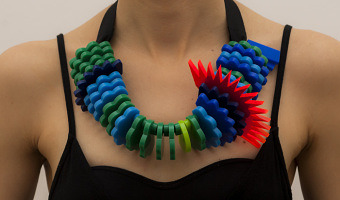
This necklace made by Stefanie Posavec and Miriam Quick shows one week of air quality data measured in the city of Sheffield. Each segment is a period of 6 hours, and its appearance conveys the concentration of particulate matter during that period of time. A low concentration yields a small, round, green segment. A high concentration yields a large, spiky, red segment. Also see our entry 2014 - Data Clothing: Dresses Show Air Pollution. Sources: Stefanie Posavec (2015) Air Transformed: Better […]
2015 – Solid Model of Stellar Winds
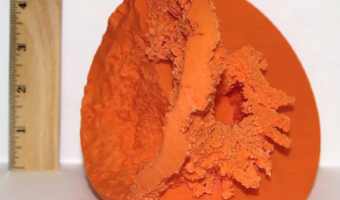
Scientists keep using solid models to help them better understand complex 3D data (here, an astrophysical simulation): They say this provides even more insight into what’s going on. “The ability to hold and inspect the 3-D printed models provides a new perspective on the WWIR’s geometry and an improved sense of the scale of the different structures,” they say. In particular, they say the model allows them to appreciate just how large the shockwave is compared to the stars and the distance […]
2015 – Data Necklace of Good Night SMS
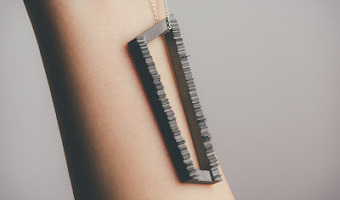
Paul Heinicker, a master student in interaction design at the University of Applied Sciences Potsdam, created a data-driven necklace representing a long-distance relationship by sent "good night"-messages from him to his girlfriend. While visualising two years of message history, two diagonal opposing points of the rectangle constitute the starting points for both years. The ongoing sides in each case are coded to the days with and without good night SMS. In detail, the plain horizontal sides […]
2015 – Physical Customer Satisfaction Survey
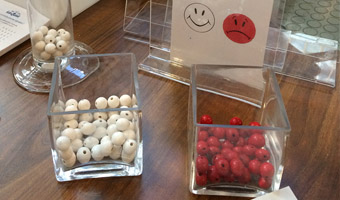
Participatory physical bar charts at the exit of the Antell cafeteria at the University of Helsinki. White beads represent statisfied customers, red beads are unsatisfied ones. Also see similar contraptions by Hans Haacke (1970), Lucy Kimbell (2006), and Jennifer Payne (2014). Source: Antell. Photo by Luana Micallef.
2016 – Woven Chronicles
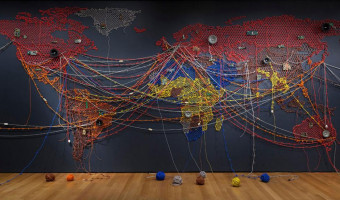
Woven Chronicle is a cartographic wall drawing that, in the artist’s words, represents “the global flows and movements of travelers, migrants, and labor.” Kallat uses electrical wires—some of which are twisted to resemble barbed wire—to create the lines, which are based on her meticulous research of transnational flows. Wire is an evocative and contradictory material: it operates as both a conduit of electricity, used to connect people across vast distances, and as a weaponized obstacle, such […]
2016 – Accomplishments
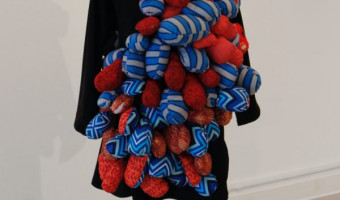
Accomplishments is an exploration of personal data tracking, wearable art, wearable technology, social media, and data physicalization. Each day accomplishments were tracked, first on paper then by sewing spheroid masses onto a dress worn for four months. By hand sewing each accomplishment onto this dress, they became a part of the wearer's physical presence and identity. The work juxtaposes the immediateness of social media posts, and the separate identity we create for ourselves online which […]
2016 – Topographic Jewelry
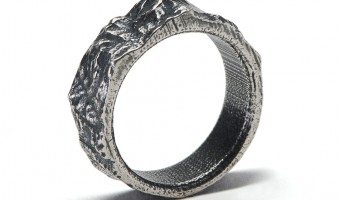
Jewelry made with data from the US Geological Survey. Source: Courtney Reckord.
2016 – Thoughtforms: 3D-Printed Thoughts
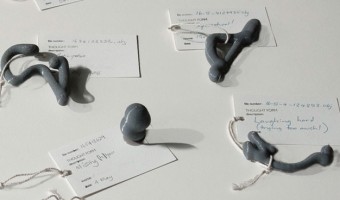
Kellyann Geurts and In Dae Hwang, Monash University, give physical shape to thoughts by turning EEG data into solid objects. During three public events at Melbourne in 2016, she placed a mobile EEG device on volunteers and asked them to think of a memory or emotion of their choice. Their EEG output was translated in real time into a 3D shape they could see on a computer screen. Participants could then press a button to pause the shape and send it to a 3D printer. They were then invited to write […]
2016 – Walkable Collaboration Network
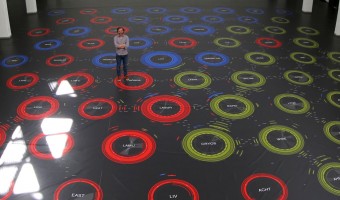
Designer Dario Rodighiero created a large (15x15m) walkable visualization showing scientific relationships between researchers and laboratories at the ENAC school of EPFL in Switzerland. The visualization was printed on tarpaulin, a heavy covering employed for trucks. Two years before, Dario created a coauthorship network visualization for the Digital Humanities 2014 conference. He initially considered showing a large poster, but since sticking posters was not allowed at the conference center, […]
2016 – Cairn: Situated Data Collection and Analysis for Fab Labs
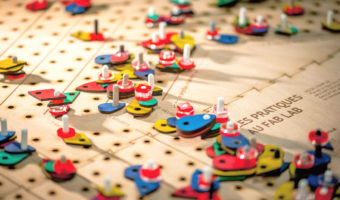
Designed within the community of practice of a French FabLab, Cairn aims at understanding the variety of practices within FabLabs. Cairn explores tangible alternatives to questionnaires and other traditional evaluation techniques, and stresses aesthetic and affective dimensions to create an engaging experience. It invites Fablab visitors to reflect on their practices by materializing their activities using small colored woodentiles. Interacting individually with Cairn, people contribute to […]
2016 – Dataponics: Human-Vegetal Play

“Dataponics: Human-Vegetal Play” maps human physical activity measured by a Fitbit to the amount of light and water fed to a potted plant. Also, the system measures the moisture in the growing hydroponic medium (in this case, expanded clay) that surrounds the plant’s roots, and plays different internet radio stations accordingly. Source: Cercos, R., Nash, A., Yuille, J., Goddard, W. (2016) Coupling quantified bodies: affective possibilities of self-quantification beyond the self
2016 – Housing Prices Ripping San Francisco Apart
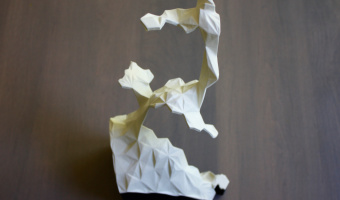
This data sculpture depicts a map of housing prices in San Francisco. It’s a map of the city, torn at the seams. The height of each area represents the average price per square foot for recent home sales. Where neighboring areas are close in value they are connected, but if neighboring areas are too far from each other I allow them to split, tearing the city along its most severe economic divides. Also see our entry 2013 – Doug McCune’s Physical Maps. Sources: Doug McCune (2016) Sculpture of […]
2016 – Actuated Prism Map of Italy
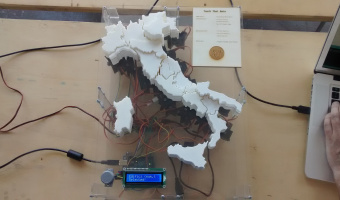
This actuated prism map was created by Alessandro Masserdotti in the OpenDot Fablab in Milan, Italy, for the SOD16 meeting and invites people explicitly to Touch That Data. OpenDot Fablab (Milan) project with Arduino and 3D printing visualizes regional statistics changing the height of each region. In the picture there's the building count from the regional extracts. Sources: Open streetmap wiki, 2016. Video from a demo at OSMIT 2016.
2016 – FizViz: A Wall-Mounted Data Gauge
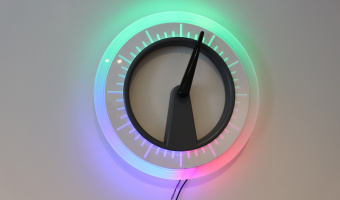
Maker project by iot design shop of a clock-like physical visualization device. "The concept is that you'd hang a set of FizViz widgets in your office, workshop, or wherever you want to watch and share data that matters" Source: FizViz - Large Scale Physical Visualizations for your Stats! (video)
2016 – Motus Forma: People's Motions in a Shared Space
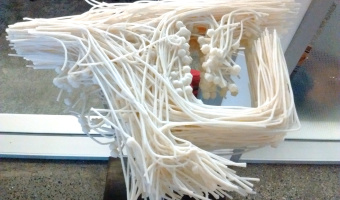
Motus Forma is a data sculpture by Brian Allen and Stephanie Smith that aggregates 10 hours of people movements in the lobby space at Pier 9. The 1300+ motion paths are piled up according to time. Also see our other entries on temporal data. Sources: Autodesk (2016) Motus Forma Instructables (2016) Motus Forma Photo by Pierre Dragicevic
2016 – Turning Weight into Scale
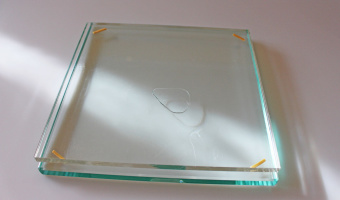
This simple prop or analog interface by designer Chang Hee Lee is part of an art project titled "Three Studies of Synaesthesia", and studies how weight and scale could be associated with each other. The liquid between the two glass sheets immediately expands its surface according to the pressure it receives on the glass surface. The heavier the weight or pressure, the more the surface expands. Sources: via Chang Hee Lee website
2016 – Central Park NYC Temperatures
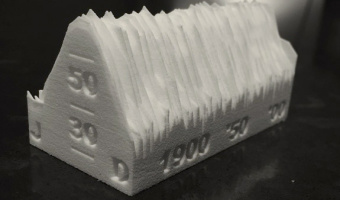
Seasonal plot of the monthly average temperature in Central Park NYC since 1869. The long axis is mapped to years, the other axis is mapped to months from January to December. Data sourced from the National Weather Service. Source: RoundTableRdDesign on shapeways.
2016 – Podium: Physical Competition Monitor
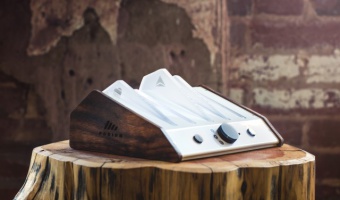
Podium is an internet connected device that uses real-time social data to show comparative rankings of a brand’s performance versus their competitors. Developed in a partnership between iSketchLab and TrackMaven, Podium is a physical device that pulls Facebook, Instagram, and Twitter data from airline brands and offers an snapshot overview of the brands' performance on social media. Sources: Podium
2017 – CNC-Milled Wood Visualization of a Studio's Energy Usage
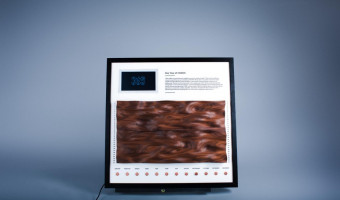
"How might we make data more tangible, persuasive, and persistent?" This was the challenge I posed to myself during my internship at IDEO Chicago. My answer is an artistic exploration made tangible through different design disciplines: data design, industrial design, and electrical engineering. The data for this exploration is the energy usage of the Chicago studio during 2015. An algorithm created with Grasshopper, a visual programming language, turned unfiltered data into a three-dimensional […]
2017 – Fabricating Physical Globe Visualizations
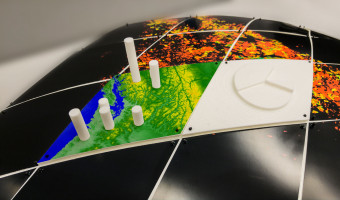
Geospatial datasets are too complex to easily visualize and understand on a computer screen. Combining digital fabrication with a discrete global grid system (DGGS) can produce physical models of the Earth for visualizing multiresolution geospatial datasets. This proposed approach includes a mechanism for attaching a set of 3D printed segments to produce a scalable model of the Earth. Two models have been produced that support the attachment of different datasets both in 2D and 3D format. Also […]
2017 – Yellow Dust: Making Visible Particulate Matter in the Air

A three-dimensional water vapor canopy; Yellow Dust is a sensing and sensuous infrastructure that monitors, makes visible and partially remediates particulate matter in the air through variable clouds of yellow mist. Composed by Do It Yourself sensors and using off-the shelf construction systems, it aims to contribute to collective forms of making air pollution visible. In contrast to scientific and policy making versions of air monitoring, where the devices remain invisible and sensing only […]
2017 – Data Sculpture of Latin American Apprehensions
This piece is a physical matrix representing recorded data on Latin American migrants traveling to the United States between the years 2011 and 2014. It was constructed as a conceptual study into using sculpture and tangibility as an alternative form of expressing empirical data. Even though apprehensions do not account for those who make it through to the U.S. or those who were killed or gone missing, apprehensions still shed light on important migration patterns over time. Each column […]
2017 – Participatory Matrix and Parallel Coordinates
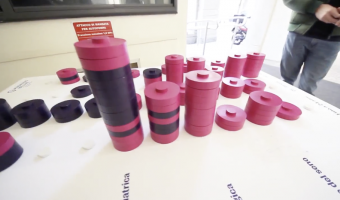
In order to inform a local audience about a largely-avoided topic such as cancer, a research study was commissioned by KnowAndBe.Live, a startup working in the field of cancer prevention awareness, with the aim of fostering a bottom-up information request from a local audience. The research team included a designer, a sociologist and experts on the topic of cancer-prevention, who worked together relying on a collaborative design approach, with the goal of delineating possible strategies to […]
2017 – Popsicles of Pollution
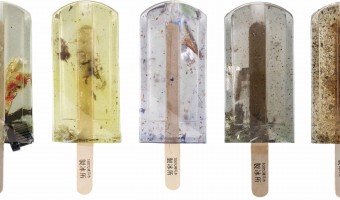
Students from New Taipei City collected samples from urban rivers, creeks and ports which they then froze in moulds and preserved in resin. ‘We hope when more people see this they can change their lifestyles,’ said one of the group. Source: Elle Hunt (2017) Popsicles of pollution: ice lollies highlight Taiwan's contaminated waterways.
2017 – Gravity Wave Spectrogram - LIGO
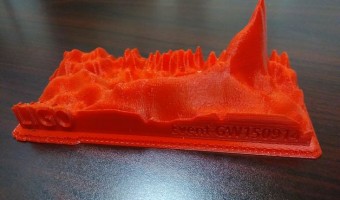
Humanity has been gazing at light from distant stars since time immemorial. But in 2015, our ability to understand the University achieved a major milestone, when ripples in Spacetime itself - instead of light - told the tale of an ancient, cataclysmic collision between black holes. The Laser Interferometer Gravitational-Wave Observatory (LIGO) is an experimental system of almost unbelievable sensitivity. Using interferometer arms four kilometers long, it can detect changes in length as tiny as […]
2017 – Street Debaters
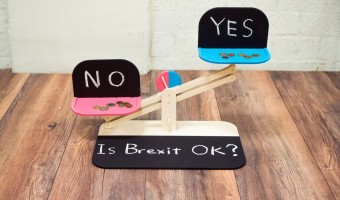
Japanese designer Tomo Kihara invented a polling device that is both entertaining and profitable. Source: Tomo Kihara (2017) Street Debaters.
2017 – Green Berlin
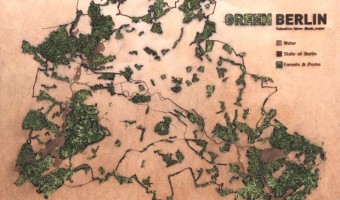
Tangible data visualization of green areas and water in Berlin. "Green Berlin" is a living map showing parks and forests in Berlin. The green areas on the wooden map are laser cut, with moss growing through the holes. Source: Sebastian Meier, Green Berlin
2017 – The All Too Evident Ashtray

The ATEA is an ashtray made of concrete. It carries data about smoking habits & lung cancer in the United States between 1975 and 2014, split by gender. The data is encoded in concentric bubbles/half spheres, where the distance to the center shows lung cancer prevalence by year. The bubble diameters display the average number of cigarettes smoked per day during that particular year. The causal relationship between smoking and cancer is well researched and known for decades, so there’s […]
2017 – Are you Sure you Want to Smoke?
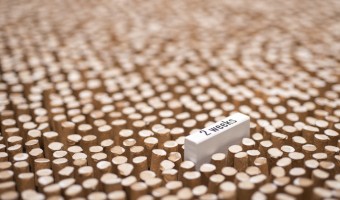
Giacomo Flaim, a student in Communication Design at Politecnico of Milan, made a single-datum physical visualization out of 4,234 cigarette butts to convey the average annual cigarette consumption of an Italian smoker. Labels were added to indicate the reduction in life expectancy depending on the quantity smoked, from 10 minutes for a single cigarette to more than a month for the entire year. Sources: Giacomo Flaim (2017) Are you sure you want to smoke? (behance.net). Information is Beautiful […]
2017 – CO2 Emissions Shown with Balloons
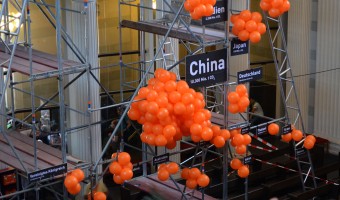
The installation shows a representative selection of twenty countries and their CO2 emissions in 2014. Every orange beach ball equals 100 billion tonnes of carbon dioxide. The values refer to combustion of fossil fuels and production of cement. This work was created by Mario Klemm and José Ernesto Rodriguez in the context of the course « Data objects » with Prof. Boris Müller at University of Applied Science, Potsdam. Source: original post by Mario Klemm. Also see our other entries on air […]
2017 – Animals Tracking
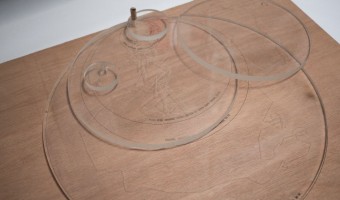
We wanted te show the difference of scale made by animals that were tracked including mankind depending on their needs. The result is a group of transparent disks with different sizes representing the employed path and its length during 24h for each subject. Also see other projects from the datafossil #3 workshop. Sources: Noémie Duval, Timothé Gourdin, Simon Le Roux et Quentin Lambert Jérôme Héno, Matthias Rischewski and Louis Eveillard (2017) Workshop datafossil #3
2017 – Damião's Dataphys Project
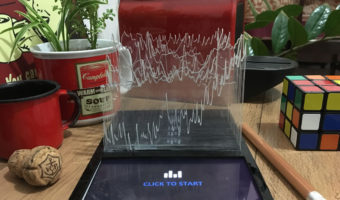
A project that communicates information in a beautiful and unusual way. Using simple features, Evandro Damião a data intelligence professional from Brazil creates a project that allows even blind people to interact with graphics through audio, braille, acrylic and a lot of creativity. Visualization and physicalization are not the secrets to communicating data, they are only some aspects that must be transcended. Source: Evandro Damião (2017) The Dataphys Project. Also see our entry 2013 - […]
2017 – Coral Reefs
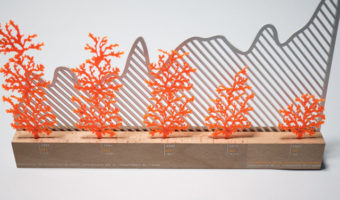
This data sculpture made by three design students at the datafossil #3 workshop depicts the destruction of Australian coral reef since 1985 (in orange) together with the rise of ocean temperature (in gray). The Great Barrier Reef has been losing more and more of its area since the last 27 years. One of the biggest cause is coral bleaching due to global warming and more exactly to the rise of the temperature of ocean's water. Scientists say that the reef is going to keep deteriorate as fast […]
2017 – Wearable Self
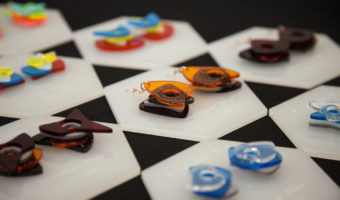
Wearable Self is a collection of data jewelry which is Jiyeon Kang's master's thesis project at Parsons School of Design. South Korean designer Jiyeon Kang transformed a year of self-tracking data (e.g. daily steps) gathered by Fitbit and iPhone Health into personalized fashion items that can hold and wear. Through laser cut and 3d printing with different materials, the designer creates customizable fashion items generated by users' self-data, aiming to make self-tracking data more meaningful […]
2017 – EuroGums: Edible Population Pyramids
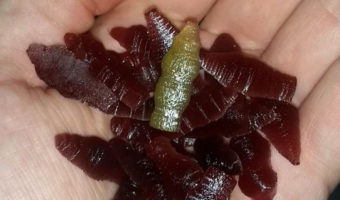
Eurogums are edible population pyramids of the 28 EU member countries. Whereas 27 countries taste cherry-sweet, the UK Eurogum is rather sour, due to the referendum and Brexit. Also see our other entries on data-driven food. Source: meikl3D
2017 – Hand-Crafted Magazine Infographics
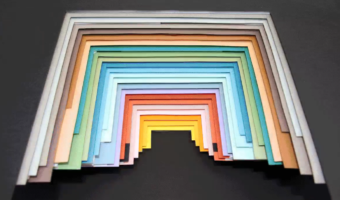
Infographic designers at the National Geographic crafted a 3D physical visualization out of paper and colored cardboard in order to prepare a 2D infographic. Also see our entry on IBM's cosmograph. Source: Alberto Lucas López (2017) Handmade #dataviz (tweet).
2018 – The 20 Year Gap
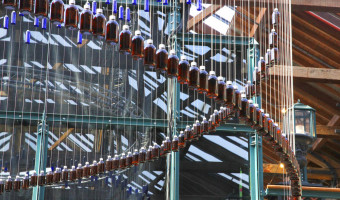
This data physicalization is an art installation that represents the difference in disability-free life expectancy* and overall life expectancy for different areas in the UK, thereby highlighting the unequal health conditions in the country. Each area is represented by a hanging thread. On each thread a red bottle corresponds to disability-free life expectancy while the blue bottle represents overall life expectancy. The title of the artwork refers to the finding that in the UK there is gap of […]
2018 – Landscaper: 3D Printing and Assembling of Terrain Models
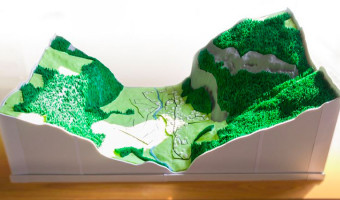
Landscape models of geospatial regions provide an intuitive mechanism for exploring complex geospatial information. However, the methods currently used to create these scale models require a large amount of resources, which restricts the availability of these models to a limited number of popular public places, such as museums and airports. Landscaper is a system for creating these physical models using an affordable 3D printer in order to make the creation of these models more widely […]
2018 – Harassment Plants
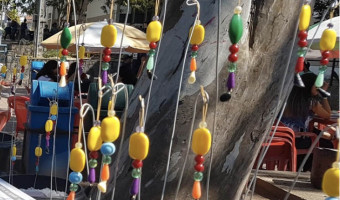
Harassment Plants is a situated physicalization exhibited in a Brazilian city to represent stories of harassment experienced by women in a public lakeside. Each vase represents a different category of harassment and contains glyphs that represent cases of harassment. The color in the middle of the vase corresponds to the type of harassment, which is also represented by the same color in one of the beads. Each glyph is composed of a rod — whose length represents the time of the day the […]
2018 – CairnFORM: a Physical Ring Chart Showing Renewable Energy Data
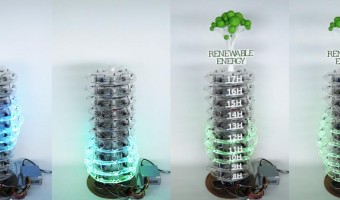
CairnFORM is a stack of expandable illluminated rings for display that can change of cylindrical shape (e.g., cone, double cone, bicone, cylinder, spheroid). CairnFORM can be used as a dynamic physical ring chart for encoding 360°-readable data: we use it for encoding forecast data about renewable energy availability in collective and public spaces, such as public places and workplaces. Source: Maxime Daniel, Guillaume Rivière, and Nadine Couture (2019) CairnFORM: a Shape-Changing Ring Chart […]
2018 – Traveling Datavis Game
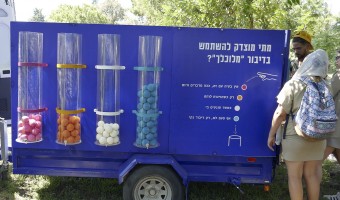
A public participation project, in which the boundaries of the political debate were discussed. Hoping to define a respectable “clean” political discourse and formulate a treaty reflecting the public's expectations of what constitutes a legitimate discourse based on political ideology or clear up when is a misuse of a public position. The project was made up of an ice-cream truck, driving around Israel periphery, inviting the public to participate in 4 interactive games asking question about […]
2018 – Stretch Orchestra Marble Run
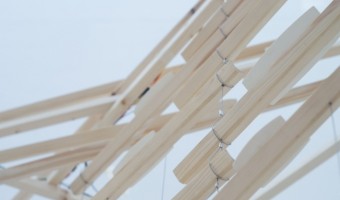
A connected exercise pad made with textile sensors responds to your interaction by inviting you to experience physical activity data in a playful way; a giant marble run, to elicit a childlike feeling of wonder and satisfaction. The installation is part of research project using materials to explore the experience of systems and technologies designed to aid behaviour change. In collaboration with intelligent textiles innovators Footfalls and Heartbeats the interactive installation proposes a […]
2018 – DayDohViz: Data Visualizations made with Play-Doh
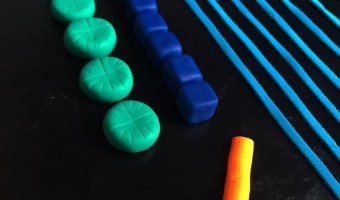
DayDohViz is as a "daily" inspiration project that experiments with physically visualizing data in 3D using a smartphone and Play-Doh. Yes, Play-Doh. Creator Amy Cesal's subjects range from self-disclosing and serious (her personal financial data, government enforcement actions) to delicious and exhilarating (pizza types, top roller coasters). Amy has found the tactile, ephemeral & imprecise nature of Play-Doh - so different from the typical data viz technology - to be creatively […]
2018 – Anthropocene Footprints
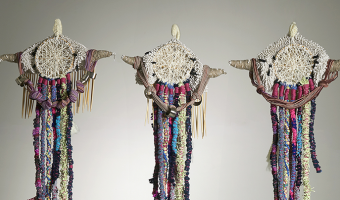
Handmade physicalizations of Canada's greenhouse gas emissions, by Mieka West and Sheelagh Carpendale. Each object represents data from a specific year (1990, 2010, and projections to 2030). Initially meant to be smog masks, the designs evolved into strange and beautiful objects evoking indigeneous artefacts such as Native American dreamcatchers, Inca quipus and Polynesian genealogical instruments, and whose visual and material complexity is reminiscent of Nathalie Miebach’s Woven Sculptures. […]
2018 – Solving the Shortest Route Problem with a 3D Printer
Christian Freksa, a professor of Cognitive Systems at the Department of Informatics at the University of Bremen, shows how a shortest route can be computed by 3D-printing the route network using flexible material, and then pulling apart the start and end nodes. The tight portion of the network immediately gives the shortest route. The right image shows an earlier version using strings. This idea was first proposed by mathematician George Minty in 1957, in a short letter to the editor of the […]
2018 – Phylogenetic Tree with Real Specimens
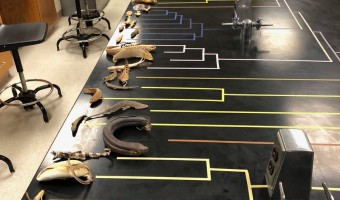
As part of a zoology class, evolutionary biologist Leo Smith created a phylogenetic tree of fishes where each leaf is an actual fish specimen. Also see our other entries on physical visualizations built by re-arranging physical items. Source: Leo Smith's tweet (29 April 2018).
2018 – Living Map: Precipitation Visualized with Moss
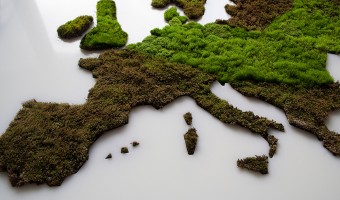
Climate change is a very hot topic nowadays. We are facing extreme weather events more and more frequently. Unusual temperatures, excess rainfall or extremely strong winds, forest fires disrupt our habitual life. The LIVING MAP visualizes the change of summertime rainfall in Europe. A precipitation data comes from the European Environmental Agency. The data was derived using climate simulation model. It compares summer precipitation in the period 1971-2000 and 2071-2100. The simulation of […]
2018 – Inequality in Chile Represented with LEGO Bricks
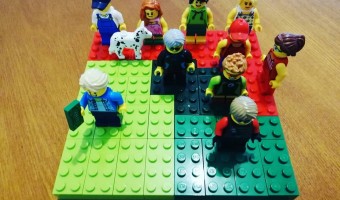
Inequality in Chile represented with LEGO bricks. Made by Harry Lizama, a data scientist in the Ministry of the Environment of Chile. The surface represents the totality of the income. Each person represents a decile. In light green is decile 10. In green is decile 9. In dark green are deciles 7 and 8. In red are deciles 1 to 6. Also see our other entries featuring LEGO bricks. Sources: Harry Lizama, based on data from the Ministry of Social Development, CASEN 2017. Image taken from […]
2018 – The Long Run: Marble Runs Convey Cost of Health Care
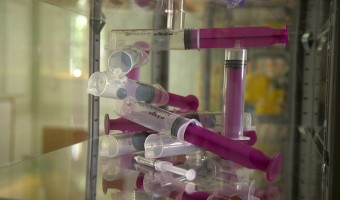
An artwork that represents the cost of health care for different age groups, based on the time it takes for a marble to fall. Each of the 7 runs represents a different decade of life, and the length of the runs presents the average cost of care to the UK's National Health Service, for a person in that year of their life. Each run is constructed from medical equipment. It was commissioned by the British Medical Association and the British Medical Journal to mark the NHS's 70th Birthday on the 5 […]
2018 – ON BRINK: Live Physicalization of the Bitcoin Blockchain
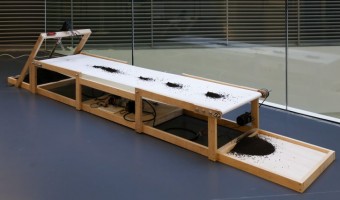
ON BRINK is a physical data visualisation of the Bitcoin blockchain: Adapting the mining metaphor, it encodes data on blocks appended to the chain in real-time. It produces piles of soil that relate in size to the number of transactions within a block, and displays six of them at a time on a continuous conveyor system, thus reflecting the human attention span given to a transaction on the blockchain: A transaction counts as confirmed after five blocks have been appended to its containing block. […]
2018 – Multimaterial Printing of Volumetric Scientific Visualizations
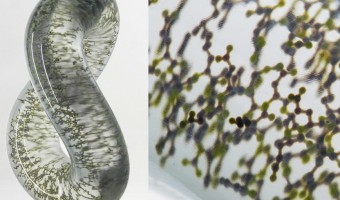
Researchers from MIT Media Lab and Harvard University have developed a method for accurately physicalizing scientific visualizations using multimaterial 3D printers: To fabricate an item on conventional 3D printers, one must make calculations regarding the object’s digital description, and then convert the resulting numeric description to geometric shapes which can be used to 3D print it. But the research team has developed a new technique to 3D print multimaterial data sets as physical […]
2018 – Spanish Dictionary Cemetery
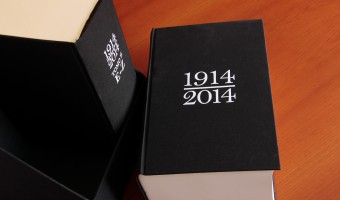
1914-2014 consists of a comparison between the Spanish official Dictionary from the year 1914 and the one from 2014. The result of this comparison is a list of all the words which are not included in the last edition of the dictionary any longer. Every word is displayed on a single page in order to show the number of lost words physically. This visualization is materialised in an artist book with the format of a dictionary divided in two volumes. The size of the book already shows us the amount […]
2018 – Steven Pinker explains Global Life Expectancy with Physical Line Charts
Bill Gates shared a short video featuring Steven Pinker on his Twitter feed with the comment People today are living longer, healthier, and happier lives than ever before. I asked @sapinker to explain why. At first glance it appears that line charts are digitally overlaid on the video. However, closeups and a light swaying of the graphs when Steven Pinker touches them, as well as the addition of another country towards the end of the video indicate that the graphs visible in this video are […]
2019 – Data Beyond Vision: Physicalizing Bookshop Data
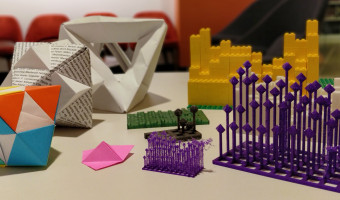
[Data Beyond Vision] explores new ways of engaging with a dataset and the arguments and narratives behind it, in order to challenge the dominant paradigms of conventional screen-based data visualization. The project currently comprises: 3D printing a model of library member activity over time from the Shakespeare and Company Project juxtaposing documented activities from two sets of archival materials Folding paper forms of borrowing activity from the Shakespeare and Company Project surfacing […]
2019 – Physical Violin Plot
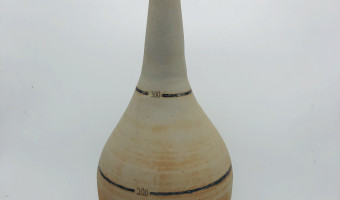
A physical violin plot created by sculptor and psychology researcher Hunter Brown. See related entries also using clay here. Source: Tweet from Julia Strand (@juliafstrand), June 12, 2019.
2019 – Data Earrings of Country Happiness
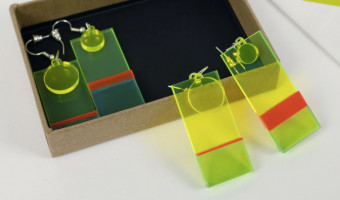
This data jewellery displays data the happiness of its citizens and potentially contributing factors. One earring encodes the proportion of a countries GDP as a stacked bar chart with categories: service, agriculture, and industry. Towards the top a circle encodes the overall happiness rank of a country's citizens. Also see our other entries on data jewelleries. Source: Jang Lee: https://janglee.myportfolio.com/happiness-x-gdp
2019 – Perpetual Plastic
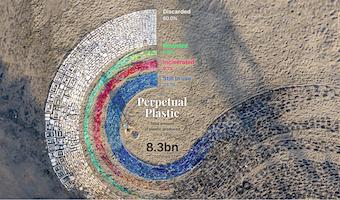
Winner of the National Geographic and Sky Ocean Ventures Ocean Plastic Innovation Challenge [This project] highlights the scope of the plastic problem (in terms of amount produced as well as its fate) and the transformation of plastic over its lifetime, using beach debris as a salient example. The situated, participatory data installation approach extends abstract displays of numbers towards a more gripping form of ‘data visceralization.’ The direct link to beach clean-up activities suggests […]
2019 – Anamorphic Data Spatialization
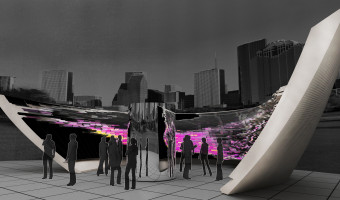
Data spatialization is a design technique through which data is used to create architectural spaces. It does not necessarily preserve the legibility of the represented data, but rather focuses on the spatial qualities that can be gained from the data. This research aims to introduce a method for the design of a data-driven pavilion that represents data spatially through catoptric (mirror-assisted) anamorphosis. In this work, a set of environmental datasets from North America–including […]
2019 – Physicalizing Cardiac Blood Flow Data
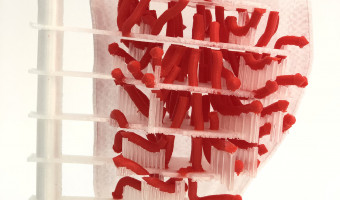
Blood flow data from cardiac 4D Flow MRI (magnetic resonance imaging) holds much potential for research and diagnosis of flow-related diseases. However, understanding this data is quite challenging – after all, it is a volumetric vector field that changes over time. This paper proposes a novel slice-based physical model as a complementary method for visualizing the flow data. The design of this model respects the conventional method of viewing medical imagery (i.e., in cross-sections) but has […]
2019 – Tattoo Biosensors
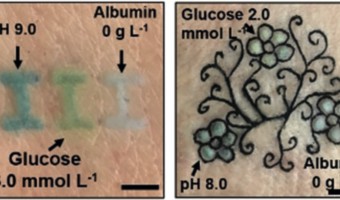
Tattoos that Change Color When Reacting With Glucose Levels: minimally invasive, injectable dermal biosensors were developed for measuring pH, glucose, and albumin concentrations. Sources: Biotech (2019) Twitter post. Yetisen et al (2019) Dermal Tattoo Biosensors for Colorimetric Metabolite Detection.
2019 – Sleep Blanket
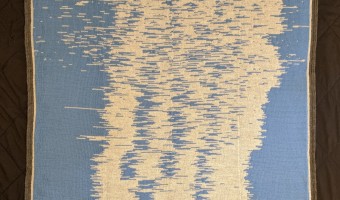
A visualization of my son's sleep pattern from birth to his first birthday. Crochet border surrounding a double knit body. Each row represents a single day. Each stitch represents 6 minutes of time spent awake or asleep. Also see our entry 2013 – Temperature Scarves and Afghans. Source: Seung Lee (2019) Twitter thread.
2019 – Hostile Terrain 94: Deaths at the US/Mexico Border
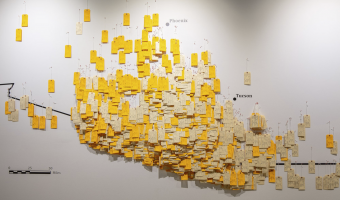
Prototype of a series of physical maps that will be exhibited across 94 cities worldwide in fall 2020. Each of the 3500 hand-written toe tags represents the recovered body of a migrant who died while crossing the US/Mexico border in the Sonoran Desert between 2000 and 2020. Coordinated by the Undocumented Migration Project (UMP). To learn more about UMP and the context of this map, listen to the Radiolab podcast series Border Trilogy. Sources: hostileterrain94.wordpress.com Left image from […]
2019 – New Worry Beads: Deaths from Terrorism
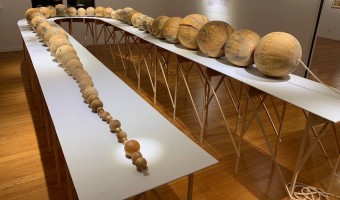
Worry Beads, one for every year from 1945 (closest in the pic), are scaled at one cc per human life. The volume of each is set by the number of terrorist-caused deaths for that year globally. The whole thing is about 40' long, the largest bead (2014) is 19" dia. There’s other material which hopefully makes clear that the #1 American fear, terrorist attack, is ridiculous. There’s another string of beads, 50" long, which shows terrorist deaths in the US. You’re more likely to be […]
2019 – Self Knitted Scarf of Train Delays
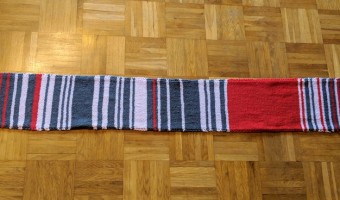
The mother [of] Sara Weber knitted this scarf during her daily train rides to work in Munich and used different colors depending on train delays. Every day two rows: Grey, less than 5 minutes delay. Pink, 5 to 30 minutes delay. Red, both rides delayed or one more than 30 minutes. The huge red area was during construction work, where the train was substituted by a bus. Side note: The tweet went viral and at the end she sold the scarf at eBay and gave the money to the "Bahnhofsmission" who take […]
2020 – Ownership: Occlusions, Night Terrors, and Pernicious Doubt

This series of bronzes visualizes 2020 data on gun ownership in America. Pernicious Doubt Access to a gun increases the risk of suicidal death by 3 times. Occlusions Carrying a gun makes the bearer 4 times more likely to be killed in an aggressive encounter than without a gun. Night Terrors Women are 5 times more likely to be killed in acts of domestic abuse when their partner owns a gun. Source: Matthew Mosher. Ownership: Occlusions, Night Terrors, and Pernicious Doubt.
2020 – Data Badges
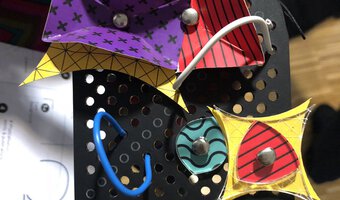
A physical conference badge that participants create themselves during an event by assembling tokens on a wearable canvas. The process is guided by an instruction sheet that helps translate the tokens to various professional characteristics. Also see our related entries on data jewellery and data clothing. Sources: Tweet from Andre Vande Moere. Georgia Panagiotidou, Sinem Gorucu, Andrew Vande Moere (2020) Data Badges: Making an Academic Profile Through a DIY Wearable […]
2020 – LOOP: Ambient Visualization of Personal Activity
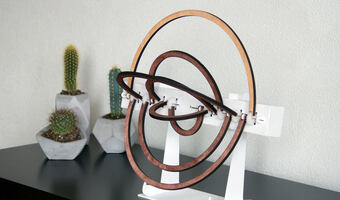
LOOP is a physical artifact that changes its shape according to the activity data of the owner, providing an abstract visualization. The artifact consists of eight rings, of which seven represent weekdays from small to large, and the outermost ring represents the step goal. When the owner is active, the ring representing the current weekday moves upwards and positions itself in relation to the step goal ring. LOOP was used to investigate how an alternative approach to representing […]
2020 – The Anatomical Edutainer
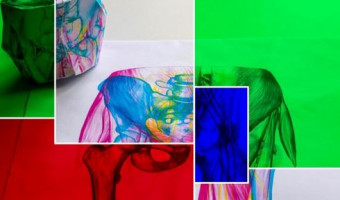
Physical visualizations (i.e., data representations by means of physical objects) have been used for many centuries in medical and anatomical education. Recently, 3D printing techniques started also to emerge. Still, other medical physicalizations that rely on affordable and easy-to-find materials are limited, while smart strategies that take advantage of the optical properties of our physical world have not been thoroughly investigated. In our paper, which received the Best Short Paper Award […]
2020 – Slice and Dice: A Physicalization Workflow for Anatomical Edutainment
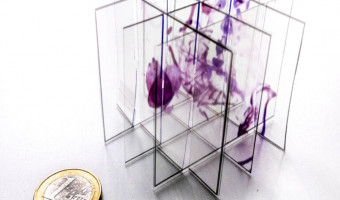
During the last decades, anatomy has become an interesting topic in education—even for laymen or schoolchildren. As medical imaging techniques become increasingly sophisticated, virtual anatomical education applications have emerged. Still, anatomical models are often preferred, as they facilitate 3D localization of anatomical structures. Recently, data physicalizations have proven to be effective and engaging—sometimes, even more than their virtual counterparts. So far, medical data […]
2020 – COVID-19 Deaths as Nails
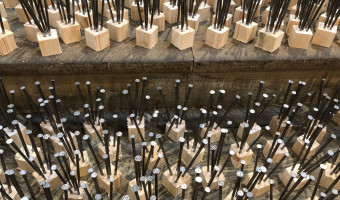
An art installation in the Cathedral of Schwäbisch Gmünd (Germany) shows COVID-19 deaths as nails hammered into wooden cubes. More nails are added as the number of deaths increase. The text down the steps says "Fürchtet euch nicht", meaning "do not be afraid". Also see our other entries on single-datum physical visualizations and on conveying deaths. Sources: Tweet from Friedrich Hart (@mxfh), Dec 9, 2020. SWR (2020) Schwäbisch Gmünd: 13.000 Nägel für Coronaopfer.
2020 – I am a Book. I am a Portal to the Universe.
All-ages book by Stefanie Posavec and Miriam Quick. Each of the book's dimensions – from its height, weight and volume to the loudness of the sound made when it is slammed shut – embodies a fact or measurement about the universe on a 1:1 scale. Hello. I am a book. But I’m also a portal to the universe. I have 112 pages, measuring 20cm high and wide. I weigh 450g. And I have the power to show you the wonders of the world. I'm different to any other book around today. I am not a book of […]
2020 – Venous Materials
. A team of researchers at the MIT Media Lab developed physical user interfaces based on fluidic channels that can interactively respond to mechanical inputs from the user, without any electrical power. Above, line charts that are activated and animated by pressure input. Also see our other artifacts involving mechanical interaction and physical computation. Source: Hila Mor, Yu Tianyu, Ken Nakagaki, Benjamin Harvey Miller, Yichen Jia, and Hiroshi Ishii (2020) Venous Materials: Towards […]
2020 – Econundrum: Visualizing the Climate Impact of Dietary Choices
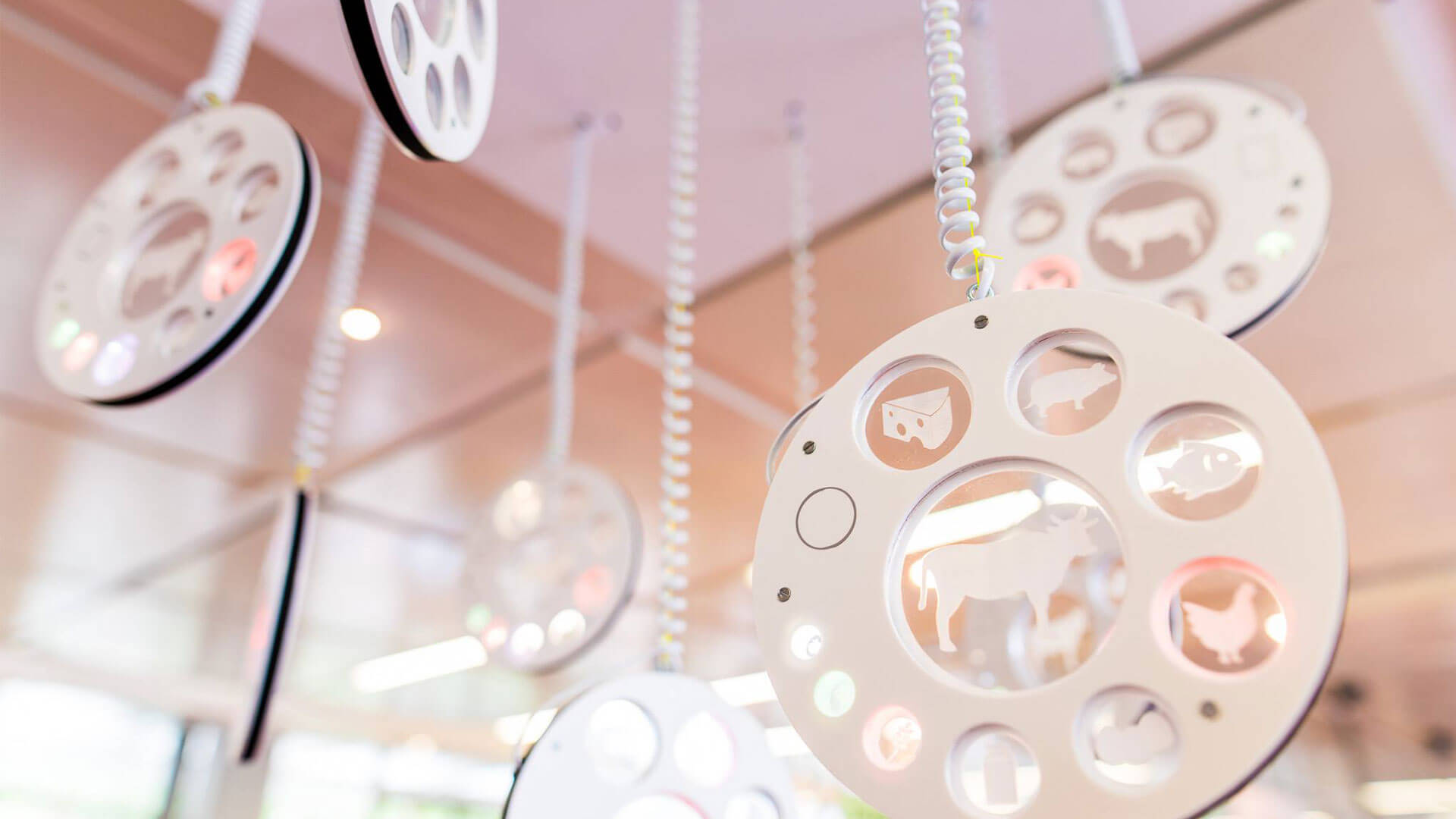
Econundrum is a shared physical system, designed to visualize the carbon emissions as a result of dietary choices. People of a community can indicate on their phone what food types they ate that day, which will be visualized on the physical installation. Every disk represents the impact of one person, and its elevation indicates the level of impact: higher is fewer carbon emissions, lower is more carbon emissions. The highlighted food types visualize how the 'foodprint' of each person is […]
2021 – State of the World as Population Pyramids
The collection "State of the World" is composed of population pyramids and was created by Mathieu Lehanneur for the 2021 exhibition art basel - design miami. Each of the 100 sculptures encodes the population data of one country: age is encoded in rings from birth at the bottom to 100 years at the top; the width of each ring encodes the proportion of the population being of that age. each age pyramid reveals the particularities of a nation — the youth of chad, translated by the geometric […]
2021 – Walkable Bar Chart

A bar chart conveying two quantities, one of which is clearly larger. The activists and artists at the Respect New Haven rally yesterday offered this stunning graphic to visualize Yale's $32 Billion endowment compared to its paltry $13 million contribution to the city of New Haven...a FRACTION of the taxes it would pay if properly assessed. Also see our other entries on walkable physical visualizations. Source: Tweet from Davarian L. Baldwin.
2021 – Watermap: A Physical Live Weather Visualization
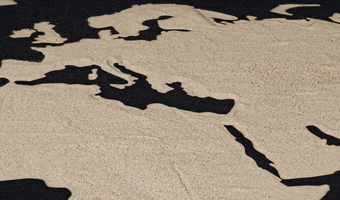
Without water, nothing organic exists. This water installation visualizes - symbolically - how rain brings the whole world to life. In a very tangible way of presenting and visualizing data, rain is represented by real drops of water. The installation features a black, wooden pedestal with a recessed world map filled with sand. Technically, the realization is done by a mini-computer, which evaluates live weather data and positions a water tank in an X-Y system above the world map. At places […]
2021 – Personal Data Physicalizations in Class
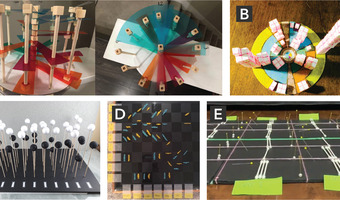
Images created by students to represent their personal data. Refer to the publication below for image attributions. I describe the results of implementing a personal data physicalization assignment in an information visualization course for senior undergraduate and graduate students in computer science and software engineering. By collecting data about themselves and representing this data in physical forms, students were able to i) learn about data visualization, ii) […]
2022 – Edo, a participatory data physicalization of the climate impact of dietary choices

Edo is a participatory data physicalization meant to enable a small community to track the carbon impact of their dietary choices. Each type of food item is represented as a token, a disk, whose surface area encodes the carbon impact of a typical portion of that type of food (data source: Agribalyse). After a meal, one can add data by selecting tokens for all the types of food one just consumed. For example, a burger with fries would require a beef token, a bread token, a salad token, and a […]
2025 – Digitally-Fabricated Visualizations of the Future
These images have nothing to do with physical visualizations: they are not data-driven but abstract, and they are not even physical but instead photo-realistic computer-generated images. However, these images from digital artist Lee Griggs give an idea of what physical visualizations may look like in the near future once we overcome the limitations of today's digital fabrication technology: they will be visually and haptically elaborate, colorful, rich, and beautiful. Make sure you look at the […]
2033 – Cetonia: Drone Swarm Visualizations
As part of the VIS'14 Workshop Death of the Desktop, infovis researcher Wesley Willett imagines how nano drone swarms may be used in 2033 both to capture and visualize data directly in the real world: At barely 1.5 centimeters across, each Cetonia scarab is a marvel of precision engineering. Designed from the ground up for agile flight, their integrated hydrogen chambers and a high-efficiency hover mode permit 15+ minutes of air time between charges. The hueSHIFT carapace is capable of […]
2060 – Programmable Matter
In 1965 Ivan Sutherland already mentioned programmable matter as the ultimate computer display: The ultimate display would, of course, be a room within which the computer can control the existence of matter. A chair displayed in such a room would be good enough to sit in. Handcuffs displayed in such a room would be confining, and a bullet displayed in such a room would be fatal. With appropriate programming such a display could literally be the Wonderland into which Alice walked. Several […]